Barter
Learn how people traded goods and services before money existed and understand the advantages and challenges of this economic system.
1 What is Barter?
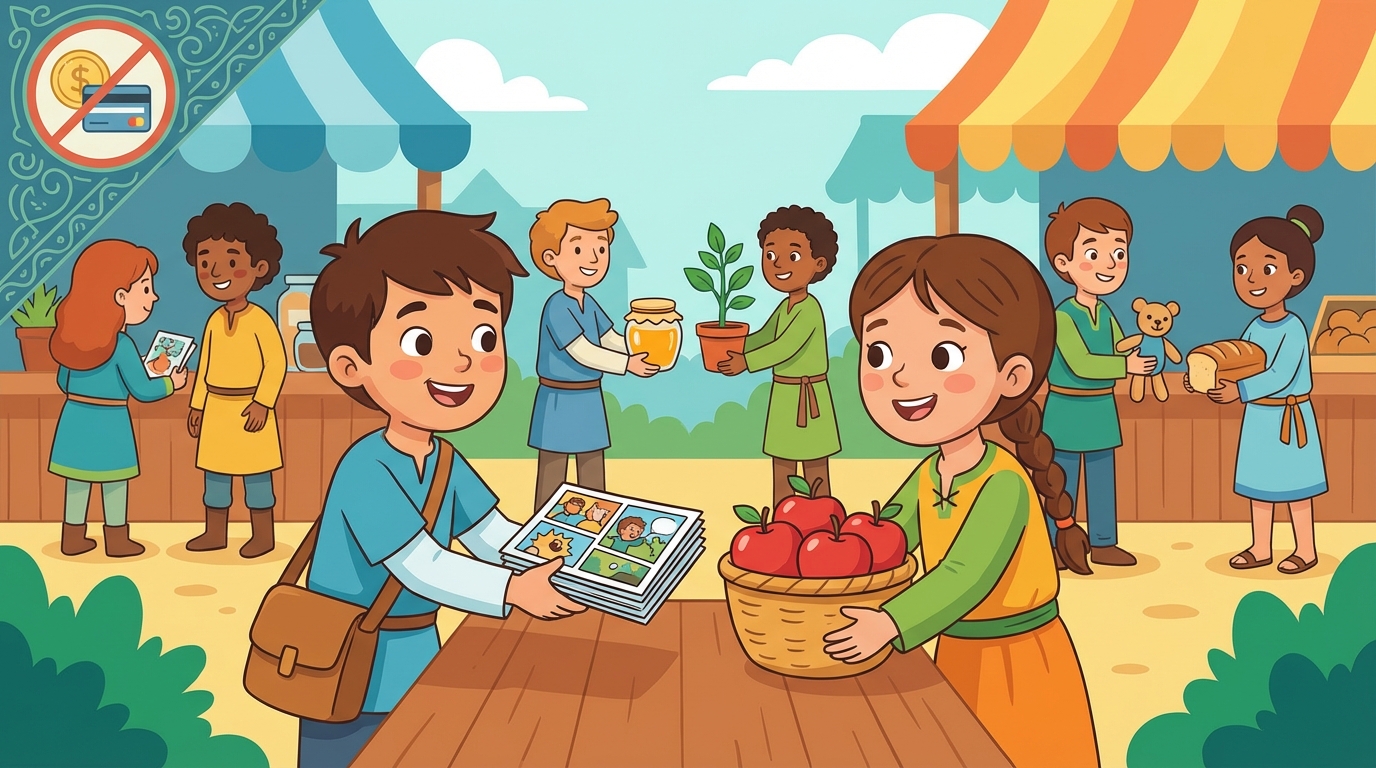
Imagine a world without any coins, bills, or credit cards. 💸 How would you get a new video game or a sandwich? You would have to trade! This system is called Barter.
Barter is the direct exchange of goods (things) or services (actions) for other goods or services without using money. It is the oldest form of commerce in human history!
How does it work?
In a barter system, you trade something you possess for something you desire. However, there is a catch! 🎣 You need to find someone who wants exactly what you have and has exactly what you want. Economists call this the 'Double Coincidence of Wants'.
🏫 The Lunchroom Scenario
Let's see barter in action at school:
An Apple 🍎
You want:
A Cookie 🍪
A Cookie 🍪
Friend wants:
An Apple 🍎
If you swap, that is a successful barter! If your friend hates apples, no trade happens.
Key Facts
2 History of Trade: Life Before Money
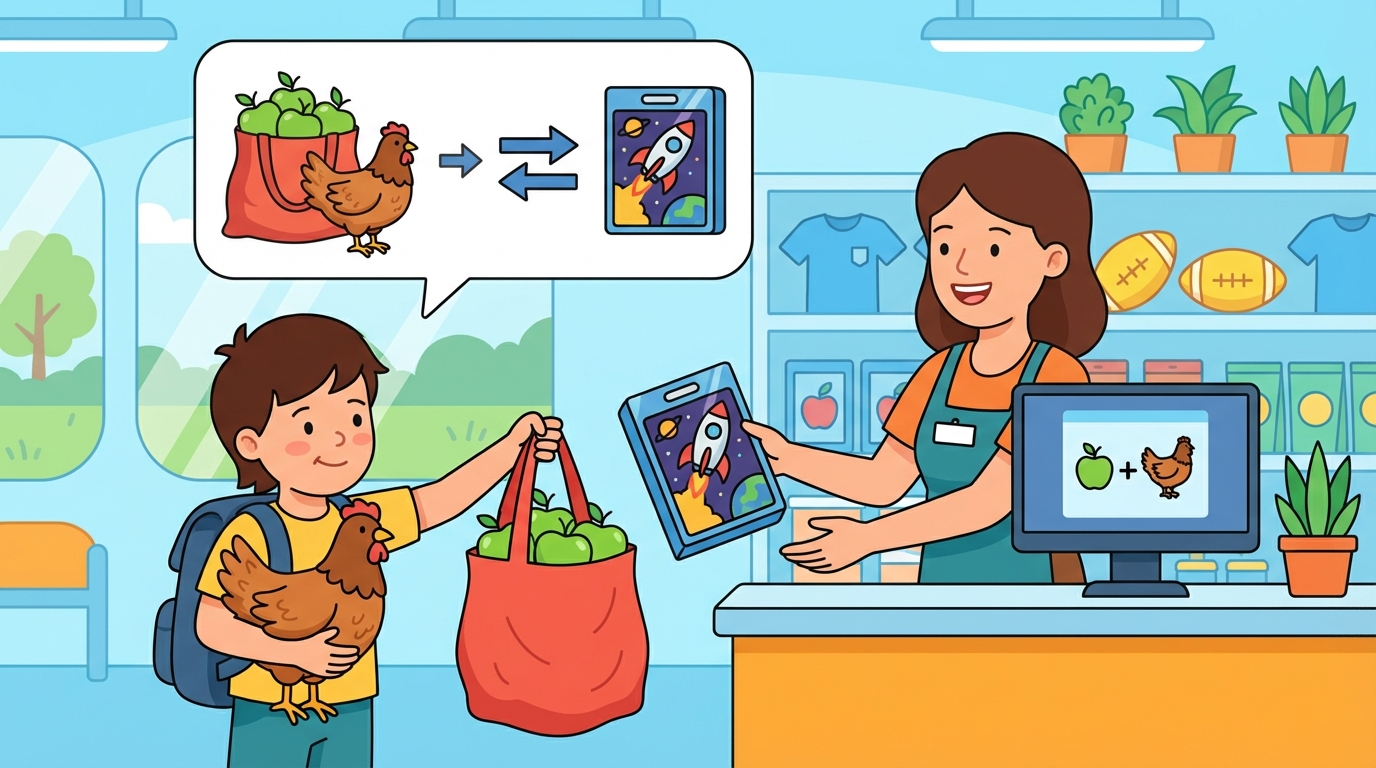
Imagine walking into a store to buy a video game, but instead of paying with cash or a card, you have to give the cashier a bag of apples and a chicken! 🐔🍎 This is how life used to be.
Long before coins and paper bills existed, people used a system called Barter. Barter is the direct exchange of goods and services for other goods and services without using money.
- Example: A fisherman giving fish 🐟 to a potter in exchange for a clay bowl 🏺.
The Big Problem: 'Double Coincidence of Wants' 🧩
Barter sounds simple, but it was actually really hard! For a trade to happen, two things must be true at the same time:
- You must have what the other person wants.
- The other person must have what you want.
If you have eggs 🥚 and want shoes 👞, but the shoemaker hates eggs... no trade for you!
Pros vs. Cons of Barter
| ✅ The Good (Pros) | 🛑 The Bad (Cons) |
|---|---|
| Simple system (no math with complex currency). | Portability: It's hard to carry 10 cows in your pocket to buy a house! 🐄 |
| Builds strong community relationships. | Perishability: If nobody wants your tomatoes today, they might rot tomorrow. 🍅📉 |
| You get exactly what you see. | Value: How many apples equal one pair of boots? Everyone disagrees! 🤔 |
Key Facts
3 The Double Coincidence of Wants
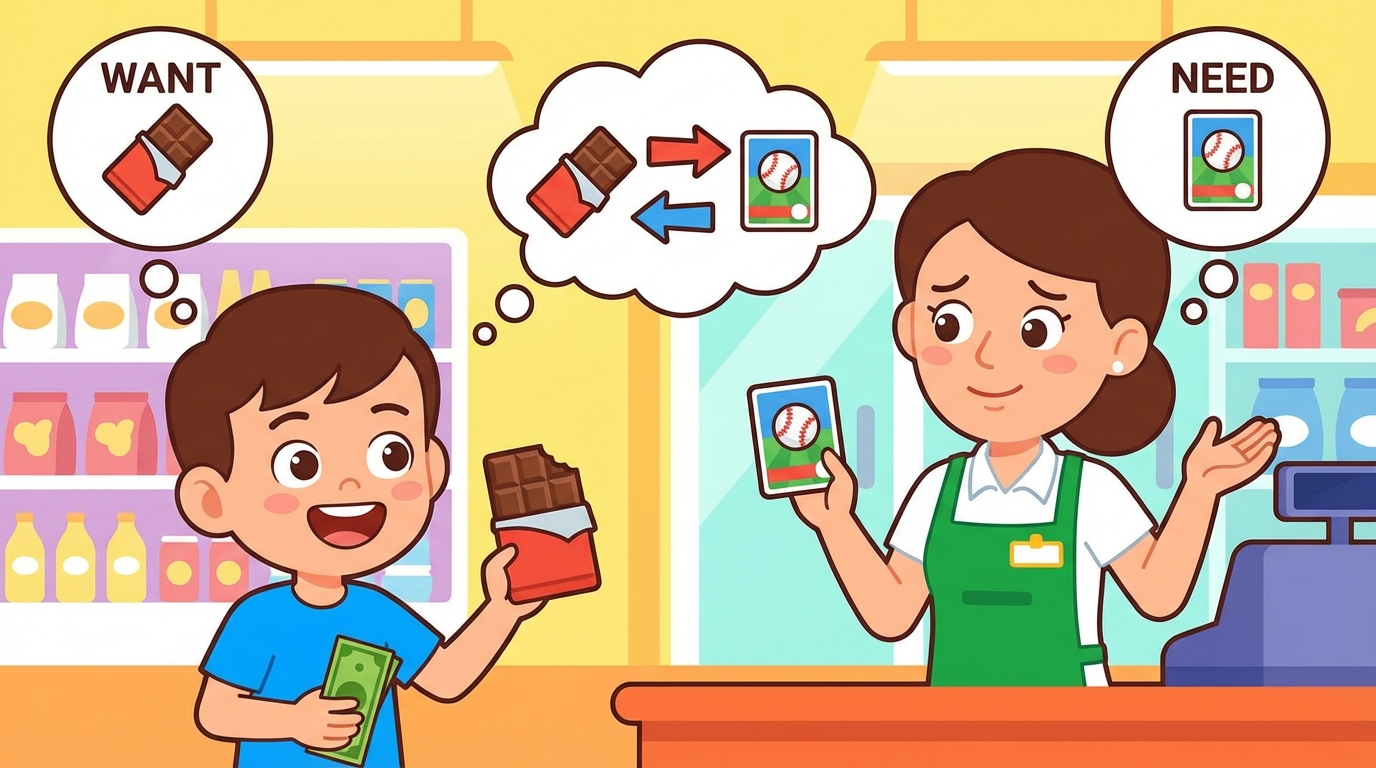
Imagine walking into a store to buy a candy bar 🍫, but the cashier says, 'Sorry, I only accept baseball cards today!' If you don't have baseball cards, you can't get the candy. This is the big problem with barter.
🧩 What is it?
The Double Coincidence of Wants happens when two people have goods they wish to trade, and both people want exactly what the other person has.
- 👤 You: Have 🍎 Apples, want 👟 Shoes.
- 👤 Baker: Has 🍞 Bread, wants 🍎 Apples.
- 👤 Shoemaker: Has 👟 Shoes, wants 🍞 Bread.
Result: It is frustrating! You have to make three trades just to get your shoes!
- 👤 You: Have 🍎 Apples, want 👟 Shoes.
- 👤 Shoemaker: Has 👟 Shoes, wants 🍎 Apples.
Result: A Double Coincidence! The trade happens instantly.
Searching for the right person to trade with takes a lot of time and effort. This difficulty is the main reason humans eventually invented money!
Key Facts
4 Challenges of Barter: Divisibility and Value
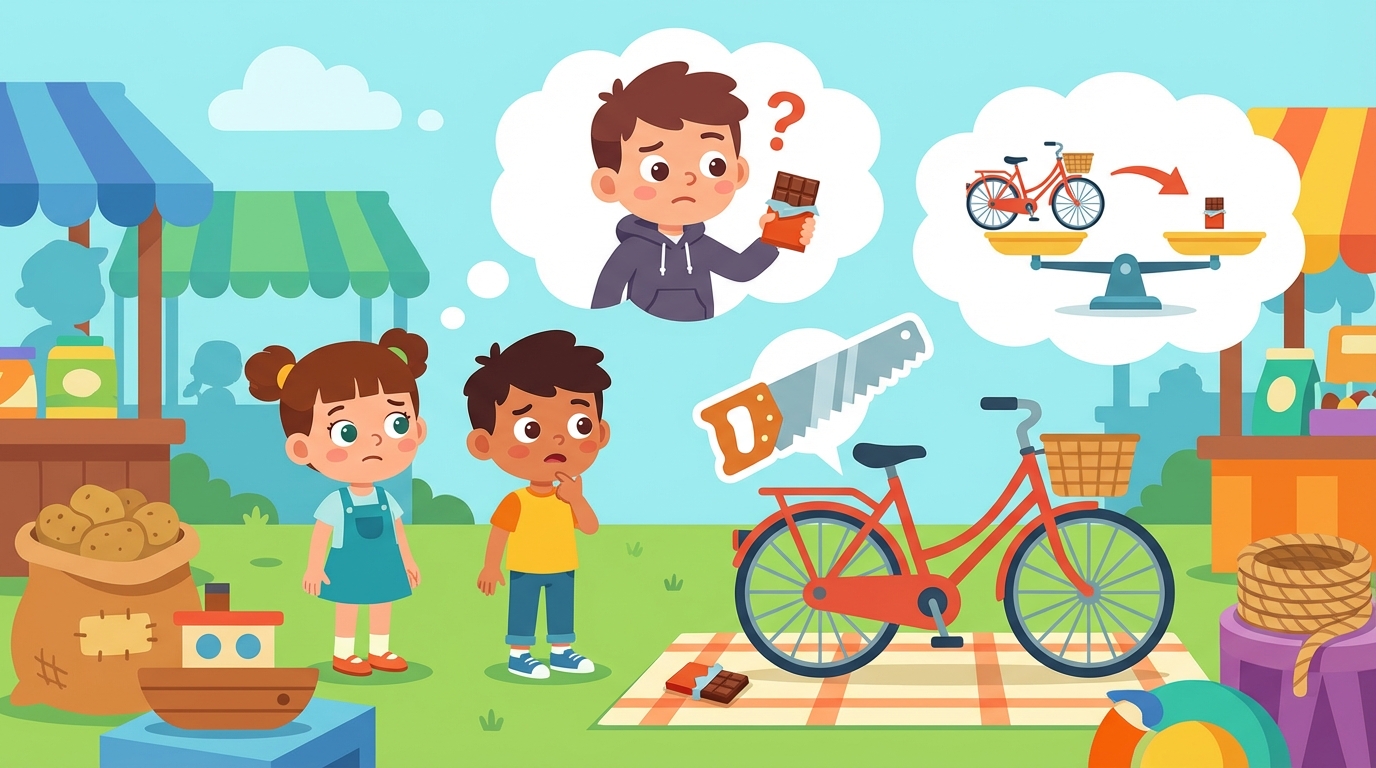
🤔 Imagine This Scenario!
You want to buy a single chocolate bar 🍫, but the only thing you have to trade is your bicycle 🚲. You can't just saw off the handlebars and trade them, right? Your bike would be ruined! This is the problem of divisibility.
One of the biggest headaches in a barter system is that many valuable things cannot be divided into smaller parts without losing their value.
- 🐮 Livestock: You cannot trade half a cow for a pair of shoes. The cow needs to stay whole to be useful!
- 🪑 Furniture: You can't trade a leg of a chair for a loaf of bread.
- 💎 Precious Stones: Cutting a large diamond into dust makes it worth much less.
Without price tags or money, how do we decide what things are worth? This creates a lot of arguments!
If 1 Cow = 100 Chickens 🐔, but you only want 1 Chicken, how much of the cow do you give? (See the divisibility problem!).
If 1 Apple = 2 Berries, and 3 Apples = 1 Banana, how many Berries equal 1 Banana? 🤯 It gets confusing fast!
To Split or Not to Split?
| Item | Can it be divided? | Result |
|---|---|---|
| 🌾 Wheat/Grain | ✅ Yes | Still useful (you just have less wheat). |
| 🧥 Winter Coat | ❌ No | Ruined! A sleeve is not a coat. |
| 🧂 Salt | ✅ Yes | Still useful (grains of salt). |
| 📱 Smartphone | ❌ No | Broken! It won't work anymore. |
Key Facts
5 Challenges of Barter: Storage and Portability
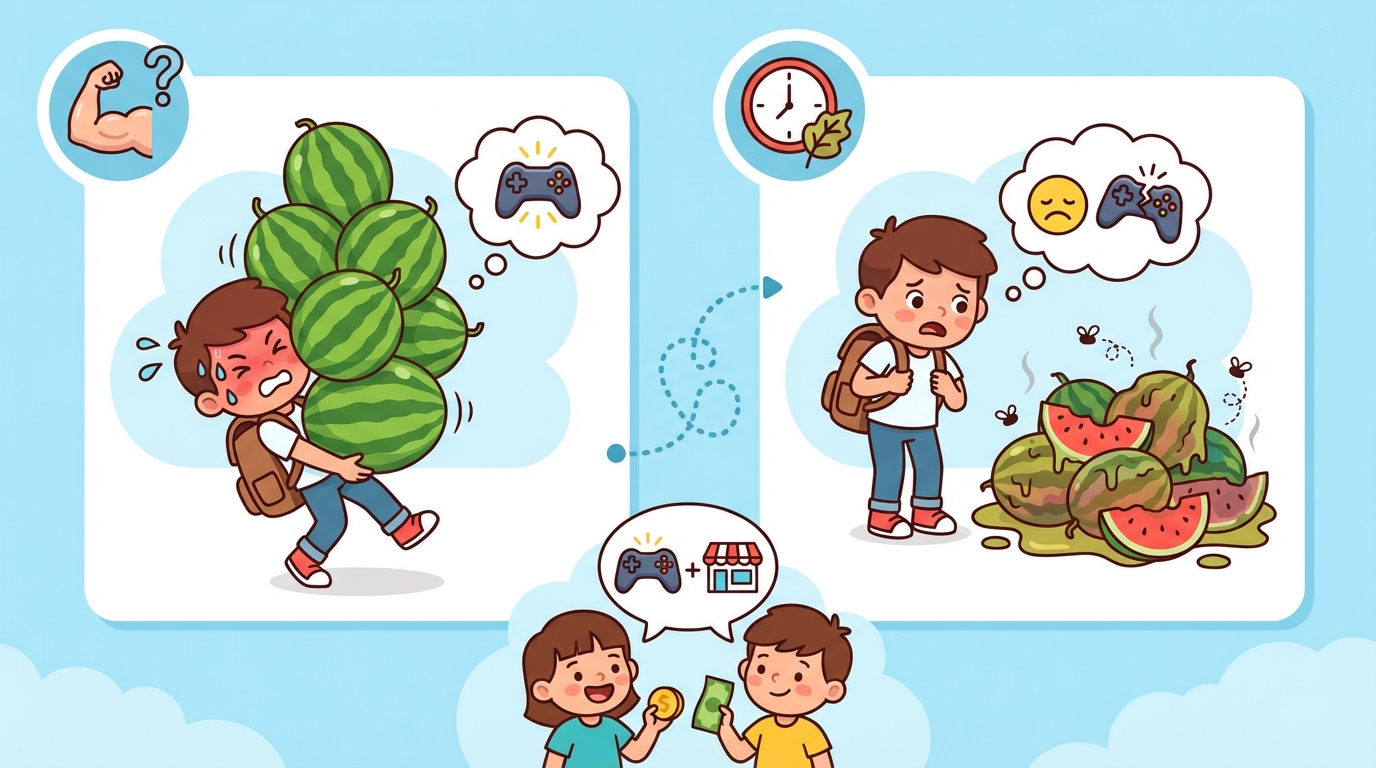
🏋️ The Problem of Portability
Portability means how easy it is to move something from one place to another. In a modern economy, money is light—you can put a $20 bill in your pocket. But in a barter system, wealth is often heavy!
Imagine if your family's wealth was in cows or sacks of wheat. If you wanted to go shopping, you couldn't just grab your wallet. You would have to load a wagon and physically drag your 'money' to the market. This made trading over long distances extremely difficult and tiring.
🏚️ The Problem of Storage
Storage is about keeping your wealth safe for the future. In a barter system, many trade goods are perishable (they go bad).
If you are a fisherman, your 'money' is fish. You have to trade them immediately. You cannot save fish for five years to buy a house because they will rot and smell terrible! This creates a huge problem: it is very hard to save wealth in a barter system compared to using coins or digital money.
⚔️ Battle: Money vs. Barter Goods
| Feature | 💵 Modern Money | 🎒 Barter Goods (e.g., Fruit, Livestock) |
|---|---|---|
| Carrying it | Fits in a pocket or digital wallet | Need a truck, wagon, or strong muscles |
| Saving it | Lasts forever (doesn't rot) | Can rot, rust, die, or get eaten by bugs |
| Space needed | Takes up almost no space | Needs a barn, warehouse, or huge freezer |
Key Facts
6 The Solution: The Invention of Money
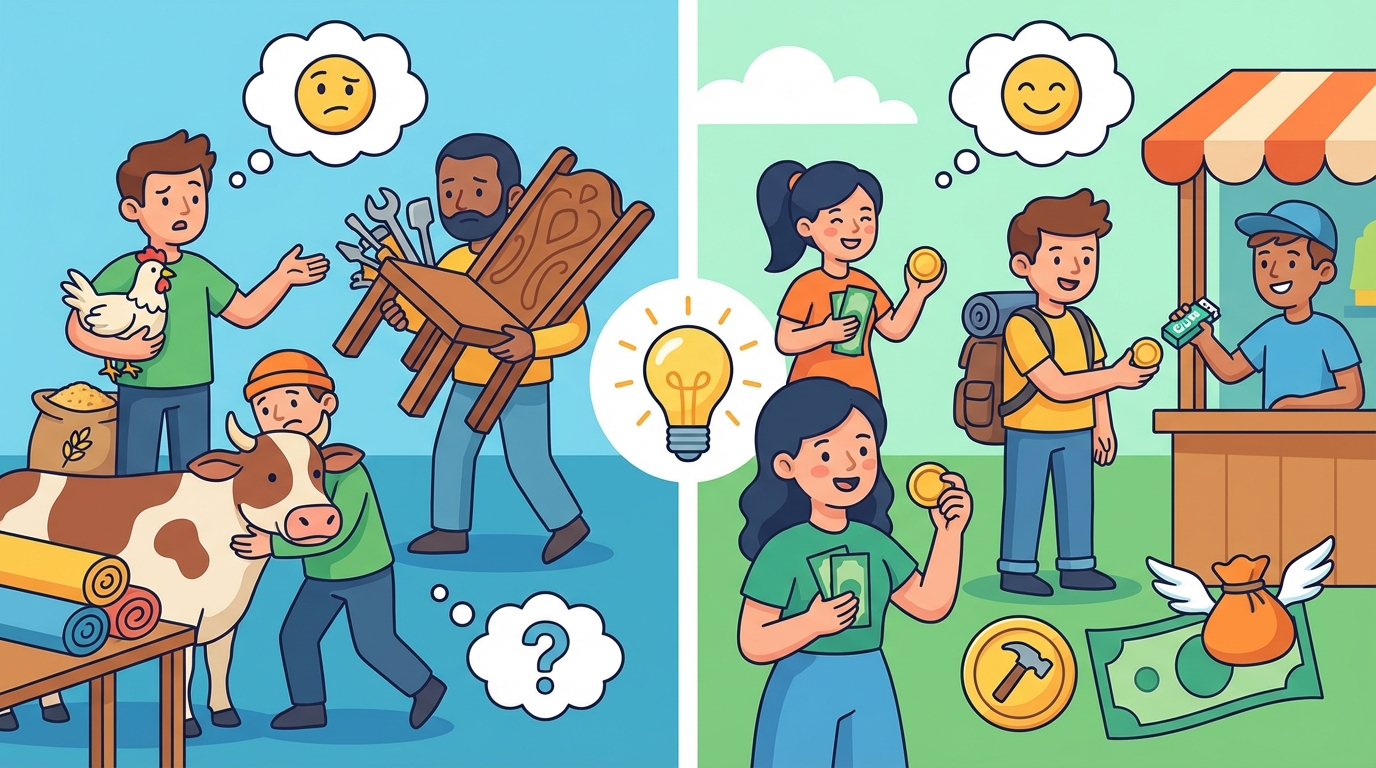
💡 The Big Idea
Barter was too complicated! People needed something that was easy to carry, durable, and that everyone wanted. The solution? Money!
Imagine trying to buy a pack of gum but having to pay with a heavy sack of potatoes. 🥔 It's not practical! To solve the problems of barter, humans created a medium of exchange. This allowed people to sell their goods for money and then use that money to buy whatever they wanted.
Before we had paper bills, people used items that had value on their own. This was called Commodity Money.
Cowrie Shells
Used in China, India, and Africa.
Salt
Roman soldiers were paid in salt!
Cacao Beans
Used by the Aztecs and Mayans.
Why is money better than trading chickens? Check out this comparison:
| Barter Problem 😫 | Money Solution 😃 |
|---|---|
| Portability: Cows are heavy to carry. | Lightweight: Coins fit in your pocket. |
| Divisibility: You can't cut a live chicken in half for change. | Change: You can break a dollar into cents. |
| Durability: Fruit rots after a week. | Lasting: Metal coins last for centuries. |
Key Facts
7 Barter in the Modern World
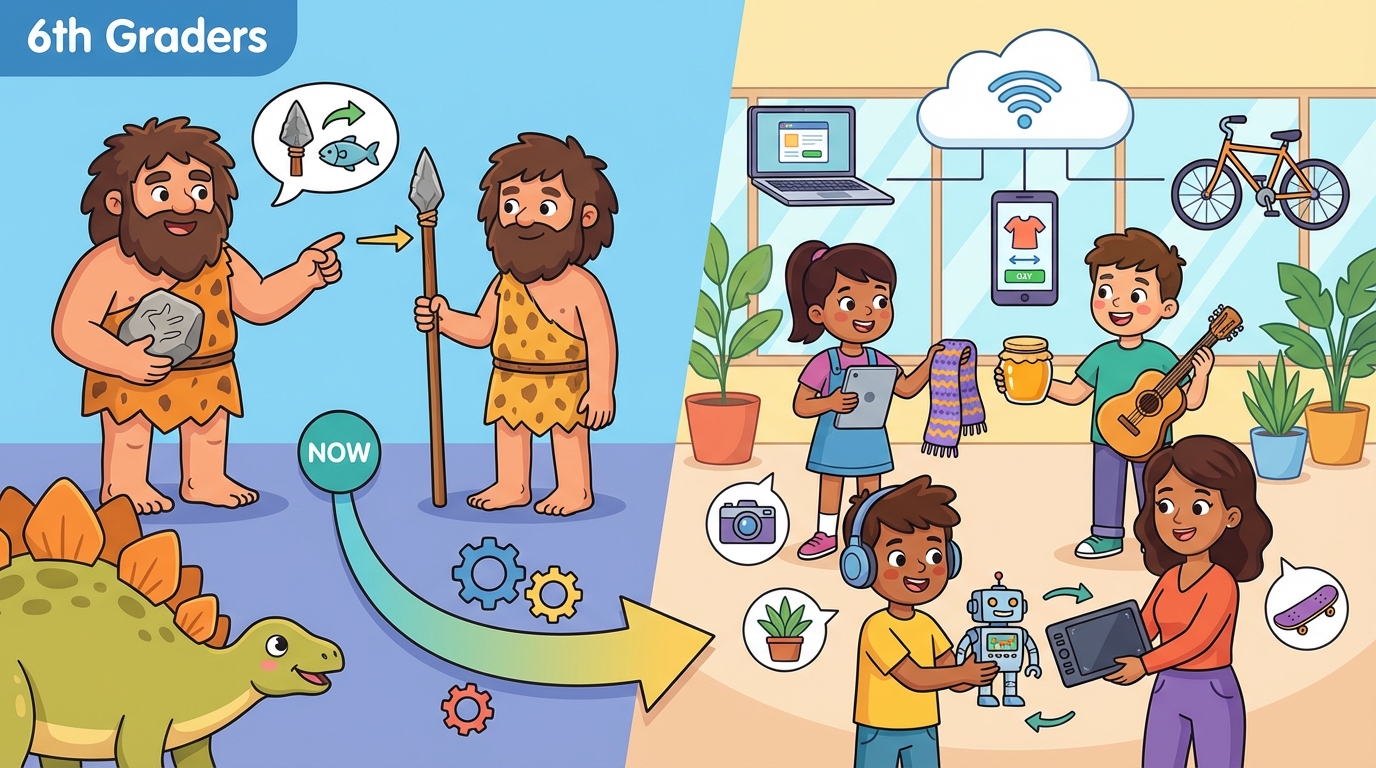
Think barter is ancient history? Think again! 🦖➡️📱 While we usually use money today, bartering is still alive and kicking in the 21st century. It just looks a little different now thanks to technology.
The internet has created a huge global marketplace for barter! There are specialized websites and apps where people can swap items without spending a penny:
- 🎮 Video Games: Finished a game? Swap it online with a kid in another city for a new one!
- 👕 Clothing: 'Swishing' parties or apps allow you to trade outfits you've outgrown.
- 🏡 House Swapping: Families swap homes for vacations to save on hotel costs.
This is a cool modern invention! In a Time Bank, the currency is time, not dollars.
If you spend 1 hour fixing a neighbor's computer 💻, you earn '1 Time Credit.' You can spend that credit to have someone else give you 1 hour of guitar lessons 🎸. Everyone's time is valued equally!
🏢 Big Business Barter
Even giant companies barter! This is called Corporate Barter. For example, a TV station might give free commercial airtime to a hotel chain. In exchange, the hotel gives the TV station free rooms for their reporters to stay in. It's a win-win deal worth millions of dollars! 🤝
Key Facts
8 Key Vocabulary
Master these important terms for your exam:
| Term | Definition |
|---|---|
|
Barter
Trueque |
The direct exchange of goods or services for other goods or services without using money.
El intercambio directo de bienes o servicios por otros bienes o servicios sin usar dinero. |
|
Double Coincidence of Wants
Doble coincidencia de necesidades |
A situation where two people each have exactly what the other wants and are willing to trade.
Una situación en la que dos personas tienen exactamente lo que la otra quiere y están dispuestas a intercambiar. |
|
Goods
Bienes |
Physical items that are produced, sold, or traded, such as food, clothes, or tools.
Artículos físicos que se producen, venden o intercambian, como comida, ropa o herramientas. |
|
Services
Servicios |
Actions or work performed by one person for another, such as a haircut or fixing a fence.
Acciones o trabajos realizados por una persona para otra, como un corte de pelo o arreglar una cerca. |
|
Trade
Comercio |
The activity of buying, selling, or exchanging goods and services.
La actividad de comprar, vender o intercambiar bienes y servicios. |
|
Value
Valor |
How much a good or service is worth to someone.
Cuánto vale un bien o servicio para alguien. |
|
Surplus
Excedente |
Having more of something than you need, which allows you to trade the extra.
Tener más de algo de lo que necesitas, lo cual te permite intercambiar lo que sobra. |
|
Scarcity
Escasez |
The state of being in short supply; when there is not enough of something to satisfy everyone's wants.
El estado de insuficiencia; cuando no hay suficiente de algo para satisfacer los deseos de todos. |
|
Commodity Money
Dinero mercancía |
Items that have value in themselves (like salt, gold, or cattle) used as money.
Artículos que tienen valor por sí mismos (como la sal, el oro o el ganado) utilizados como dinero. |
|
Divisibility
Divisibilidad |
The ability of an item to be divided into smaller parts without losing value; a problem in barter systems.
La capacidad de un artículo para dividirse en partes más pequeñas sin perder valor; un problema en los sistemas de trueque. |
|
Durability
Durabilidad |
The ability of an item to last a long time without spoiling or breaking.
La capacidad de un artículo para durar mucho tiempo sin echarse a perder o romperse. |
|
Portability
Portabilidad |
How easy it is to carry or transport an item from one place to another.
Qué tan fácil es llevar o transportar un artículo de un lugar a otro. |
|
Negotiation
Negociación |
A discussion aimed at reaching an agreement on the value of a trade.
Una discusión con el objetivo de llegar a un acuerdo sobre el valor de un intercambio. |
|
Medium of Exchange
Medio de cambio |
Anything that is widely accepted in payment for goods and services (what money does).
Cualquier cosa que sea ampliamente aceptada como pago por bienes y servicios (lo que hace el dinero). |
|
Economy
Economía |
The system of how money, goods, and services are produced and used within a country or region.
El sistema de cómo se producen y utilizan el dinero, los bienes y los servicios dentro de un país o región. |
Time to Practice!
There are 6 questions waiting for you. Questions are shuffled each attempt.
Take the Quiz