Currencies
Explore the different types of money used around the world, how exchange rates work, and why paper money has value.
1 What is Currency?
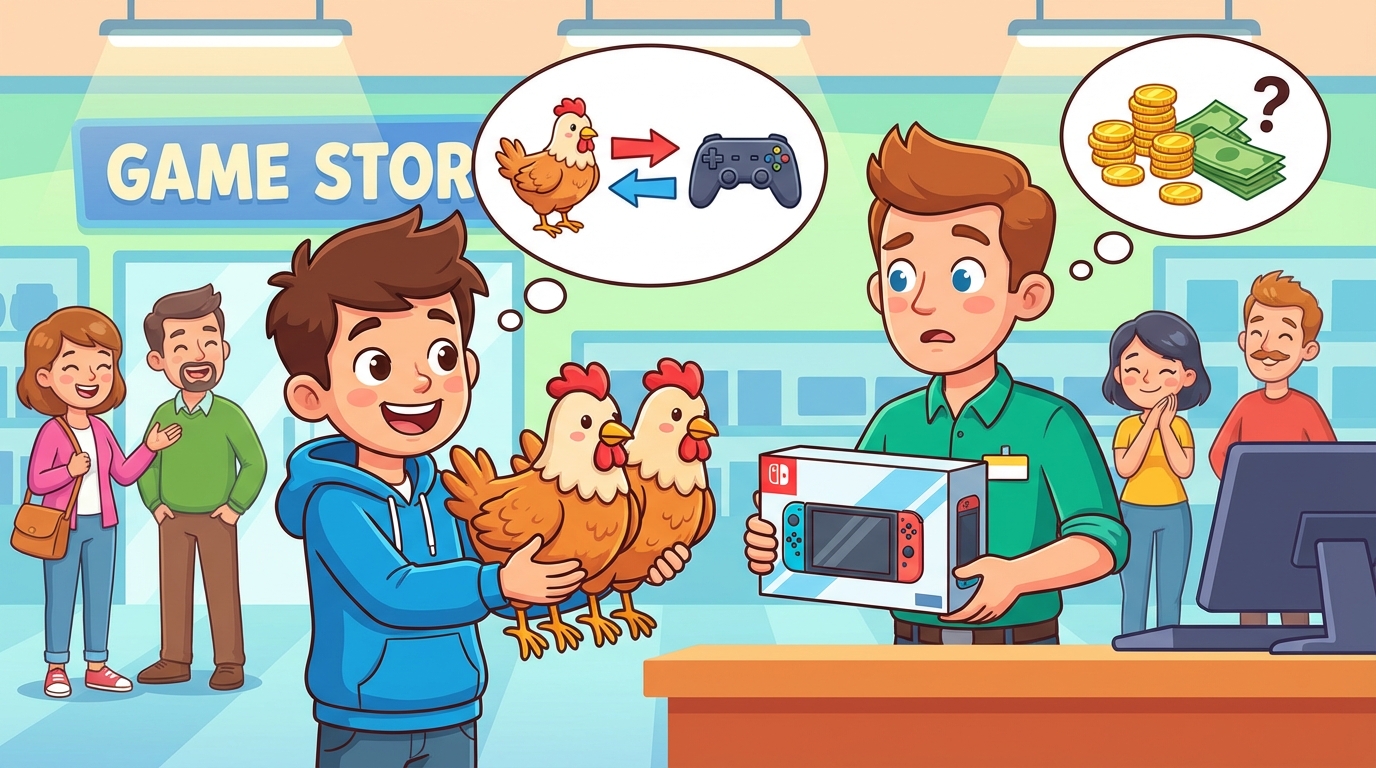
Imagine walking into a store to buy a video game 🎮, but instead of money, you try to pay with... three chickens! 🐔🐔🐔 It sounds funny, but long ago, people traded items directly. This was hard to do, so humans invented currency.
Currency is the specific system of money used in a country. It serves as a medium of exchange for goods and services. Without it, we would have to guess how many apples 🍎 equal one pair of sneakers 👟!
Barter vs. Currency
Before currency, there was barter (trading stuff for stuff). Let's see why currency is better:
| Feature | Barter (Old Way) 🤝 | Currency (New Way) 💵 |
|---|---|---|
| Portability | Hard to carry (imagine carrying a cow!) | Fits in your pocket |
| Value | Confusing (Is a goat worth 5 or 10 chickens?) | Clear ($10 is exactly $10) |
| Durability | Items can rot (like fruit) | Coins and bills last a long time |
Key Facts
2 The Three Functions of Money
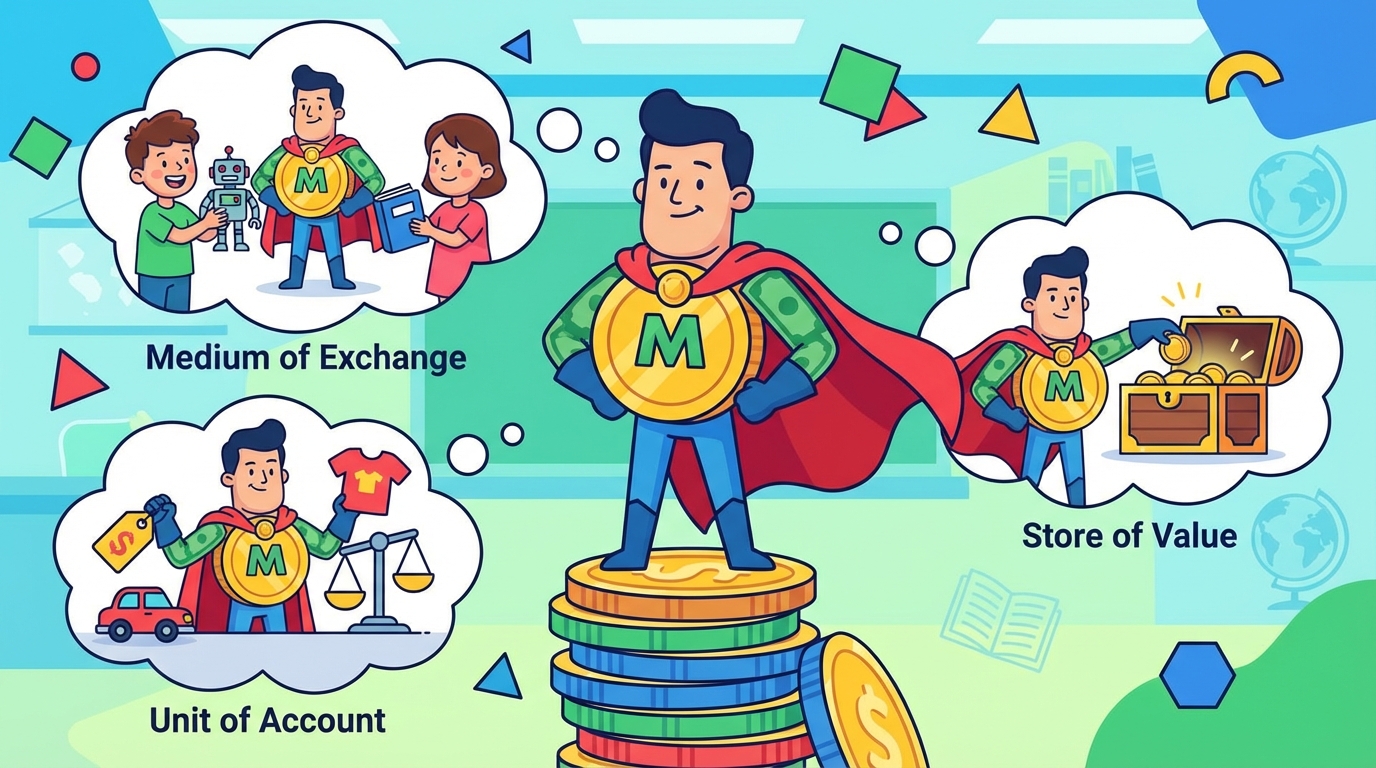
Money is like a superhero with three distinct superpowers! 🦸♂️💰 It solves the problems of trading (bartering) by doing three specific jobs for us.
This is money's most famous job. It means we use money to buy and sell goods and services.
Instead of trading your lunch for a pencil (bartering), you use money to buy the pencil.
Money acts like a measuring tape for value. It helps us compare prices and know what things are worth.
It allows us to post price tags so everyone knows the cost.
Money keeps its value over time. You can save it today and spend it later.
Unlike an apple 🍎 (which rots), a dollar bill stays a dollar bill next month.
Key Facts
3 Six Characteristics of Useful Money
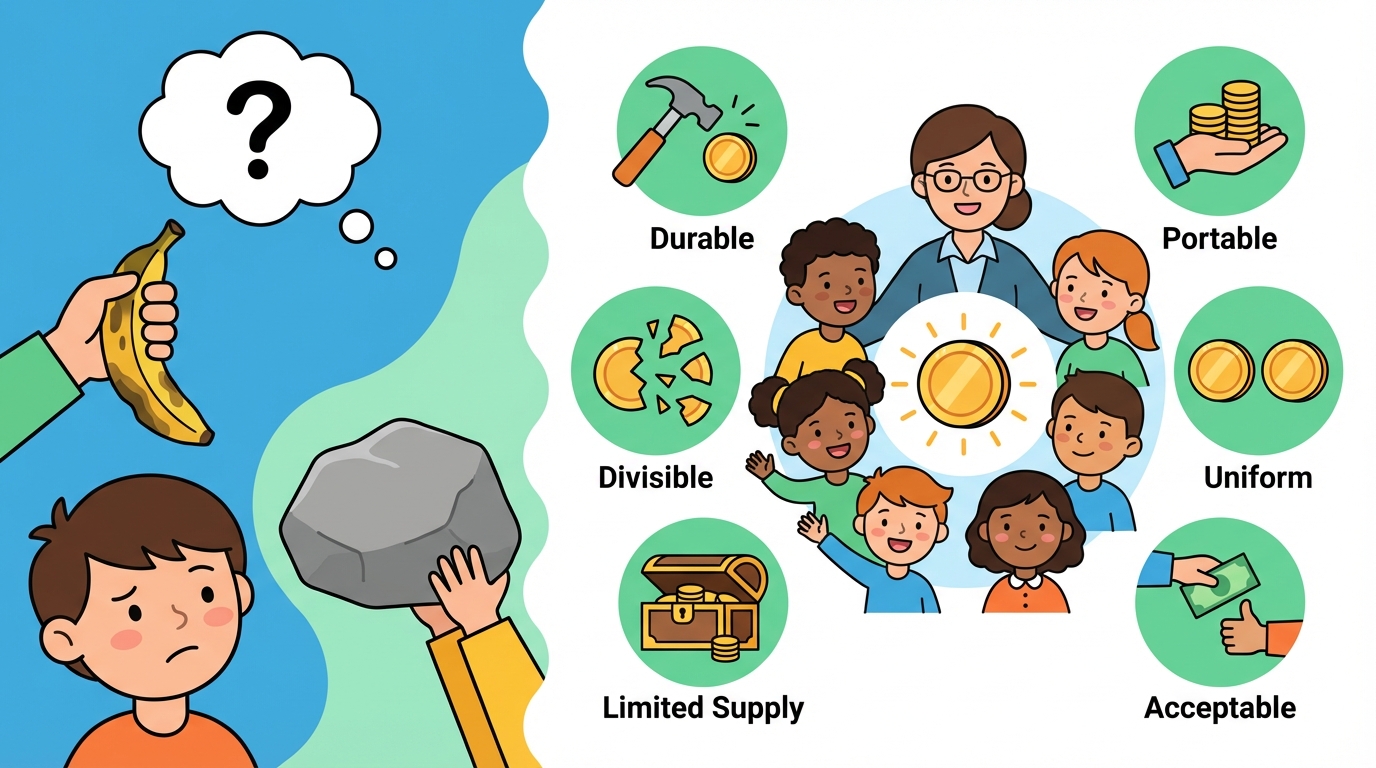
Have you ever wondered why we don't use bananas or heavy rocks as money? 🍌🪨 It is because good money needs to follow specific rules to work well in an economy!
Money must withstand physical wear and tear. If money rots (like fruit) or rips easily, it loses its value.
Example: A dollar bill can go through the wash and still survive!People need to be able to take money with them comfortably. It shouldn't be too heavy or bulky.
Example: You can carry $100 in your pocket easily.Money must be easily divided into smaller parts so we can make change for different prices.
Example: A $10 bill can be changed into two $5 bills or ten $1 bills.Any two units of money must be the same. A dollar in my pocket must buy the same amount as a dollar in yours.
Example: All quarters are the same size and weight.Money must be scarce enough to have value. If it grew on trees, it wouldn't be worth anything!
Example: The Federal Reserve controls how much cash is printed.Everyone must agree to use it. You must be able to exchange it for goods and services anywhere.
Example: Stores across the country accept U.S. Dollars.🤔 Think About It:
Why was gold used as money for thousands of years? Because it is durable, portable, and limited in supply!
Key Facts
4 Why is Paper Valuable? (Fiat vs. Commodity)
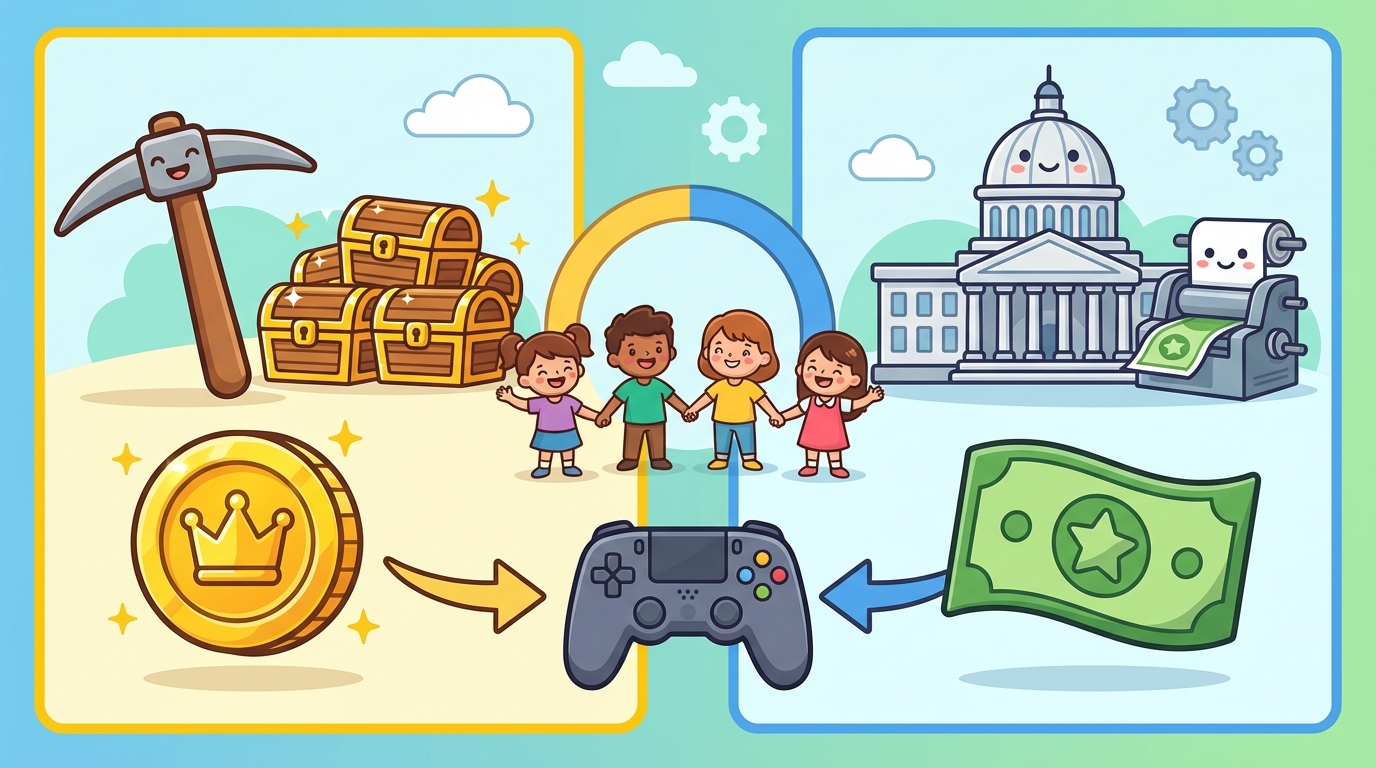
Imagine you have a solid gold coin 🪙 and a paper $20 bill 💵. Both can buy you a video game, but they are very different types of money!
Commodity money is made of something that has value on its own. Think of gold, silver, or even salt!
- If you melt a gold coin, you still have a lump of valuable gold.
- In the past, people used things like cocoa beans or shells as money. If you couldn't spend it, you could eat it or wear it!
Fiat money is what we use today. It is valuable only because the government says it is.
- 'Fiat' is a Latin word that means 'let it be done' (an order).
- The paper itself is worthless. You can't eat a dollar bill, and it makes a terrible building material!
- It works because we trust the government and our economy.
⚡ Quick Comparison ⚡
| Feature | Commodity Money 🪙 | Fiat Money 💵 |
|---|---|---|
| Source of Value | The material (Gold, Silver) | Government Order & Trust |
| Other Uses | Jewelry, Tools, Food | None (It's just paper or digital) |
| Risk | Heavy to carry, hard to divide | Inflation (printing too much) |
Key Facts
5 Major Currencies of the World
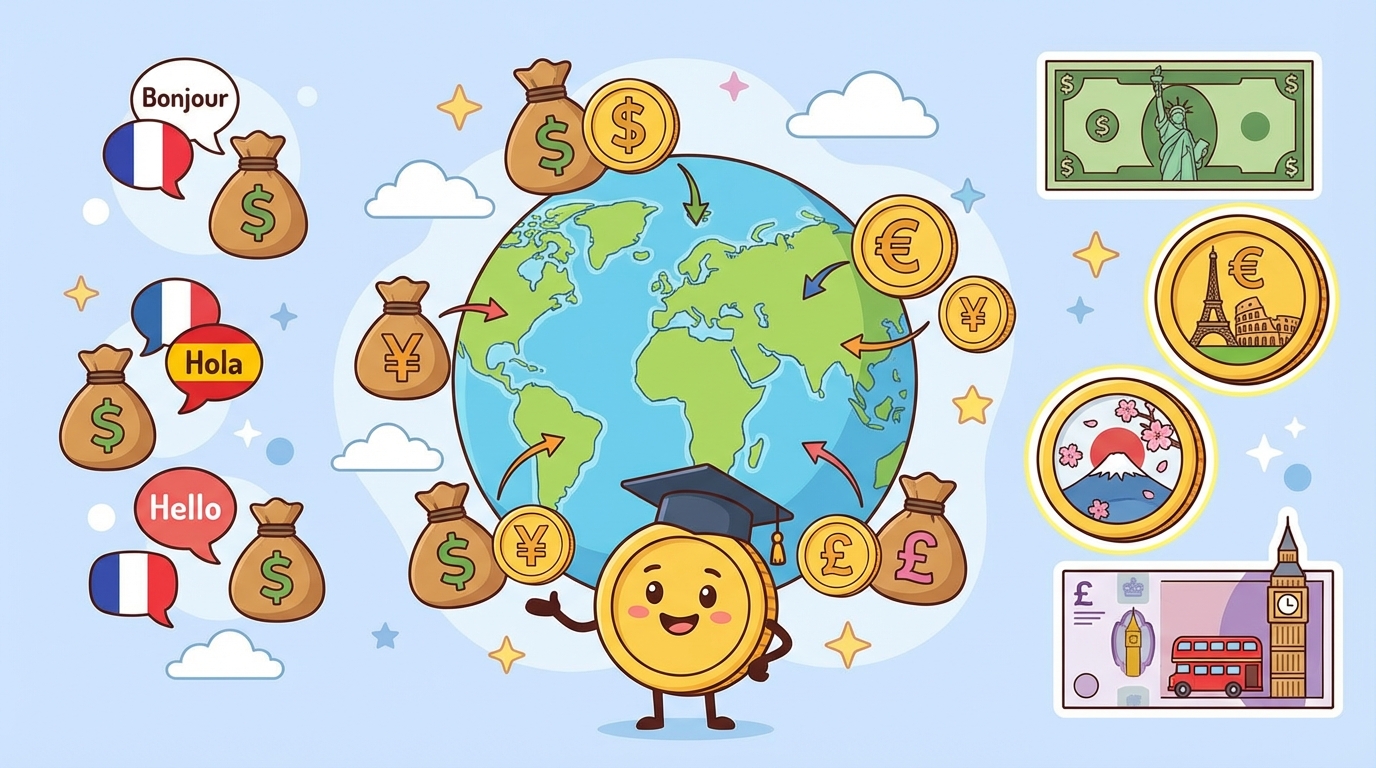
Just like different countries have different languages, they also have different money! 🌍 While there are over 180 currencies in the world, a few of them are considered 'Major Currencies' because they are used most often for buying, selling, and trading between countries.
The US Dollar ($) is the most powerful currency in the world. It is known as the 'World Reserve Currency'. This means many countries keep piles of dollars in their banks to help keep their own economy stable. Oil, gold, and many international products are priced in dollars.
The Euro (€) is unique because it isn't just for one country. It is the official money for 20 countries in Europe (like France, Germany, Italy, and Spain). This creates the 'Eurozone', making it super easy to travel and trade without changing money at every border!
🇯🇵 The Japanese Yen (¥) & 🇬🇧 The British Pound (£)
The Japanese Yen (JPY) is the most traded currency in Asia and is known for being very high-tech (hard to counterfeit). The British Pound (GBP), or 'Sterling', is the oldest currency in the world that is still being used today!
Currency Cheat Sheet 📝
| Currency Name | Symbol | Nickname |
|---|---|---|
| US Dollar | $ | Greenback / Buck |
| Euro | € | Single Currency |
| British Pound | £ | Quid |
| Japanese Yen | ¥ | En |
Key Facts
6 Understanding Exchange Rates
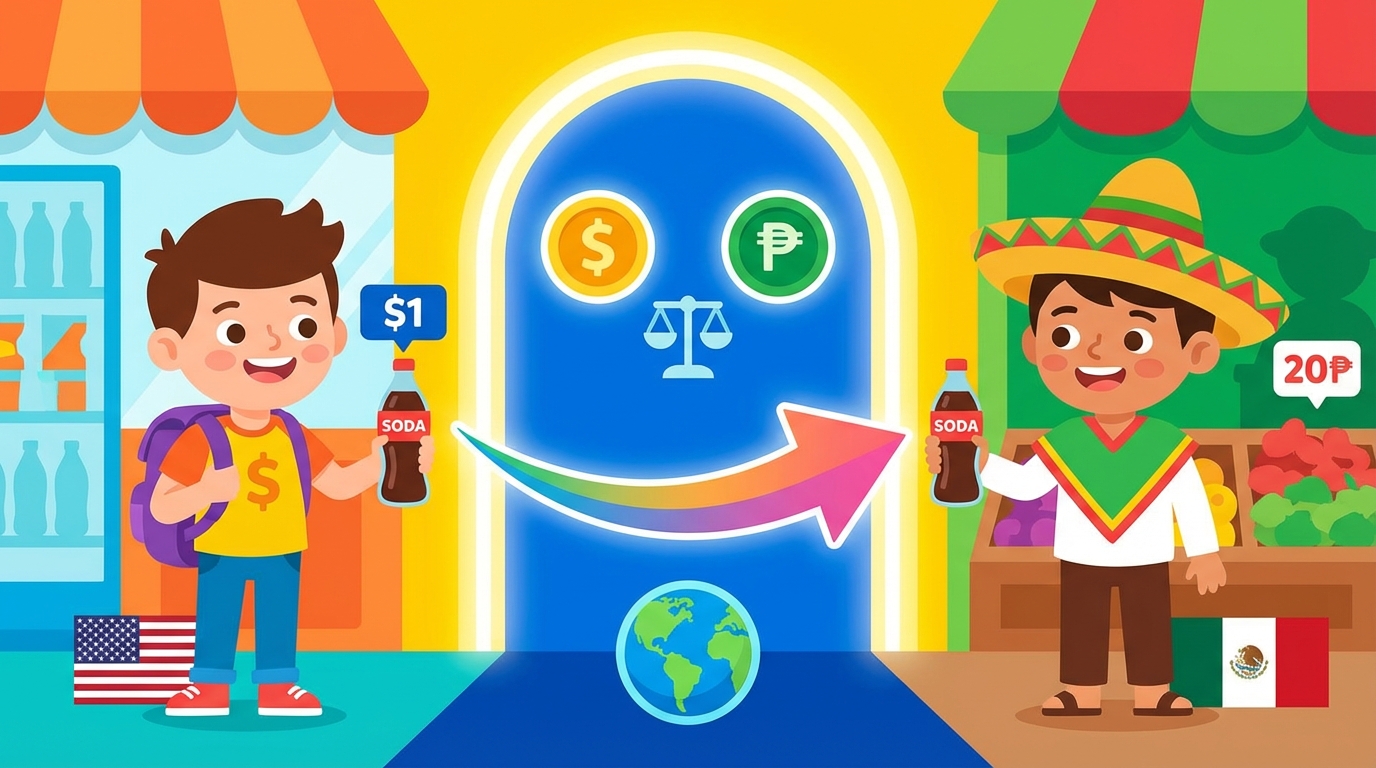
Have you ever wondered why a soda might cost $1 in the USA but 20 Pesos in Mexico? That is because of Exchange Rates! 🌍
Think of money like trading cards. Sometimes, one rare card is worth two common cards.
If the US Dollar is strong, it is like a rare card—you get more foreign money (like Yen or Euros) for every dollar you exchange!
Imagine you want to buy a cool toy in Japan.
- Toy Price: 1,500 Yen (¥)
- Exchange Rate: $1 USD = 150 Yen
- Cost to you: 1500 ÷ 150 = $10.00
Exchange rates change every day based on how well a country's economy is doing. It's like a rollercoaster! 🎢
Key Facts
7 Strong vs. Weak Currencies
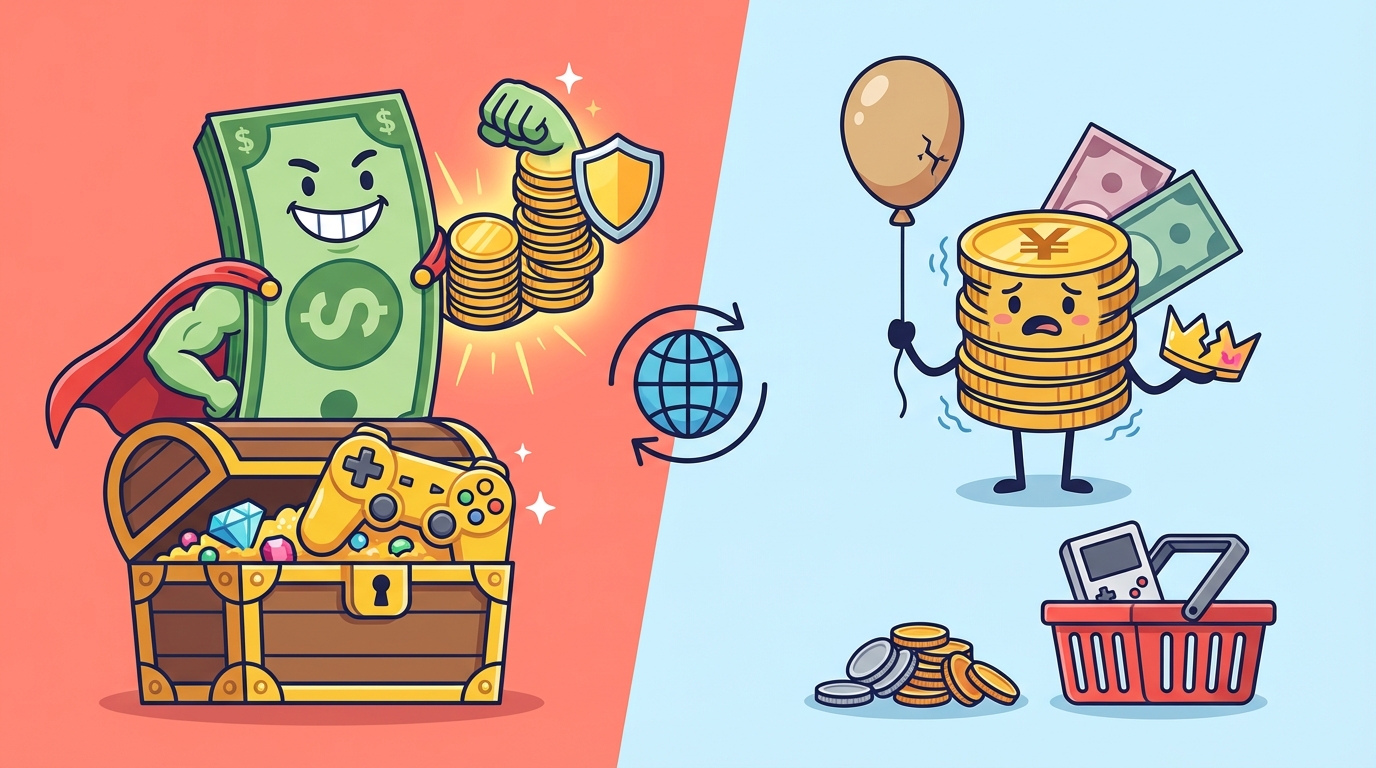
Have you ever wondered why a video game might cost $50 in the US but thousands of Yen in Japan? It depends on how strong or weak the currency is! 🌍
A currency is strong when its value rises compared to other money. It's like having a super-powered coin!
- ✈️ Vacations: Traveling to other countries is cheaper.
- 📦 Shopping: Buying toys or electronics from other countries costs less.
- 🚫 The Downside: It's harder for companies to sell things to other countries because they seem too expensive.
A currency is weak when its value drops compared to others. But don't worry, 'weak' isn't always bad!
- 🏭 Business: It's easier to sell products abroad because they are cheaper for others to buy.
- 📸 Tourism: More tourists visit because their money goes further.
- 💸 The Downside: Buying imported goods (like foreign cars) becomes very expensive.
Key Facts
8 Keeping Money Safe: Anti-Counterfeiting
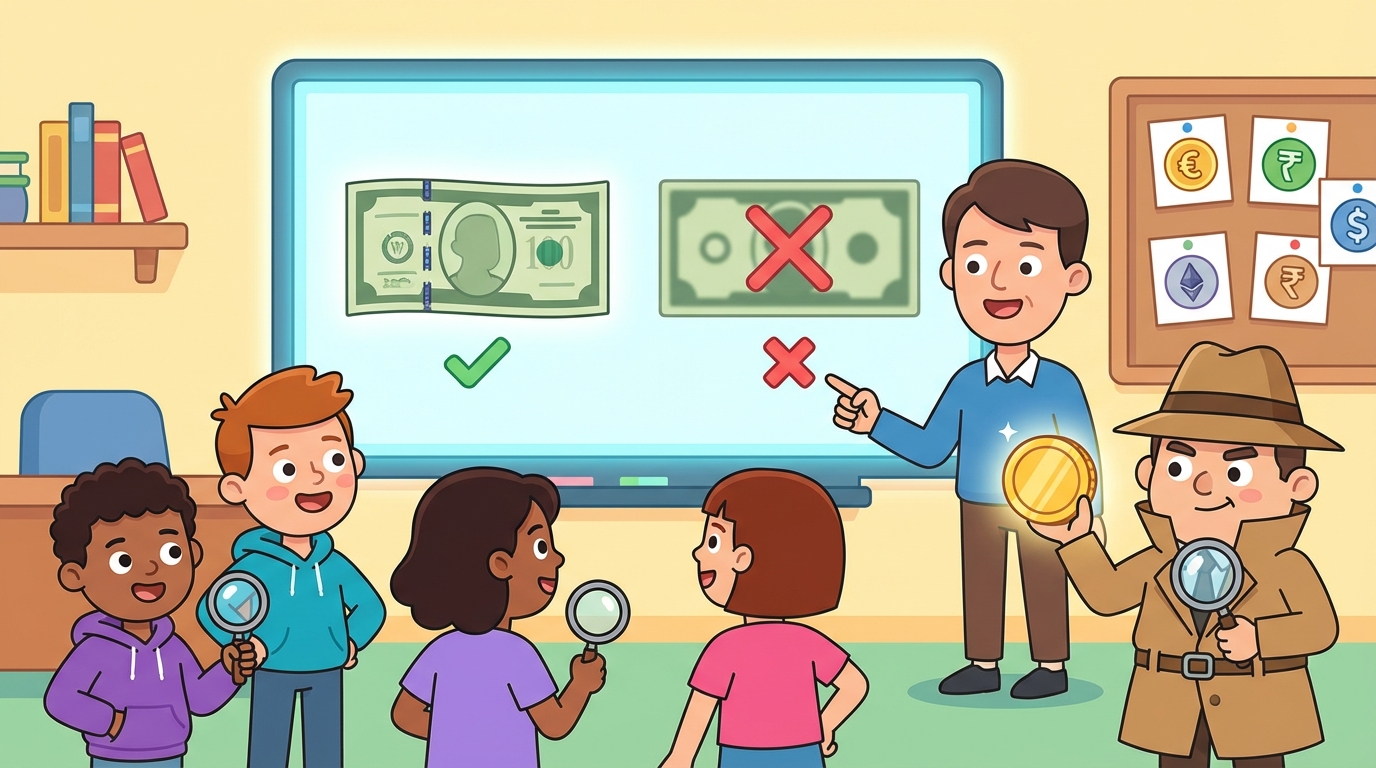
🕵️♂️ What is Counterfeiting?
Imagine working hard all summer to buy a video game, only to find out your money is just printed paper with no value. That is counterfeiting!
Counterfeiting is the crime of making fake money to trick people. To stop this, governments turn money into high-tech art pieces full of secret codes and special materials.
🔒 The Security Feature Checklist
Watermarks
Hold a bill up to the light. You will often see a faint image (like a president's face) that is hidden inside the paper itself!
Color-Shifting Ink
Tilt the bill back and forth. On real money, the numbers in the corner often change color, like from copper to green.
Microprinting
Look closely with a magnifying glass. You might see tiny words bordering the pictures that look like solid lines to the naked eye.
⚠️ Why does it matter?
If there is too much fake money, people lose trust in the currency. Stores might stop accepting cash, and the real money loses its value (inflation). Keeping money safe keeps the economy strong!
Key Facts
9 The Future: Digital Currencies and Crypto
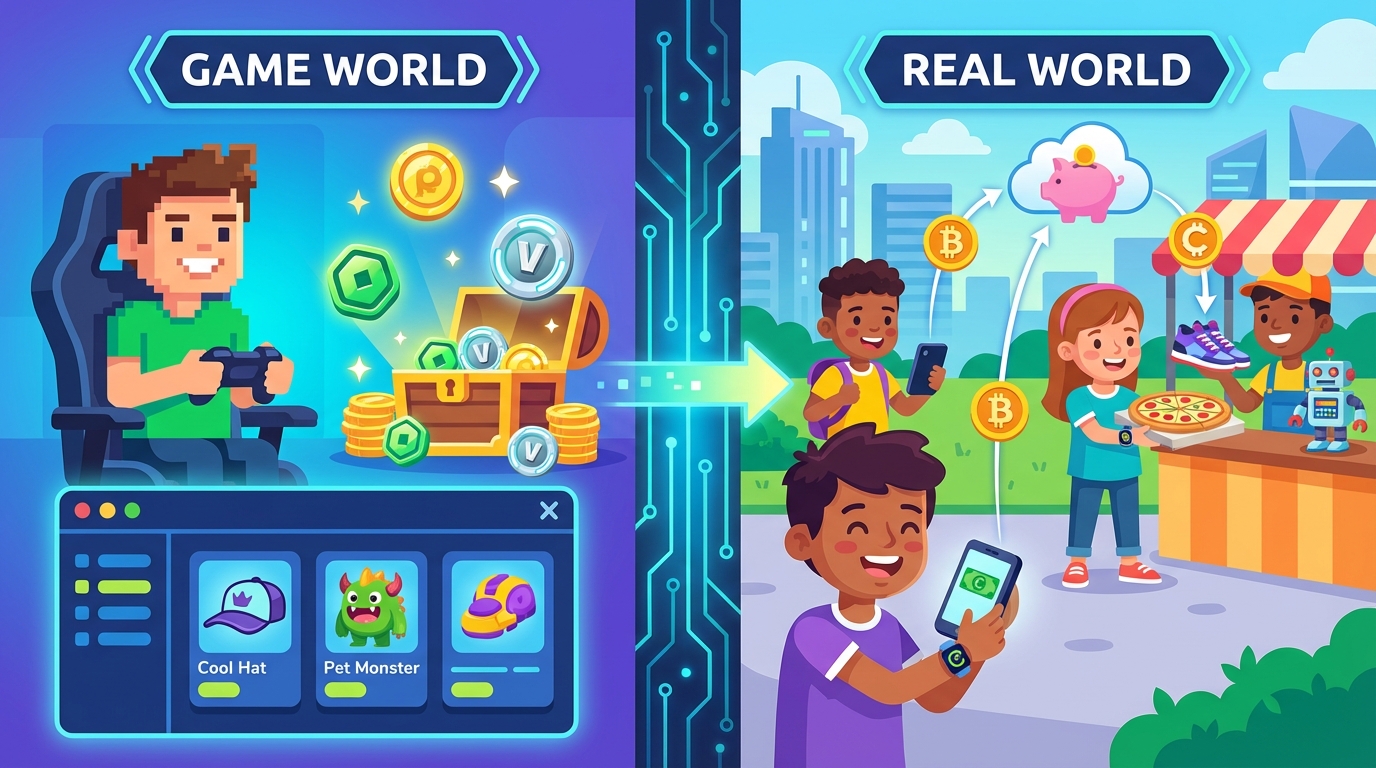
Have you ever used Robux or V-Bucks in a video game? 🎮 If so, you already know what it's like to use money that only exists digitally! Now, imagine if you could use that kind of digital money to buy real pizza or sneakers. Welcome to the world of Cryptocurrency.
Cryptocurrency (or 'Crypto') is digital money that doesn't need a bank or a government to work. It uses secret codes (cryptography) to keep transactions safe.
- 🚫 No physical coins: You can't hold a Bitcoin in your hand.
- 🏦 No middleman: You send money directly to another person, like sending an email.
Imagine a shared digital notebook that everyone can see but no one can erase. This is called the Blockchain.
Every time someone spends crypto, it gets written in this notebook. Because thousands of computers have a copy of the notebook, nobody can cheat or fake the money!
Traditional Money vs. Crypto ⚖️
| Feature | Traditional Money (Fiat) 💵 | Cryptocurrency 🪙 |
|---|---|---|
| Form | Paper bills, metal coins, cards | 100% Digital code |
| Who controls it? | Governments and Banks | Computer networks & Math |
| Speed | Can take days (international) | Usually minutes |
⚠️ The Rollercoaster Warning!
Crypto is very volatile. That means its value goes up and down super fast—like a rollercoaster! 🎢 One day, 1 Bitcoin might buy a car; the next year, it might only buy a bike. It is considered a risky investment, not a stable piggy bank.
Key Facts
10 Key Vocabulary
Master these important terms for your exam:
| Term | Definition |
|---|---|
|
Currency
Moneda / Divisa |
A system of money in general use in a particular country.
El sistema de dinero que se usa generalmente en un país específico. |
|
Barter
Trueque |
Trading goods or services directly for other goods or services without using money.
Intercambiar bienes o servicios directamente por otros bienes o servicios sin usar dinero. |
|
Exchange Rate
Tipo de cambio |
The price of one country's currency expressed in terms of another country's currency.
El precio de la moneda de un país expresado en términos de la moneda de otro país. |
|
Inflation
Inflación |
A general increase in prices and a fall in the purchasing value of money.
Un aumento general de los precios y una caída en el valor adquisitivo del dinero. |
|
Fiat Money
Dinero fiduciario |
Currency that a government has declared to be legal tender, but it is not backed by a physical commodity like gold.
Moneda que el gobierno declara legal, pero que no está respaldada por un producto físico como el oro. |
|
Commodity Money
Dinero mercancía |
Money that has value in itself because it is made of a valuable substance, like gold coins or salt.
Dinero que tiene valor por sí mismo porque está hecho de una sustancia valiosa, como monedas de oro o sal. |
|
Purchasing Power
Poder adquisitivo |
The amount of goods or services that can be bought with a specific amount of money.
La cantidad de bienes o servicios que se pueden comprar con una cantidad específica de dinero. |
|
Supply
Oferta |
The total amount of a specific good or currency that is available to consumers.
La cantidad total de un bien o moneda específica que está disponible para los consumidores. |
|
Demand
Demanda |
A consumer's desire to purchase goods and services and willingness to pay a price for them.
El deseo del consumidor de comprar bienes y servicios y su disposición a pagar un precio por ellos. |
|
Denomination
Denominación |
The face value of a banknote, coin, or postage stamp.
El valor asignado que aparece en un billete, moneda o sello postal. |
|
Medium of Exchange
Medio de cambio |
A function of money that allows it to be used to buy and sell goods easily.
Una función del dinero que permite usarlo para comprar y vender bienes fácilmente. |
|
Store of Value
Depósito de valor |
Something that keeps its value over time so it can be saved and spent later.
Algo que mantiene su valor a lo largo del tiempo para poder ahorrarse y gastarse después. |
|
Counterfeit
Falsificación |
Fake money produced illegally to look like real currency.
Dinero falso producido ilegalmente para parecer moneda real. |
|
Appreciation
Apreciación |
When a currency increases in value compared to other currencies.
Cuando una moneda aumenta su valor en comparación con otras monedas. |
|
Depreciation
Depreciación |
When a currency loses value compared to other currencies.
Cuando una moneda pierde valor en comparación con otras monedas. |
Time to Practice!
There are 7 questions waiting for you. Questions are shuffled each attempt.
Take the Quiz