Physical and Intellectual Work
An exploration of the differences, similarities, and interdependence between manual labor and mental labor in the economy.
1 What is Labor? Producing Goods and Services
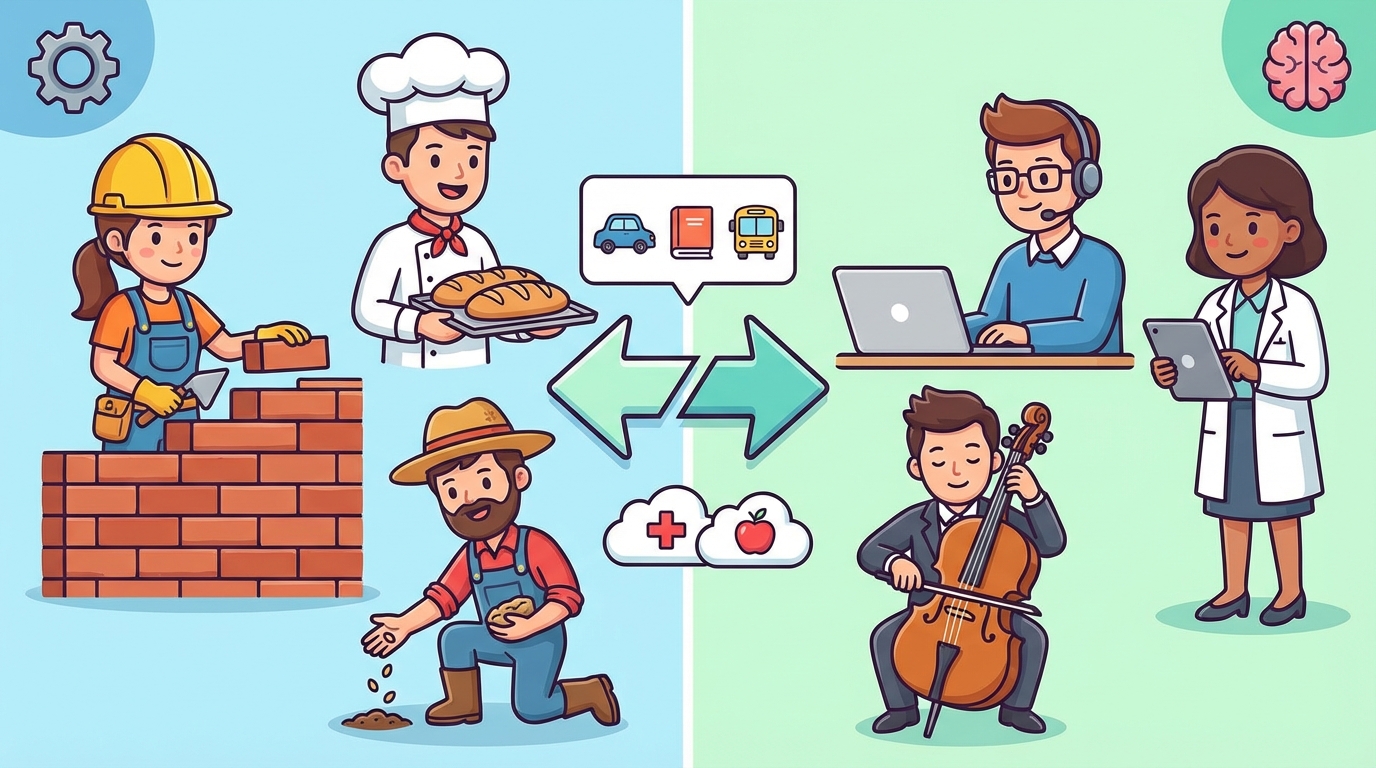
👷♀️ 👨💻 Defining Labor
In the world of Economics, labor isn't just about doing chores. Labor is the human effort—both physical and mental—used to produce goods and services. Without labor, raw materials like wood or data would just sit there doing nothing!
This type of work relies heavily on the body, strength, and coordination. It is often called manual labor.
- 🌽 Farming: Planting and harvesting crops.
- 🏗️ Construction: Building homes and schools.
- 🚗 Mechanics: Fixing car engines with tools.
This type of work relies on the mind, education, and creativity. It is often called mental labor.
- 👾 Coding: Writing software for video games.
- ⚖️ Law: Arguing a case in court.
- 🔬 Science: Researching cures for diseases.
🤝 The Perfect Mix!
In the real world, most jobs need both! Think about a Surgeon 🩺. They need incredible intellectual knowledge to know how the body works, but they also need steady hands and physical skill to perform the operation.
Key Facts
2 Physical Work: Powering the Economy with Action
💪 What is Physical Work?
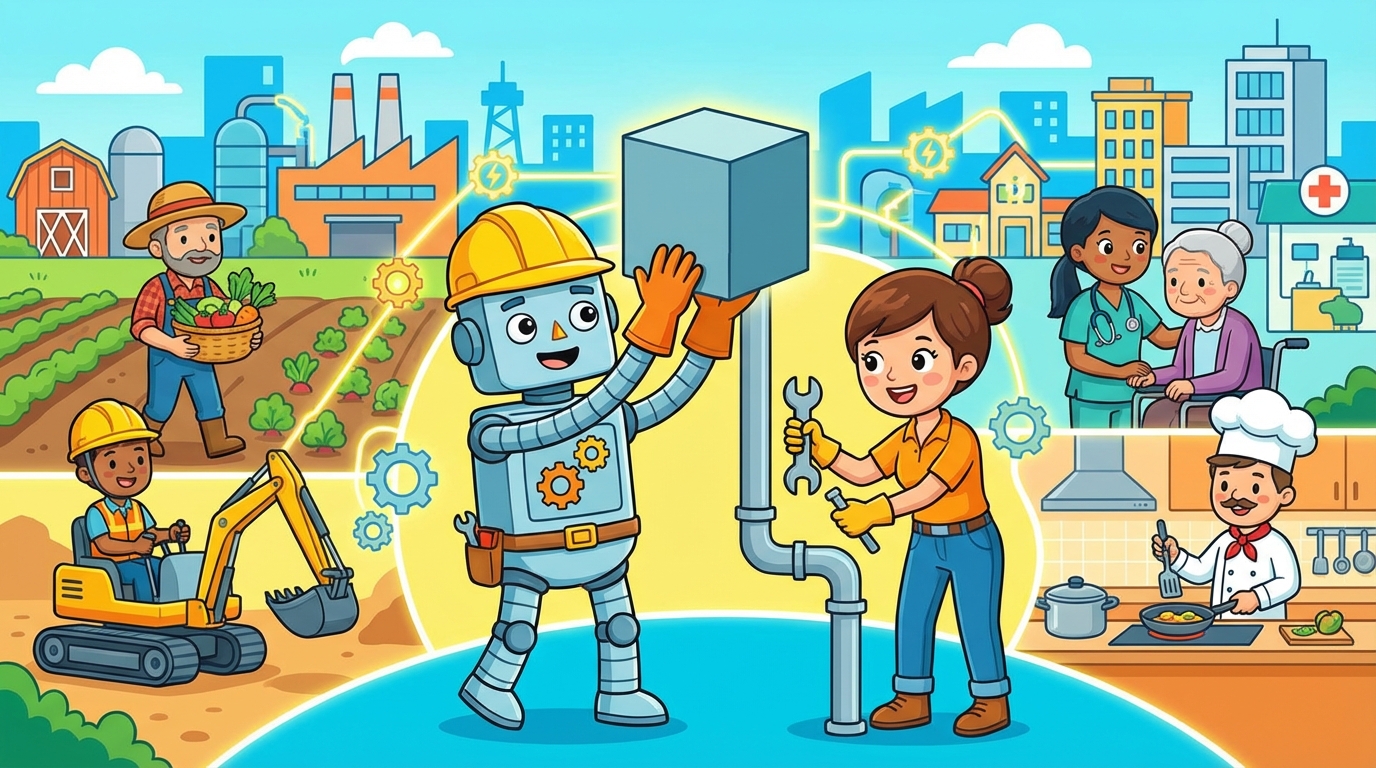
Physical work is the effort we make using our bodies, muscles, and hands to produce goods or perform services. It is the engine that builds our world!
While intellectual work uses the brain to solve problems, physical work uses energy and movement to turn ideas into reality. Without physical labor, we wouldn't have homes to live in or food to eat.
🛠️ Examples in Action
- Construction: Bricklayers and carpenters building schools.
- Agriculture: Farmers planting and harvesting vegetables.
- Logistics: Delivery drivers moving packages to your door.
- Craftsmanship: Bakers kneading dough to make bread.
⚡ Skills Required
It's not just about being strong! Physical work often requires:
Think about a surgeon or a watchmaker: they do physical work that requires tiny, perfect movements!
Key Facts
3 Intellectual Work: The Economy of Ideas
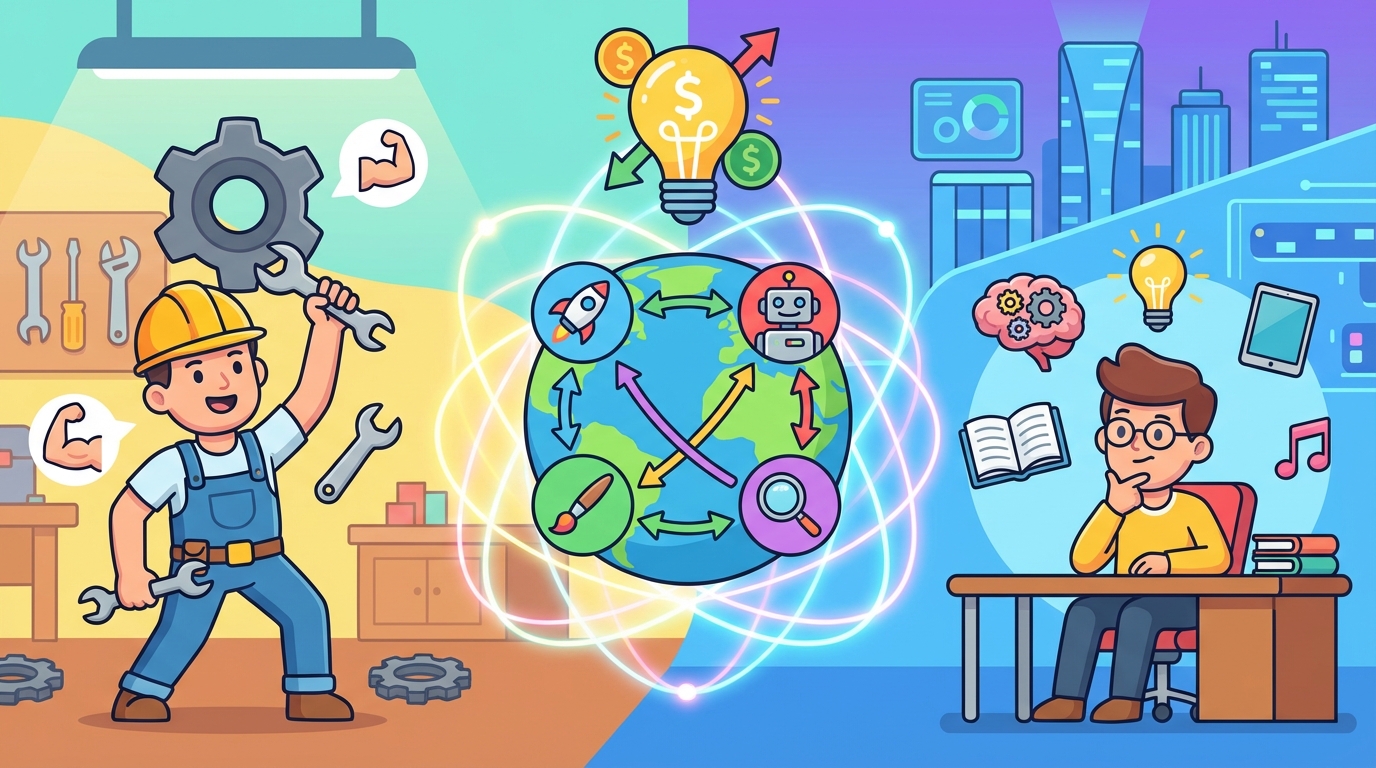
While physical work relies on muscles, intellectual work relies on the brain! 🧠 It is all about thinking, creating, and solving problems.
In today's world, many jobs are based on knowledge. This means the value comes from new ideas, inventions, and strategies rather than moving heavy objects.
Examples of Intellectual Workers
👩💻
Game Developer
Uses math and logic to code your favorite video games.
👨⚕️
Doctor
Uses years of study to diagnose and treat patients.
👩⚖️
Lawyer
Uses knowledge of the law to help people in court.
Key Facts
4 Body and Mind: When Physical and Mental Work Combine
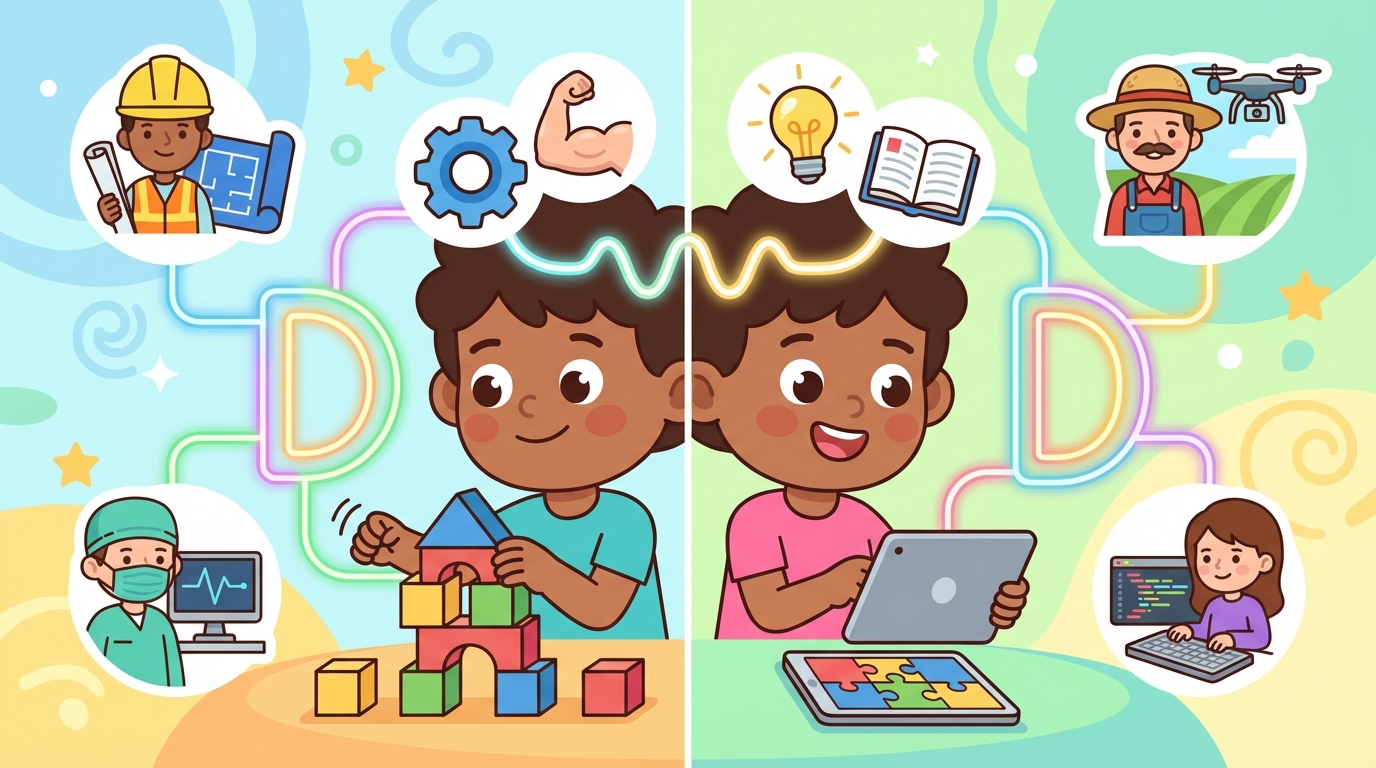
Have you ever tried to rub your belly and pat your head at the same time? 🤯 It takes both physical coordination and mental focus! In the economy, many jobs are just like that—they are a Dynamic Duo of physical and intellectual effort.
🤝 The Perfect Mix
Very few jobs are 100% physical or 100% mental. Most careers require a special blend of both to get the job done right!
Being a chef looks like physical work because they are chopping, stirring, and standing all day. But wait! 🧠
- Physical: Knife skills, carrying heavy pots, enduring heat.
- Mental: Creating recipes, calculating measurements, managing timing.
Athletes are the definition of physical fitness, right? Yes, but they also need a sharp mind to win! 🏆
- Physical: Speed, strength, agility, muscle memory.
- Mental: Memorizing plays, analyzing opponents, making split-second decisions.
🔬 Case Study: The Surgeon
Let's look at a surgeon. They need the steady hands of a sculptor and the knowledge of a scientist. Here is how their work combines:
| Action | Type of Work? | Why? |
|---|---|---|
| Reading X-Rays | Intellectual 🧠 | Analyzing data to make a plan. |
| Performing Surgery | Physical 💪 | Using hands with extreme precision (dexterity). |
| Monitoring Vitals | Both 🔄 | Watching screens (mental) + reacting quickly (physical). |
Remember: Even jobs like coding (mostly mental) require physical health to prevent strain, and jobs like construction (mostly physical) require math to measure correctly!
Key Facts
5 The Great Collaboration: Why We Need Both Types
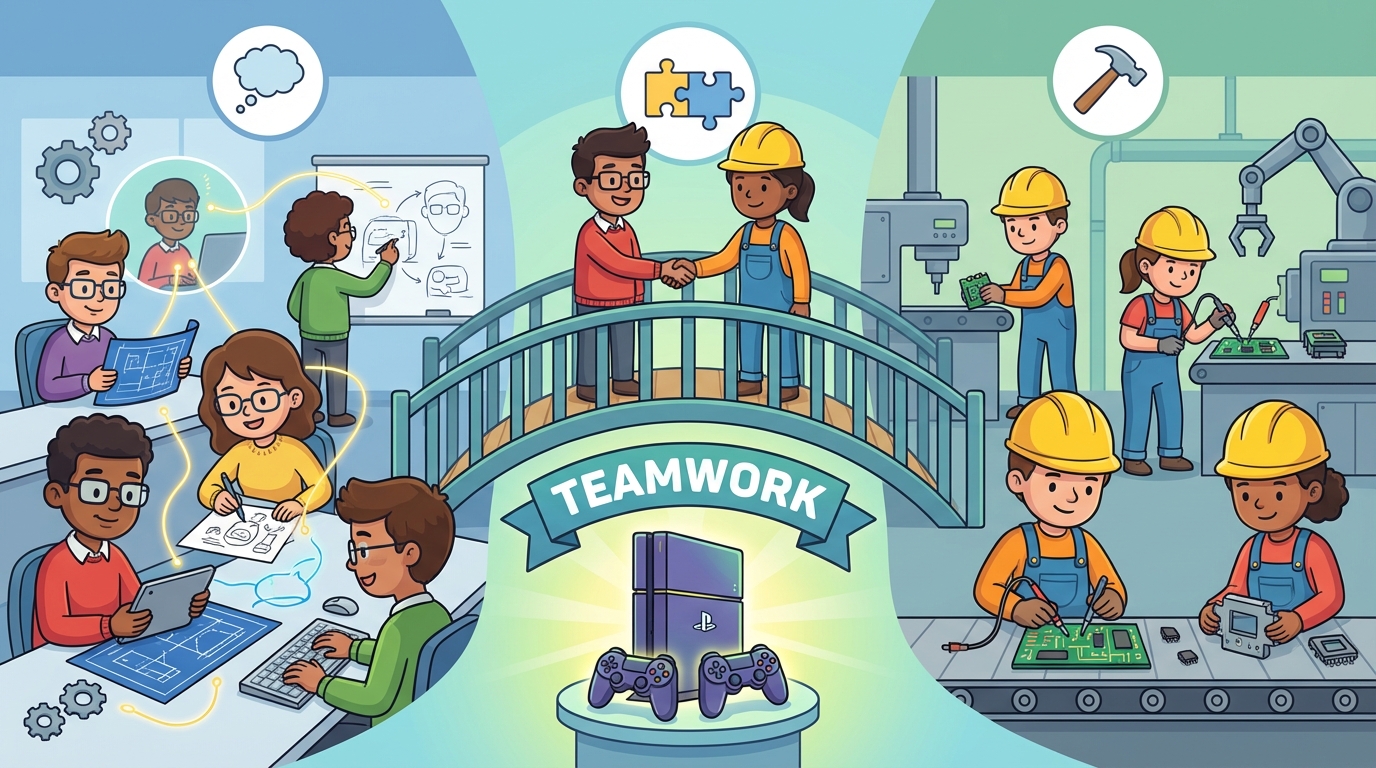
Have you ever thought about how your favorite video game console is made? 🎮 It takes a huge team to make it happen!
🤝 The Power of Teamwork
An economy cannot survive with only thinkers or only doers. Intellectual work (planning/designing) and Physical work (building/moving) are like the brain and the hands of a body. You need both to function!
An Architect uses math and art to draw the blueprints (Intellectual). But without the Construction Worker to pour concrete and lay bricks (Physical), the house would never exist. It would just be a drawing on paper!
A Software Engineer writes the code for a new phone (Intellectual). However, factory workers and Technicians must assemble the microchips, screens, and batteries (Physical) so you can actually hold the phone.
🌟 The Big Lesson
Neither type of work is 'better' than the other. They are interdependent. This means they rely on each other. A great economy respects and rewards both the person who designs the bridge and the person who builds it.
Key Facts
6 From Agriculture to Information: How Work Has Changed
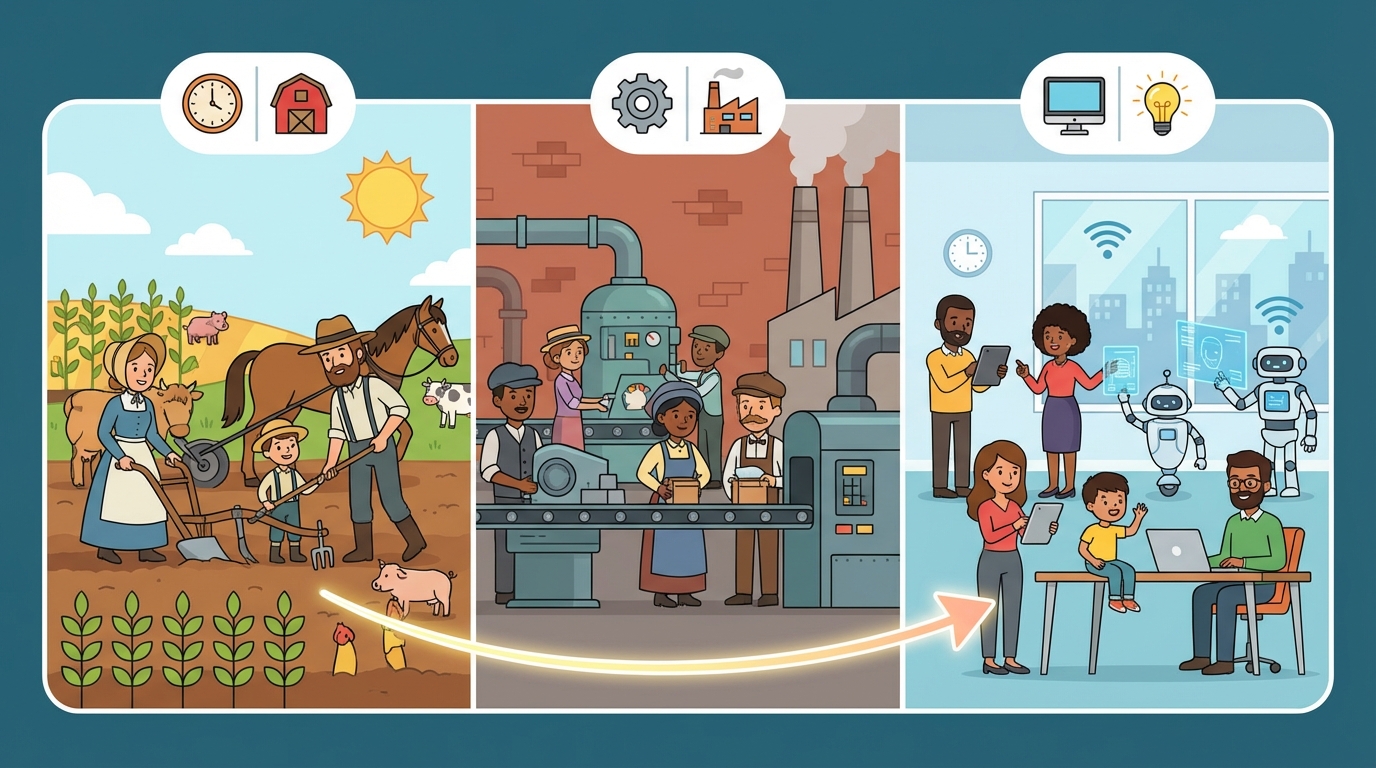
⏳ Time Travel!
Imagine living 200 years ago. There is a 90% chance you would be working on a farm! Today, work looks very different. Let's explore the Three Big Eras of work.
1. The Agricultural Age 🌾
For thousands of years, most work was physical. People used their muscles and simple tools like plows to grow food.
- 💪 Main Power: Human & Animal muscles
- 📍 Location: Fields & Farms
2. The Industrial Age 🏭
About 250 years ago, machines started doing the heavy lifting. People moved to cities to work in factories.
- ⚙️ Main Power: Steam & Electricity
- 📍 Location: Factories & Cities
3. The Information Age 💻
Today, we live in a digital world. Work is often intellectual, focusing on creating ideas, code, and services.
- 🧠 Main Power: Brains & Computers
- 📍 Location: Offices & Internet
| Feature | Physical Era (Past) | Information Era (Present) |
|---|---|---|
| Tools Used | Hammers, Plows, Shovels 🔨 | Computers, Tablets, WiFi 📱 |
| Main Product | Food, Clothes, Machines 🚜 | Apps, Data, Entertainment 💾 |
| Skill Needed | Strength and Endurance 🏋️ | Creativity and Problem Solving 🧩 |
Note: We still need physical work today (like construction and farming), but even those jobs now use high-tech tools like drones and robots! 🤖
Key Facts
7 Preparing for the Future: Vocational Skills vs. Academic Study
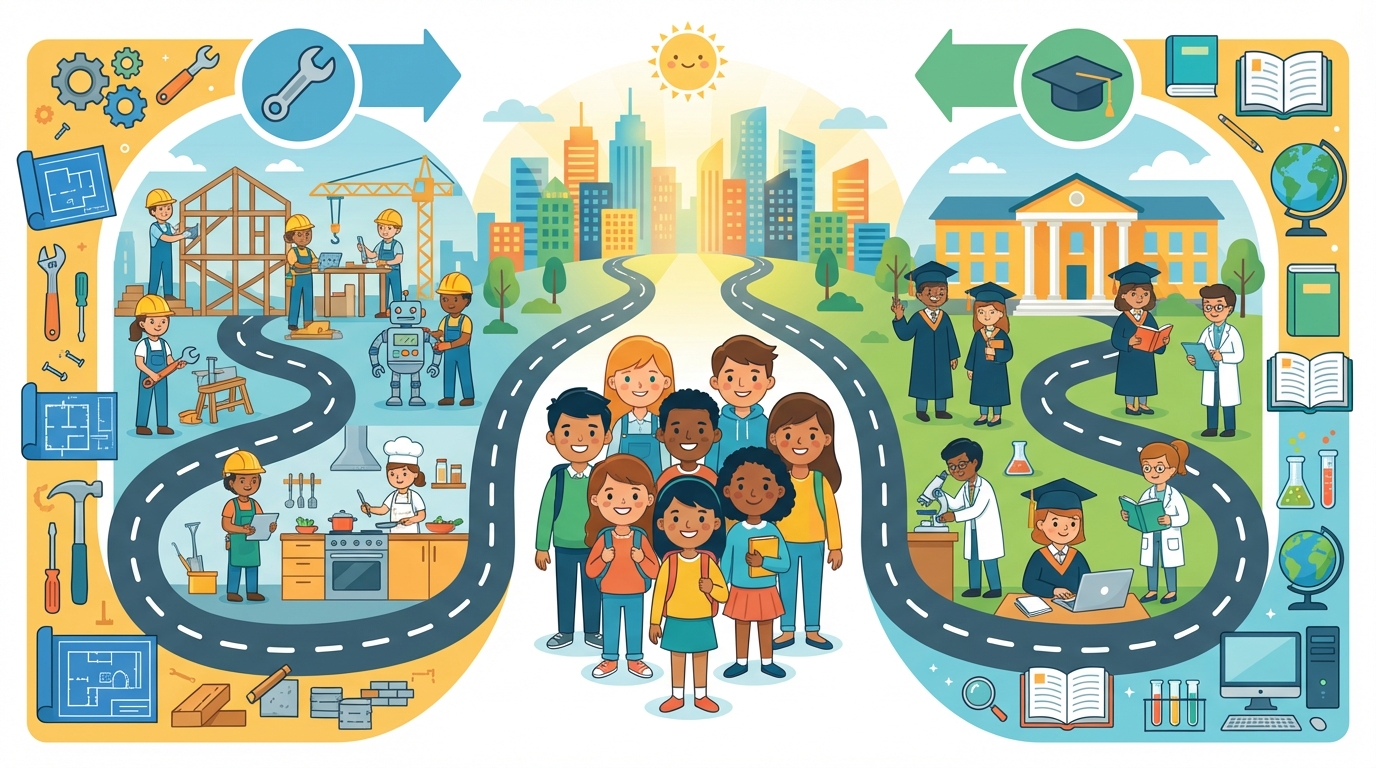
Have you ever thought about what you want to be when you grow up? 🎓🔨 There isn't just one road to success!
🛠️ Vocational Skills (Trades)
This path focuses on practical, hands-on skills. It prepares you for a specific job directly. You learn by doing rather than just reading.
- ⏱️ Time: Usually shorter (6 months to 2 years).
- 🎯 Goal: Master a specific craft.
- 👷 Examples: Electrician, Chef, Dental Hygienist, Coder.
📚 Academic Study (University)
This path focuses on theory, research, and broad knowledge. It helps you understand the 'why' behind how the world works.
- ⏱️ Time: Usually longer (4 years or more).
- 🎯 Goal: Gain deep theoretical understanding.
- 👨🔬 Examples: Biologist, Historian, Lawyer, Economist.
⚡ Which one is better? Neither!
| Scenario | Vocational Approach 🔧 | Academic Approach 📖 |
|---|---|---|
| Building a Bridge | Welders and crane operators build the structure safely. | Civil engineers calculate the physics so it doesn't fall. |
| Treating a Patient | Paramedics and nurses provide immediate, hands-on care. | Doctors diagnose complex diseases using medical theory. |
Key Facts
8 The Future of Work: Automation and Artificial Intelligence
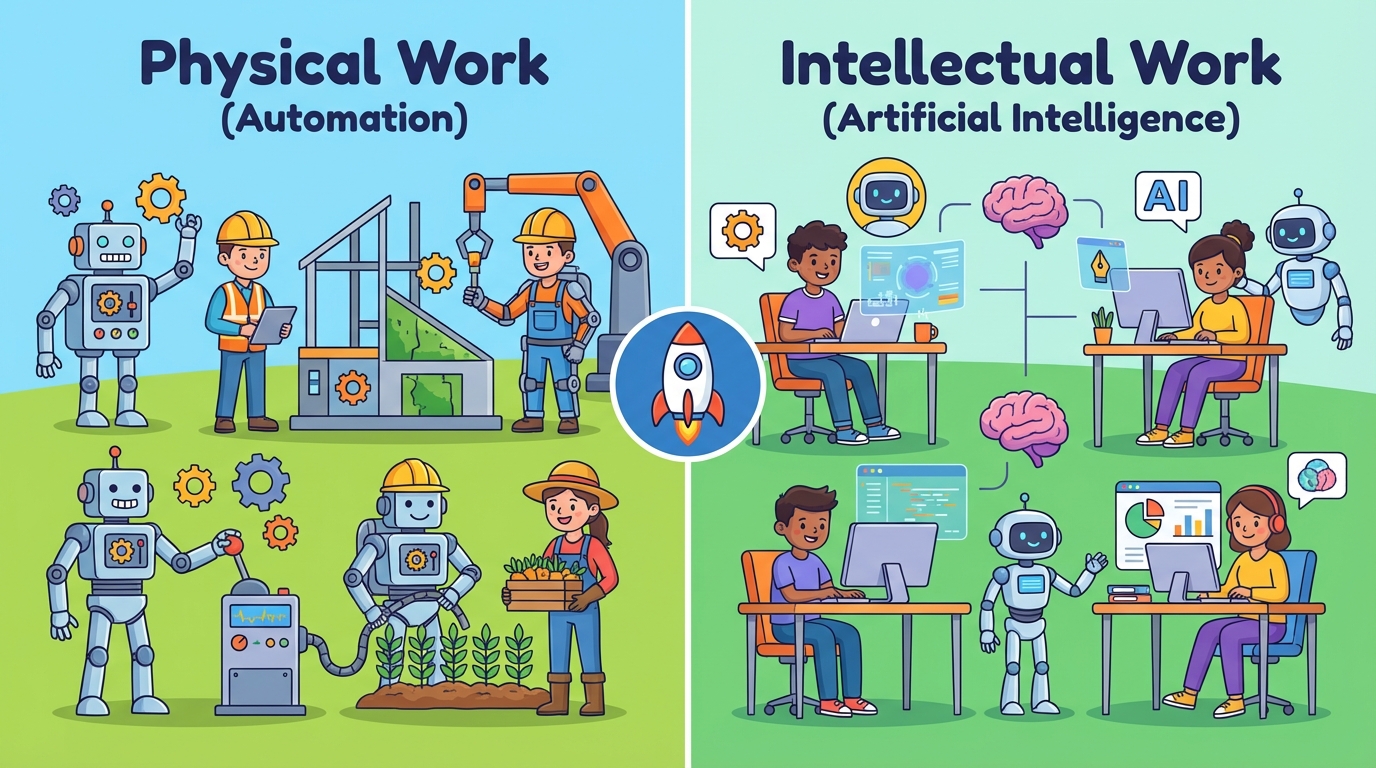
Have you ever wondered what jobs will look like when you grow up? 🚀 Technology is changing the way we work through two big forces: Automation and Artificial Intelligence (AI).
💪 Physical Work & Automation
Physical work involves using muscles and hands. Automation uses machines to do these tasks automatically.
- 🤖 Robots in factories build cars faster than humans.
- 📦 Drones can deliver packages to your doorstep.
- 🚜 Self-driving tractors plant seeds on farms.
Machines are great at tasks that are dangerous, dirty, or dull (boring)!
🧠 Intellectual Work & AI
Intellectual work involves using your brain to solve problems. AI uses computer programs to 'think' and learn.
- 🏥 Medical AI scans X-rays to find broken bones.
- 🗣️ Translators turn English into Spanish instantly.
- 🎮 Game AI controls the enemies you play against.
Computers process information much faster than we can!
✨ The Human Advantage
If machines do the heavy lifting and computers do the math, what will humans do? We have superpowers machines don't have: Creativity, Empathy (understanding feelings), and Teamwork. The future isn't about Humans vs. Robots; it's about Humans plus Robots working together! 🤝
Key Facts
9 Key Vocabulary
Master these important terms for your exam:
| Term | Definition |
|---|---|
|
Work
Trabajo |
Any activity involving mental or physical effort done in order to achieve a purpose or result.
Cualquier actividad que implica esfuerzo mental o físico realizado para lograr un propósito o resultado. |
|
Physical Work
Trabajo Físico |
Jobs that primarily require physical strength, manual labor, and the use of the body.
Trabajos que requieren principalmente fuerza física, labor manual y el uso del cuerpo. |
|
Intellectual Work
Trabajo Intelectual |
Jobs that primarily require mental effort, critical thinking, creativity, and problem-solving.
Trabajos que requieren principalmente esfuerzo mental, pensamiento crítico, creatividad y resolución de problemas. |
|
Manual Labor
Mano de Obra / Trabajo Manual |
Work done with the hands rather than by machines.
Trabajo realizado con las manos en lugar de con máquinas. |
|
Profession
Profesión |
A type of job that requires a high level of education and training, usually a university degree.
Un tipo de trabajo que requiere un alto nivel de educación y formación, generalmente un título universitario. |
|
Trade
Oficio |
A skilled job, typically one requiring manual skills and special training (e.g., plumber, electrician).
Un trabajo calificado, típicamente uno que requiere habilidades manuales y capacitación especial (ej. plomero, electricista). |
|
Wage
Salario / Jornal |
Payment earned for work, typically calculated by the hour or day.
Pago ganado por trabajar, típicamente calculado por hora o por día. |
|
Salary
Sueldo |
A fixed regular payment, typically paid on a monthly or annual basis.
Un pago regular fijo, generalmente pagado de forma mensual o anual. |
|
Skill
Habilidad / Destreza |
The ability to do something well, usually gained through training or experience.
La capacidad de hacer algo bien, generalmente adquirida a través de la formación o la experiencia. |
|
Qualification
Cualificación / Título |
An official record or document showing that you have finished a training course or have necessary skills.
Un registro o documento oficial que demuestra que has completado un curso de formación o tienes las habilidades necesarias. |
|
Productivity
Productividad |
The measure of how efficiently goods or services are produced.
La medida de cuán eficientemente se producen bienes o servicios. |
|
Automation
Automatización |
The use of machines or technology to do work previously done by humans.
El uso de máquinas o tecnología para realizar trabajos que antes hacían los humanos. |
|
Fatigue
Fatiga |
Extreme tiredness resulting from mental or physical exertion.
Cansancio extremo resultante del esfuerzo mental o físico. |
|
Specialization
Especialización |
Focusing on a specific aspect of a job or area of study to become an expert.
Enfocarse en un aspecto específico de un trabajo o área de estudio para convertirse en un experto. |
|
Service Sector
Sector Servicios |
The part of the economy that provides services (like education or healthcare) rather than goods.
La parte de la economía que proporciona servicios (como educación o salud) en lugar de bienes. |
Time to Practice!
There are 7 questions waiting for you. Questions are shuffled each attempt.
Take the Quiz