Cartesian Plane
Learn how to navigate the coordinate plane, plot points in all four quadrants, and use coordinates to solve geometric problems.
1 Introduction to the Coordinate Plane
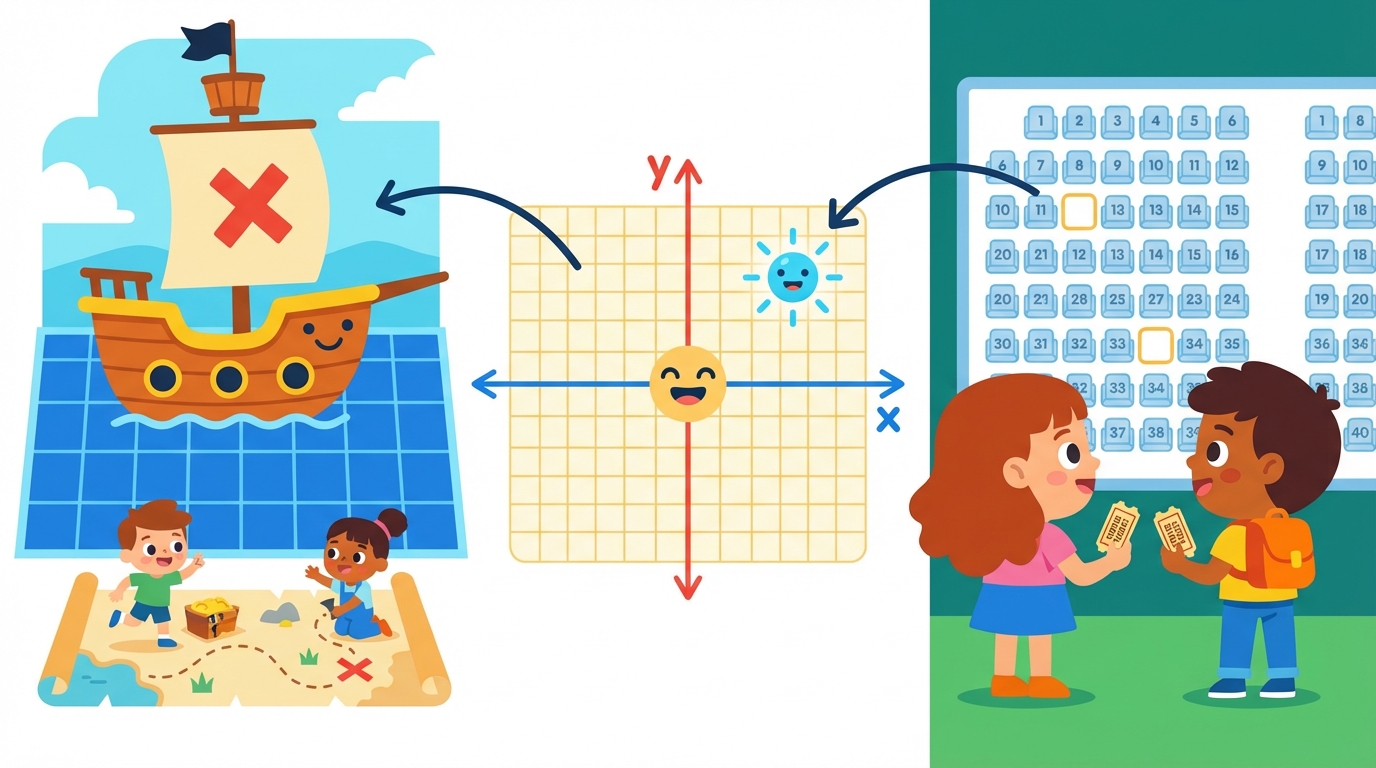
Have you ever played Battleship 🚢 or looked for a seat in a movie theater 🎬? If so, you have already used a coordinate system! To find a specific spot, you need two pieces of information: how far across and how far up or down.
🗺️ What is the Coordinate Plane?
The Coordinate Plane (also called the Cartesian Plane) is like a giant grid formed by two number lines that intersect at a right angle.
The X-Axis ↔️
The horizontal number line. It goes left and right, just like the horizon.
The Y-Axis ↕️
The vertical number line. It goes up and down, like a yo-yo!
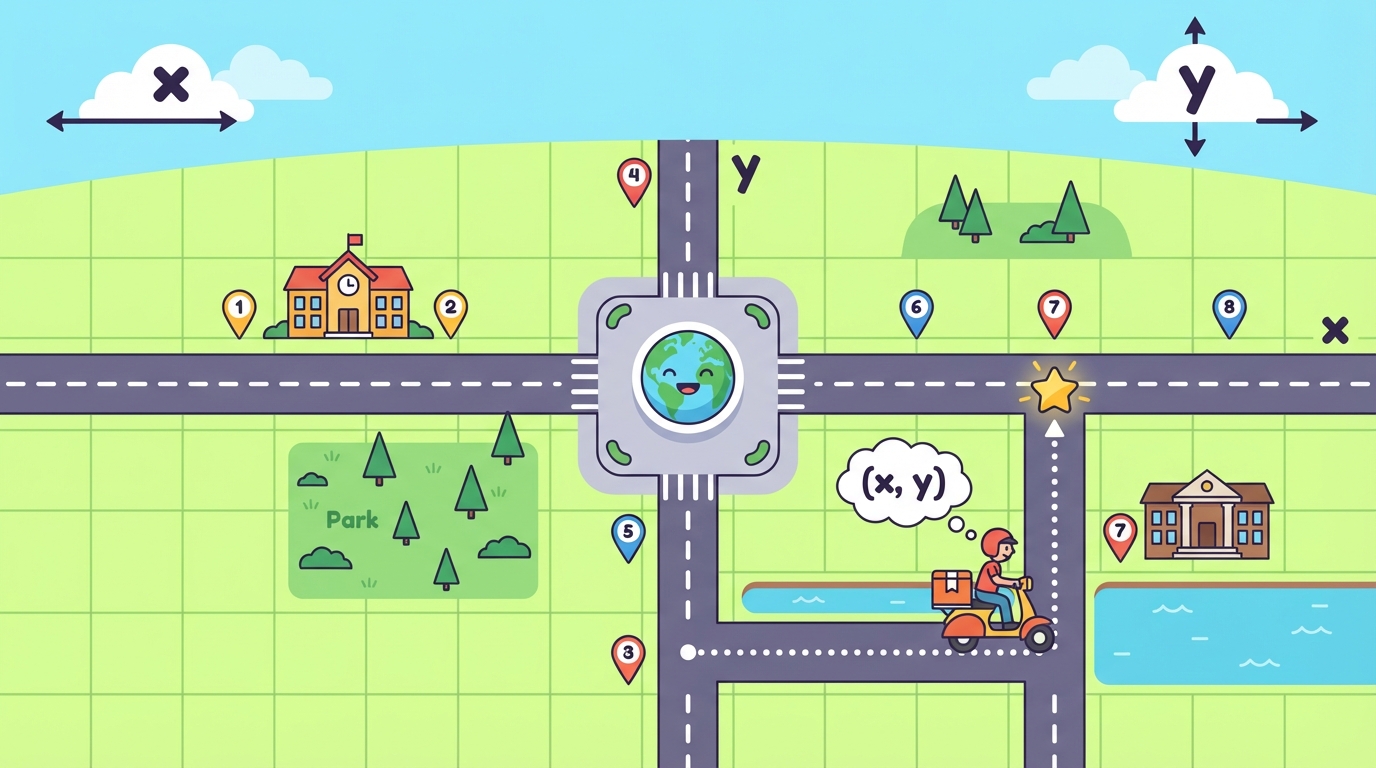
Think of the coordinate plane as a map for a city. The Origin is the town center. The X-axis is the main street going East and West, and the Y-axis is the main avenue going North and South.
Key Facts
2 The Axes and the Origin: Building the Grid

Imagine taking two ordinary number lines and crossing them so they make a perfect plus sign (+). That is how we build the Cartesian Plane! 🏗️
The X-Axis ↔️
The Horizontal Line
The line that goes left and right is called the x-axis. Think of it like the floor of a room or the horizon where the sun sets.
The Y-Axis ↕️
The Vertical Line
The line that goes up and down is called the y-axis. It stands tall like a tree or a ladder.
🎯 The Origin (0, 0)
The exact spot where the x-axis and y-axis crash into each other is called the Origin. This is the center of our map. It represents the number 0 for both lines.
It's like the town square where all streets meet!
Key Facts
3 Ordered Pairs: The Address System (x, y)
📍 What is an Ordered Pair?
Imagine the Cartesian Plane is a giant map of a city. Every specific location on this map has a unique address called an Ordered Pair.
An ordered pair looks like this: (x, y).
- The first number is the x-coordinate: How far to move left or right. ↔️
- The second number is the y-coordinate: How far to move up or down. ↕️
⚠️ Important Rule: Order Matters!
Just like putting on socks before shoes is different from shoes before socks, (2, 5) is NOT the same place as (5, 2). We call them 'ordered' pairs because the order must always be X first, then Y.
🏃♂️ The Golden Rule: Walk then Fly ✈️
Step 1: The X-Axis
Start at the center (0,0). Move along the ground (horizontal) first.
🚶'Walk to the elevator.'
Step 2: The Y-Axis
From that spot, move up or down (vertical).
🪜'Take the elevator up.'
Example: To find the point (3, 2):
- Start at zero.
- Move 3 units right along the x-axis.
- Then, move 2 units up parallel to the y-axis.
- Draw your dot! 🔴
Key Facts
4 The Four Quadrants: Positive and Negative Zones
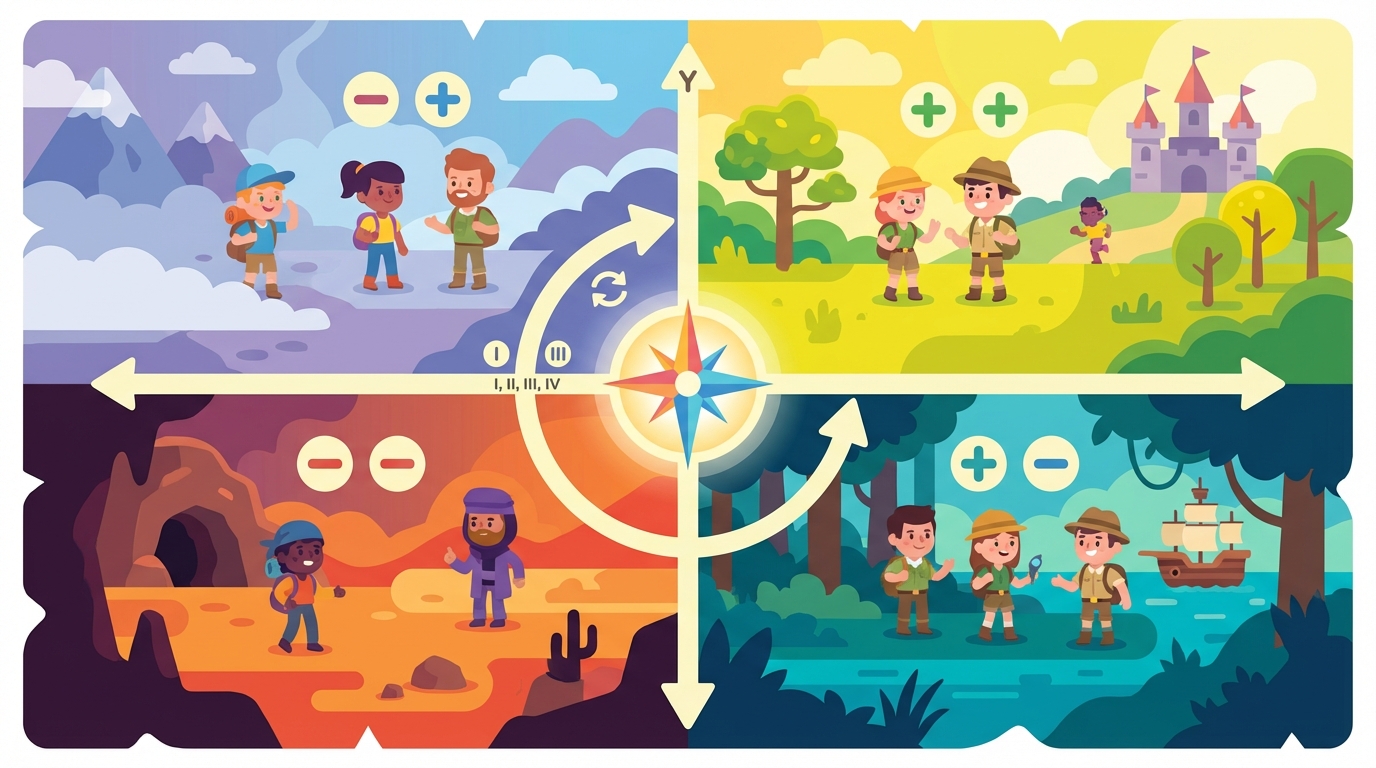
Imagine the Cartesian Plane is a giant map divided into four distinct territories. When the X and Y axes cross, they create four sections called Quadrants. 🗺️
We number the quadrants using Roman Numerals (I, II, III, IV). Here is the secret pattern:
- Start at the Top Right (Quadrant I).
- Move Counter-Clockwise (to the left).
- Trace a big letter 'C' for Cartesian!
| Quadrant | Position | Signs (x, y) |
|---|---|---|
| I | Top Right ↗️ | (+, +) |
| II | Top Left ↖️ | (-, +) |
| III | Bottom Left ↙️ | (-, -) |
| IV | Bottom Right ↘️ | (+, -) |
💡 Pro Tip: The Swimming Pool Analogy
Think of the X-axis as the water level. Quadrants I and II are in the air (Positive Y = Up). Quadrants III and IV are underwater (Negative Y = Down)! 🏊♂️
Key Facts
5 Plotting Points: Walk Then Climb (or Fall)
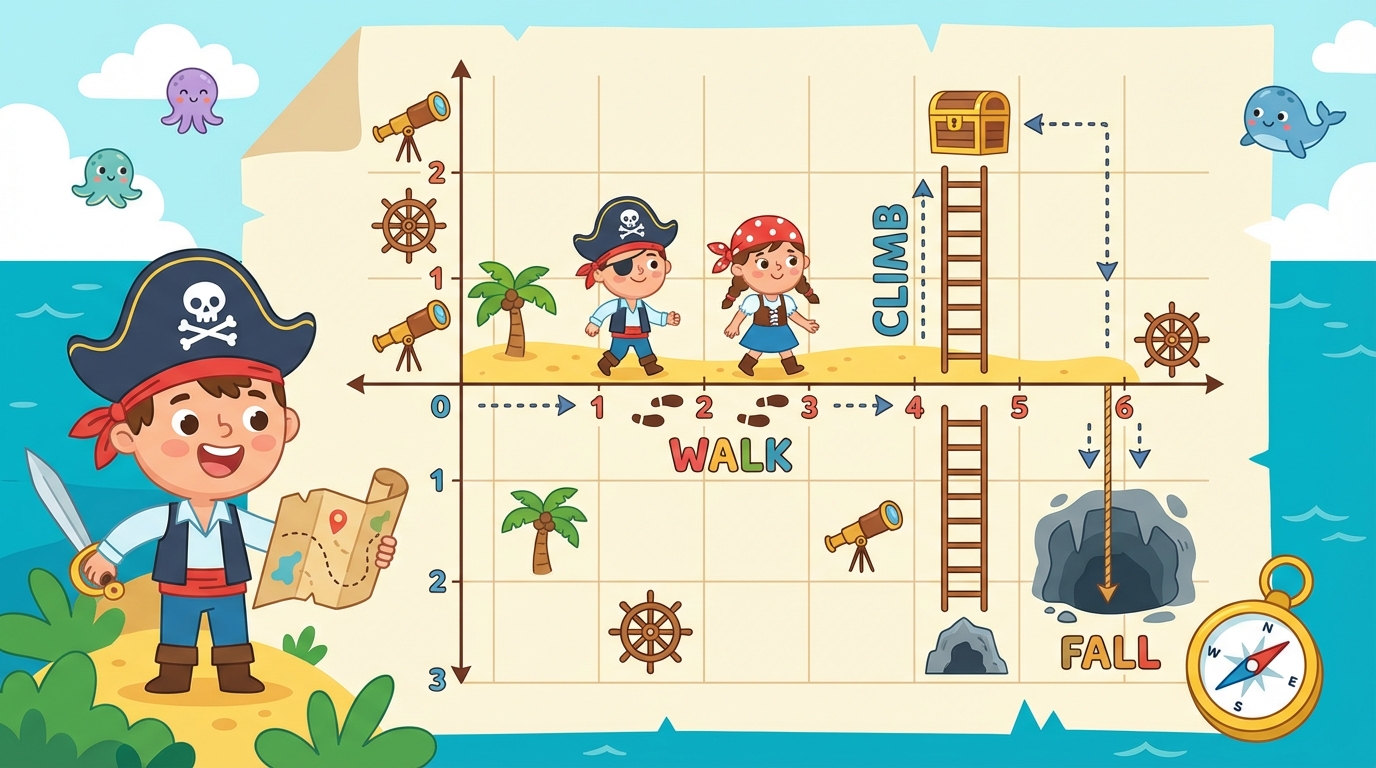
Imagine you are looking for hidden treasure on a map! 🗺️ To find the exact spot, you need specific instructions. In math, these instructions are called coordinates, written as (x, y).
The most important rule to remember is that order matters! You must always move along the horizontal line first, and the vertical line second.
- 1️⃣ Start at the Origin (0,0): Put your pencil right in the center where the lines cross.
- 2️⃣ Walk (x-axis): Move Left or Right first. Think: 'I have to walk to the building before I can go in.'
- 3️⃣ Climb or Fall (y-axis): Move Up or Down second. Think: 'Now I take the elevator up or down to my floor.'
Let's Practice!
| Point | Coordinate | Step 1: Walk (X) | Step 2: Climb/Fall (Y) |
|---|---|---|---|
| A | (4, 3) | Walk Right 4 | Climb Up 3 |
| B | (-2, -5) | Walk Left 2 | Fall Down 5 |
| C | (0, 6) | Don't Walk! | Climb Up 6 |
Key Facts
6 Identifying Coordinates of Points
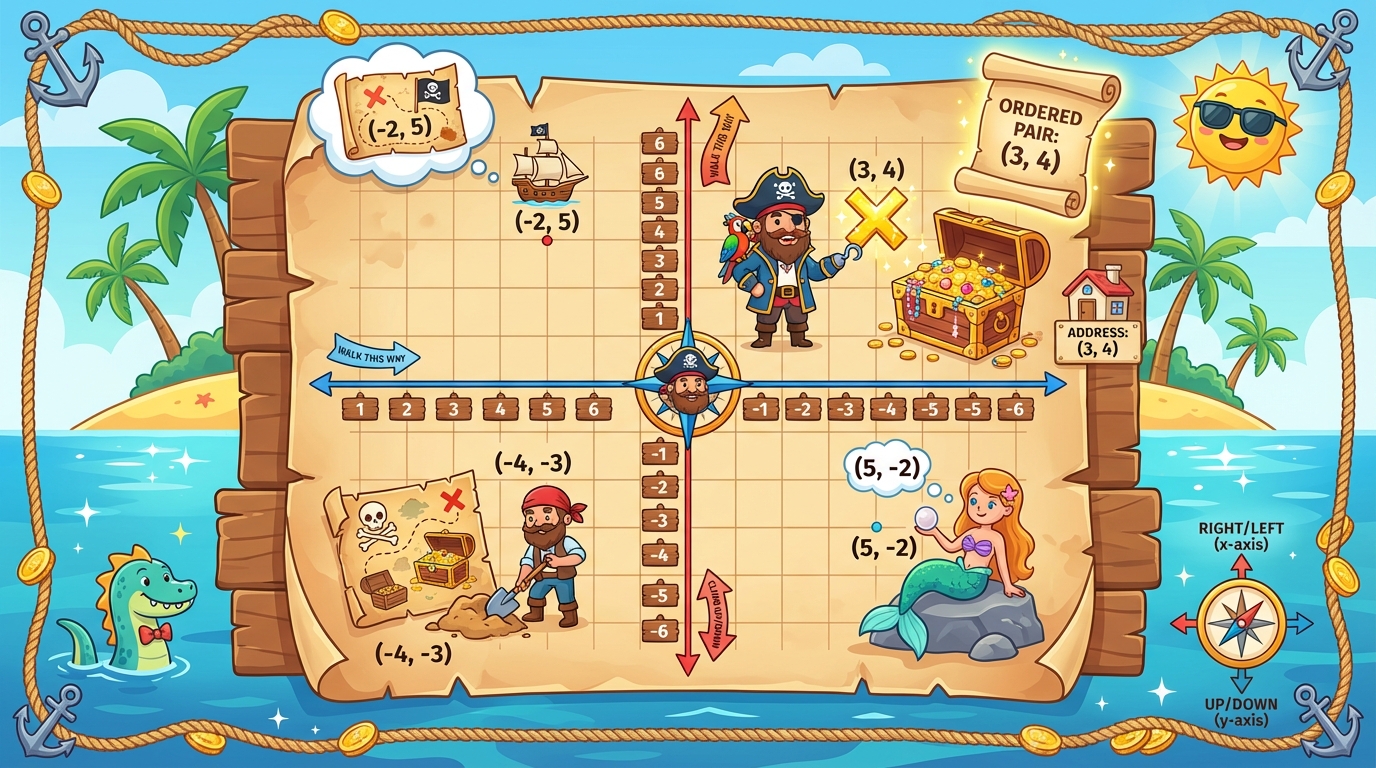
To identify where a point is located on the Cartesian Plane, imagine you are reading a Treasure Map! 🗺️ Every treasure location has a specific address called an Ordered Pair.
Coordinates are always written in alphabetical order: x comes first, then y.
- Start at the Origin (0,0): This is your starting point in the center.
- Move Horizontally (x-axis): Walk Left (negative) or Right (positive). ↔️
- Move Vertically (y-axis): Fly Up (positive) or Dig Down (negative). ↕️
Let's Practice!
| Point | Movement | Coordinate |
|---|---|---|
| A | Right 3, Up 2 | (3, 2) |
| B | Left 4, Up 1 | (-4, 1) |
| C | Left 2, Down 5 | (-2, -5) |
| D | Right 6, Down 3 | (6, -3) |
Key Facts
7 Reflecting Points Across the Axes
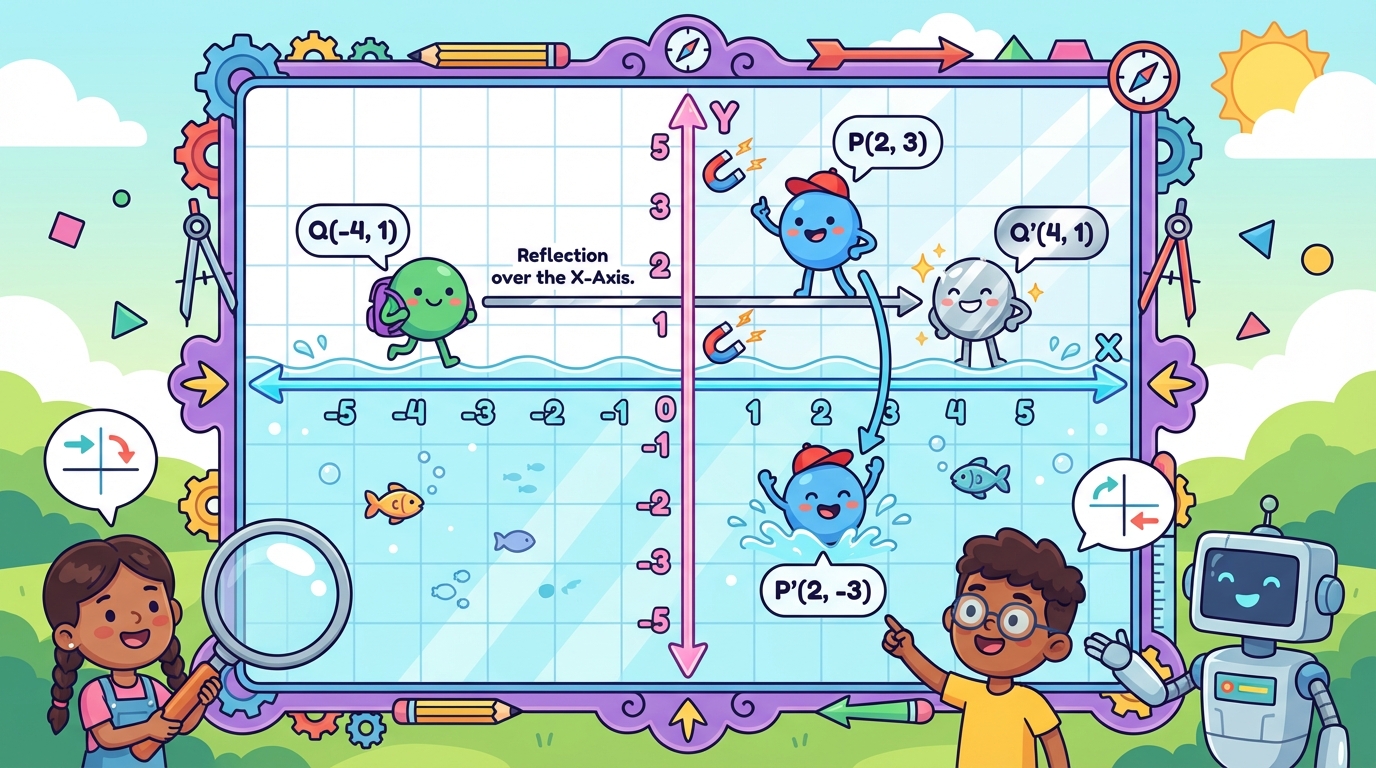
Imagine the coordinate plane is a giant mirror! 🪞 When we reflect a point, we flip it across a line (the axis) to create a mirror image.
🌊 Reflection over the X-Axis
Think of this like standing at the edge of a lake. Your reflection appears upside down in the water.
- The point moves Up or Down.
- The X-coordinate stays the same.
- The Y-coordinate changes its sign (positive becomes negative, or vice versa).
🚪 Reflection over the Y-Axis
Think of this like looking into a wall mirror. Your reflection appears across from you.
- The point moves Left or Right.
- The Y-coordinate stays the same.
- The X-coordinate changes its sign.
✨ Let's try it with Point A (3, 4)
| Action | Rule | New Coordinate |
|---|---|---|
| Reflect over X-Axis | Keep X, Flip Y | (3, -4) |
| Reflect over Y-Axis | Flip X, Keep Y | (-3, 4) |
Key Facts
8 Finding Distance: Vertical and Horizontal
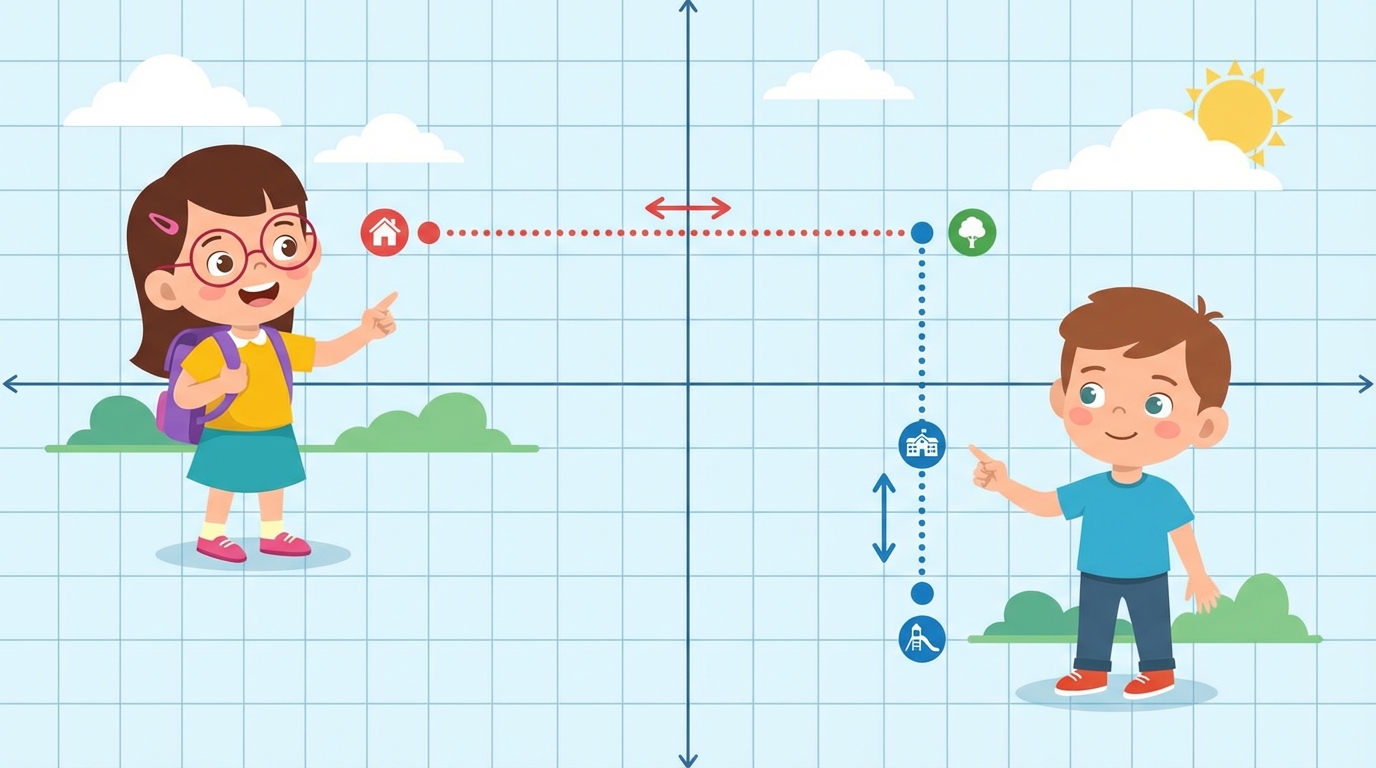
Have you ever used a map to see how far the park is from your house? 🗺️ On the coordinate plane, we can measure distance easily if the points are lined up straight!
↔️ Horizontal Distance
If two points have the same y-coordinate, the line connecting them is horizontal (left to right).
To find the distance:
- Look at the x-coordinates.
- Find the difference between them (subtract the smaller from the larger) or count the 'jumps' on the grid.
The y stays the same (5).
Distance = 6 - 2 = 4 units.
↕️ Vertical Distance
If two points have the same x-coordinate, the line connecting them is vertical (up and down).
To find the distance:
- Look at the y-coordinates.
- Find the difference between them.
The x stays the same (3).
Distance = 4 - 1 = 3 units.
🚧 Crossing the Axis?
If your points are on opposite sides of an axis (one positive, one negative), you add their absolute values (their distance from zero).
Example: From (-2, 0) to (3, 0). That is 2 steps to zero, plus 3 steps past zero = 5 units total.
Key Facts
9 Drawing Polygons on the Coordinate Plane
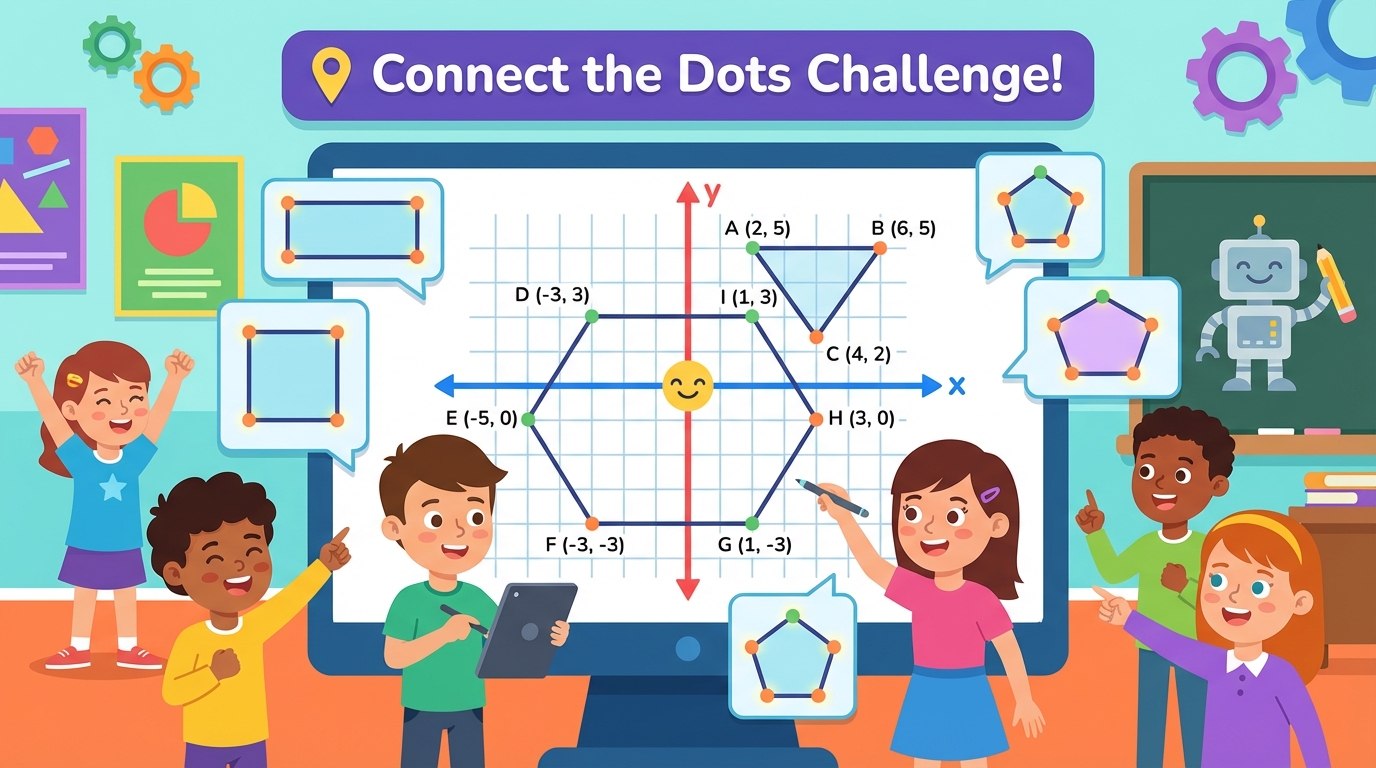
📍 Connect the Dots Challenge!
Drawing polygons on the coordinate plane is just like playing an advanced game of connect-the-dots. By plotting specific points (called vertices) and connecting them in order, we can create squares, rectangles, triangles, and even complex shapes!
- Plot the Vertices: Mark each ordered pair $(x, y)$ on the grid. These are the corners of your shape.
- Connect in Order: Draw straight lines connecting the points in the order they are listed.
- Close the Shape: Connect the very last point back to the first point to finish the polygon.
💡 Tip: Use a ruler to keep your lines straight!
Let's plot these four points to see what we get:
| Point | Coordinates |
|---|---|
| A | $(2, 2)$ |
| B | $(2, 6)$ |
| C | $(5, 6)$ |
| D | $(5, 2)$ |
If you connect A ➔ B ➔ C ➔ D ➔ A, you get a Rectangle! 🟦
📏 Measuring Side Lengths
Once your polygon is drawn, you can measure its size without a ruler! Just count the grid units.
- Vertical Side (A to B): From $y=2$ to $y=6$. The length is $4$ units.
- Horizontal Side (B to C): From $x=2$ to $x=5$. The length is $3$ units.
Key Facts
10 Key Vocabulary
Master these important terms for your exam:
| Term | Definition |
|---|---|
|
Coordinate Plane
Plano Cartesiano |
A two-dimensional surface formed by two number lines intersecting at a right angle.
Una superficie bidimensional formada por dos rectas numéricas que se cruzan en ángulo recto. |
|
X-axis
Eje X |
The horizontal number line on the coordinate plane.
La recta numérica horizontal en el plano cartesiano. |
|
Y-axis
Eje Y |
The vertical number line on the coordinate plane.
La recta numérica vertical en el plano cartesiano. |
|
Origin
Origen |
The point (0,0) where the x-axis and y-axis intersect.
El punto (0,0) donde se cruzan el eje X y el eje Y. |
|
Ordered Pair
Par Ordenado |
A pair of numbers (x, y) used to locate a point on the coordinate plane.
Un par de números (x, y) usado para ubicar un punto en el plano cartesiano. |
|
Coordinates
Coordenadas |
The values in an ordered pair that identify the position of a point.
Los valores en un par ordenado que identifican la posición de un punto. |
|
X-coordinate
Coordenada X |
The first number in an ordered pair; it tells how far to move left or right.
El primer número en un par ordenado; indica cuánto moverse a la izquierda o derecha. |
|
Y-coordinate
Coordenada Y |
The second number in an ordered pair; it tells how far to move up or down.
El segundo número en un par ordenado; indica cuánto moverse hacia arriba o abajo. |
|
Quadrant
Cuadrante |
One of the four regions created by the intersection of the x-axis and y-axis.
Una de las cuatro regiones creadas por la intersección del eje X y el eje Y. |
|
Intersect
Intersecar |
To cross or meet at a common point.
Cruzar o encontrarse en un punto común. |
|
Horizontal
Horizontal |
Going from side to side, like the horizon.
Que va de lado a lado, como el horizonte. |
|
Vertical
Vertical |
Going straight up and down.
Que va directamente hacia arriba y hacia abajo. |
|
Plot
Graficar / Ubicar |
To locate and mark a point on the coordinate plane.
Localizar y marcar un punto en el plano cartesiano. |
|
Scale
Escala |
The distance between the marks on the number lines (axes).
La distancia entre las marcas en las rectas numéricas (ejes). |
|
Integer
Entero |
A whole number that can be positive, negative, or zero.
Un número completo que puede ser positivo, negativo o cero. |
Time to Practice!
There are 7 questions waiting for you. Questions are shuffled each attempt.
Take the Quiz