Distributive, Associative, and Commutative Properties
Learn the fundamental rules of arithmetic that allow you to rearrange, group, and distribute numbers to simplify expressions and solve problems easily.
1 Introduction to Properties: The Rules of Math
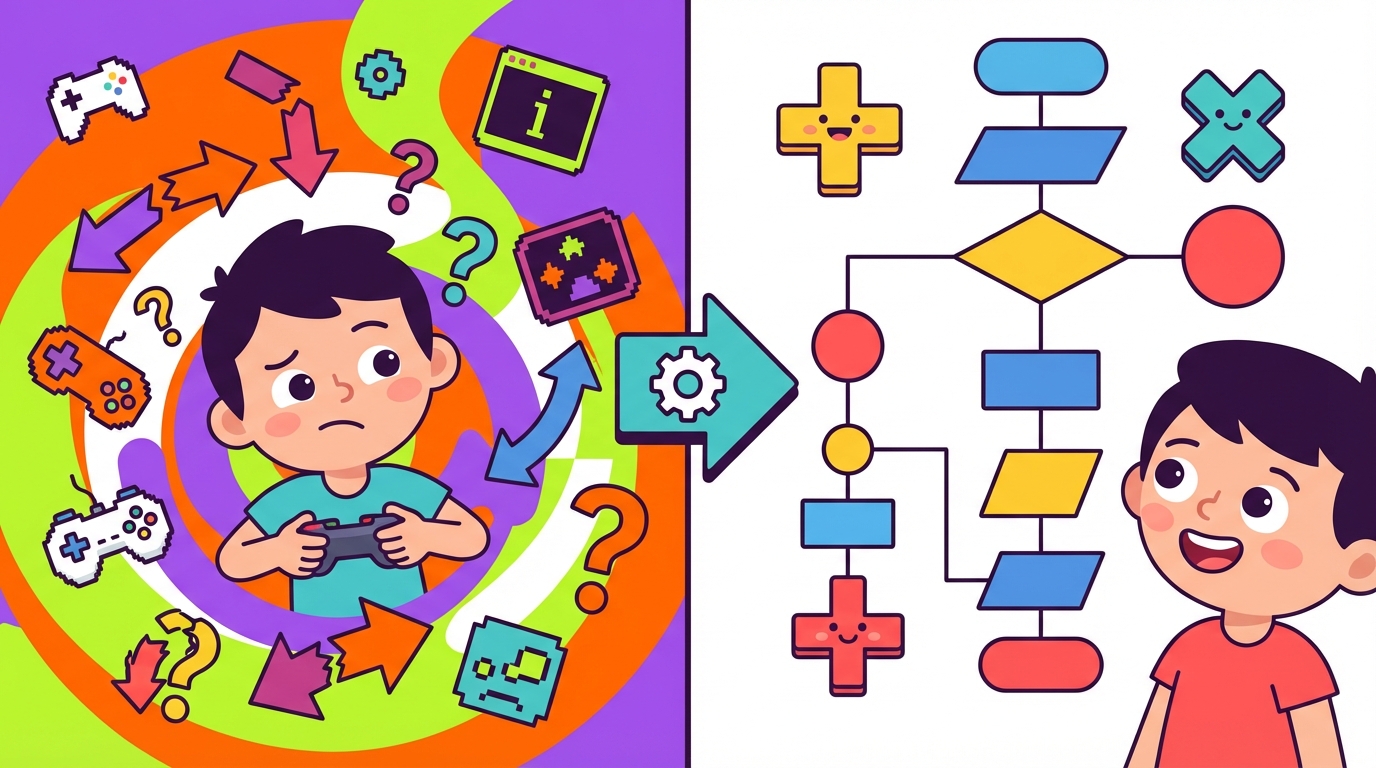
Why do we need rules? 🎮
Imagine playing a video game where the controls change every time you press a button. It would be chaos! Just like games have rules to make them fair and fun, mathematics has Properties. These are the universal laws that numbers follow.
Properties help us simplify complex problems and do mental math like a wizard! 🧙♂️ In 6th grade, we focus on three superpowers:
Think 'Commute' (move around).
Changing the order of numbers doesn't change the answer in addition or multiplication.
Think 'Associate' (group of friends).
Changing how we group numbers with parentheses doesn't change the result.
Think 'Distribute' (share).
Multiplying a number by a group is the same as doing each part separately.
🌟 Real Life Example: The Lunchbox
Imagine packing a lunch. Does it matter if you put the apple in before the sandwich? No! (That's the Commutative Property). If you pack a lunch for yourself and one for your friend, and you put a cookie in each bag, you are distributing the cookies!
Key Facts
2 The Commutative Property: Changing Order
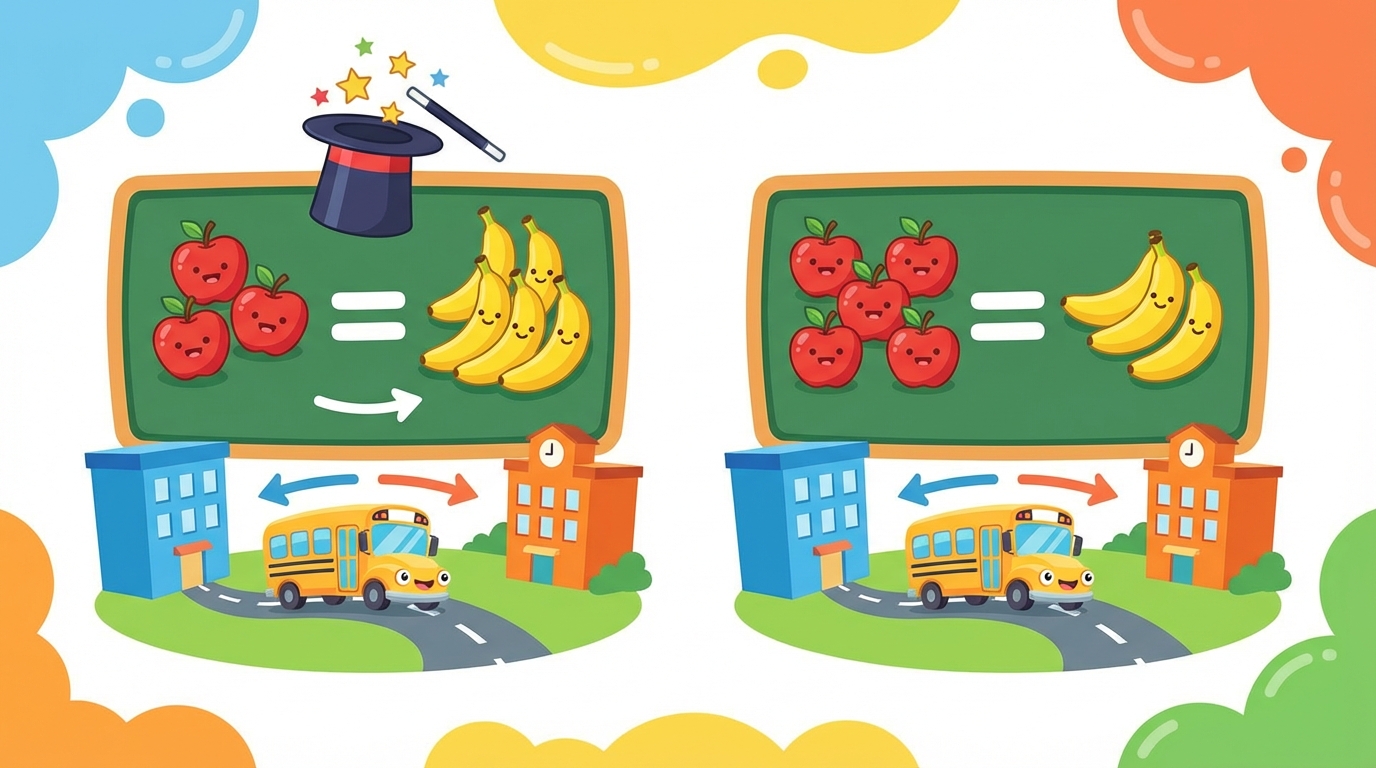
Have you ever noticed that 5 + 3 gives you the same answer as 3 + 5? That isn't magic—it's math! 🎩✨ This rule is called the Commutative Property.
🚌 The 'Commute' Connection
Think of the word commute. It means to travel or move around (like commuting to school). In math, the Commutative Property says you can move numbers around, and the answer stays the same!
It Works for Addition & Multiplication! ➕✖️
Addition
4 + 2 = 6
2 + 4 = 6
The sum is the same!
Multiplication
3 × 5 = 15
5 × 3 = 15
The product is the same!
🛑 STOP! Watch Out!
The Commutative Property DOES NOT work for Subtraction (➖) or Division (➗).
Example: 10 - 2 = 8, but 2 - 10 = -8. Totally different answers!
Real Life Example: The Smoothie 🥤
Imagine making a fruit smoothie. Whether you put the strawberries in the blender first and then the bananas, or the bananas first and then the strawberries, the smoothie tastes exactly the same! That is the Commutative Property in action.
Key Facts
3 The Associative Property: Changing Groups
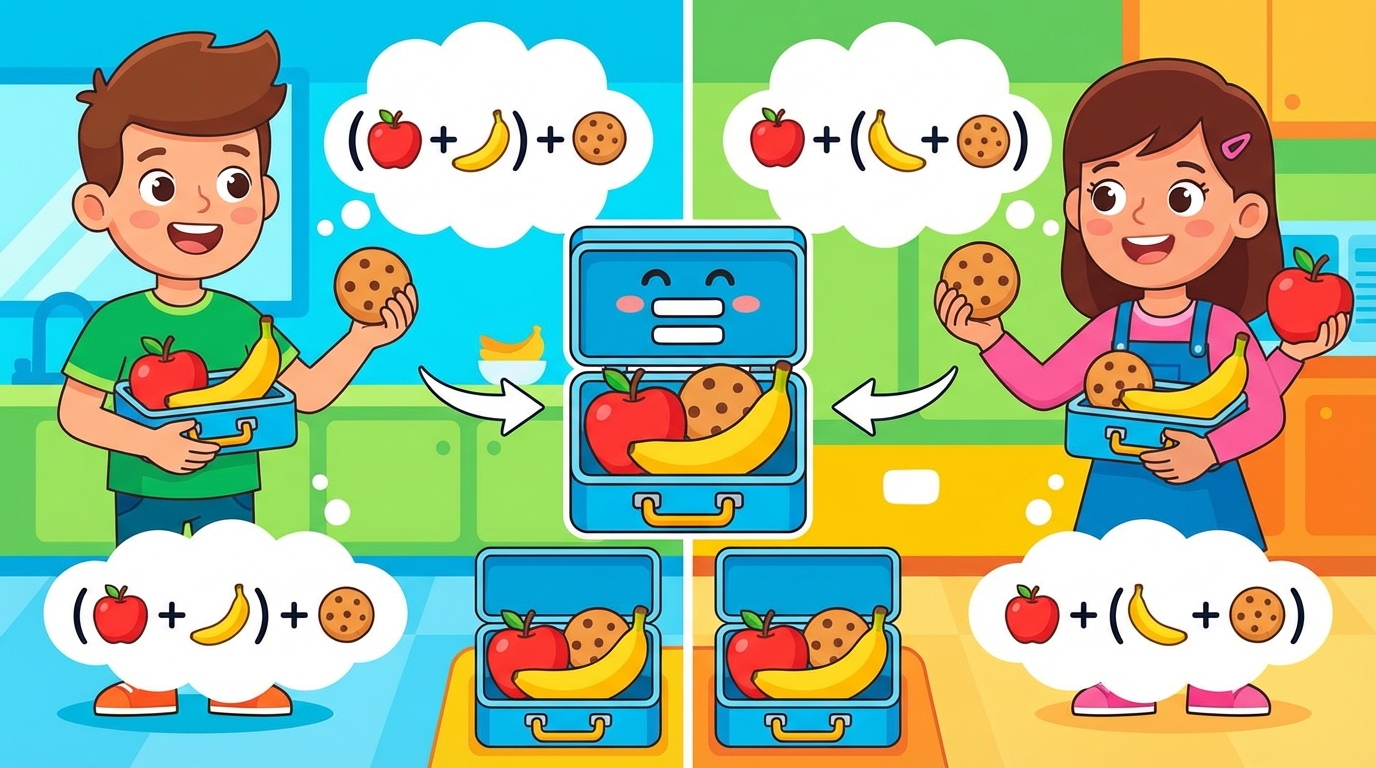
Imagine you are packing a lunchbox with an 🍎 Apple, a 🍌 Banana, and a 🍪 Cookie. Does it matter if you pack the Apple and Banana first, then the Cookie? Or if you pack the Apple first, then the Banana and Cookie together? No! The lunchbox still has the same three snacks. That is the Associative Property!
The Rule of Grouping ( )
The word Associative comes from associate, which means to group together. In math, this property says that when adding or multiplying, changing which numbers are grouped in parentheses does not change the answer.
➕ Addition Example
Let's add 2 + 3 + 4.
| Group First: | (2 + 3) + 4 = 5 + 4 = 9 |
| Group Last: | 2 + (3 + 4) = 2 + 7 = 9 |
The sum is the same! ✅
✖️ Multiplication Example
Let's multiply 2 × 3 × 4.
| Group First: | (2 × 3) × 4 = 6 × 4 = 24 |
| Group Last: | 2 × (3 × 4) = 2 × 12 = 24 |
The product is the same! ✅
Example: (10 - 5) - 2 = 3, but 10 - (5 - 2) = 7. They are not equal!
Key Facts
4 Commutative vs. Associative: Spotting the Difference
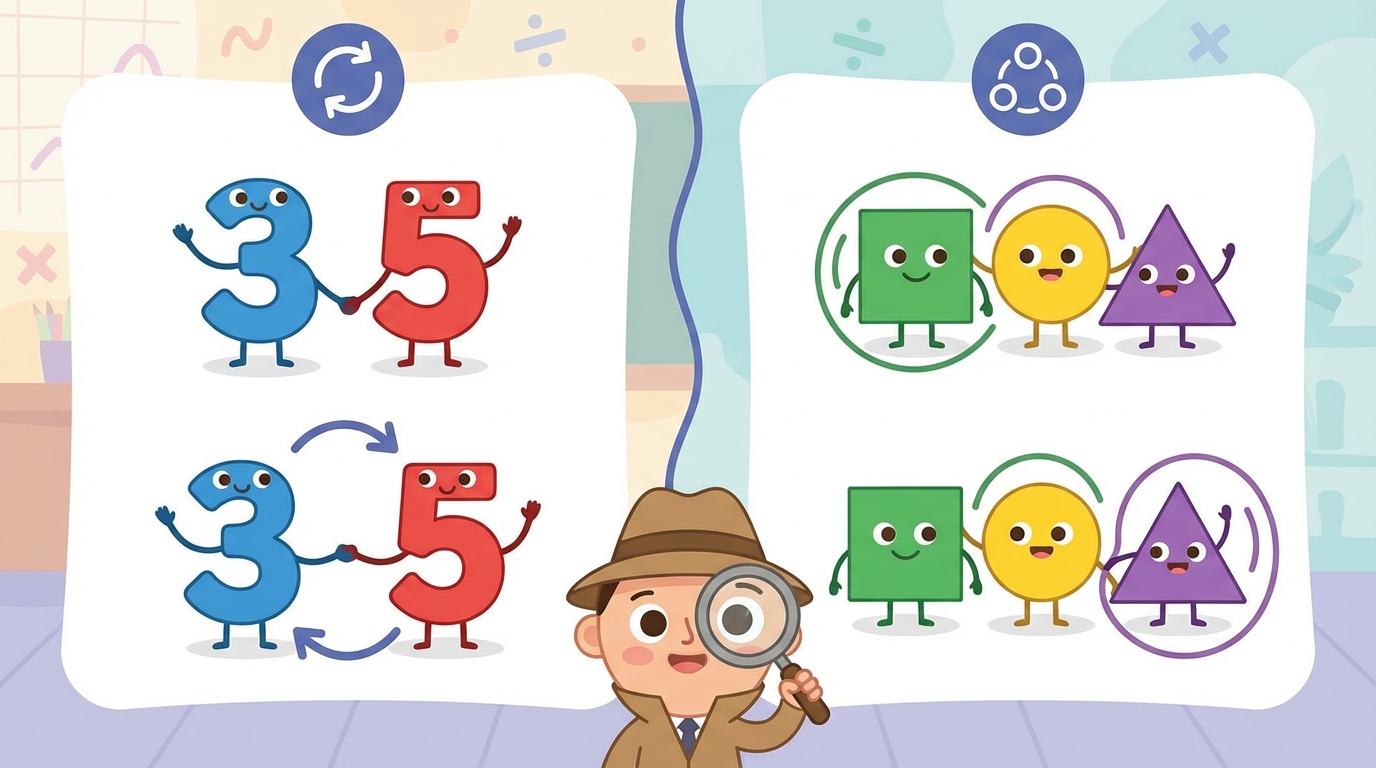
Have you ever confused these two properties? It happens to the best of us! Let's become Math Detectives 🕵️♀️ and learn exactly what to look for to tell them apart.
It's all about ORDER
Think of the word Commute (to travel or move). Here, the numbers actually move and swap places.
2 + 5 = 5 + 2
The numbers swapped spots!
It's all about GROUPS
Think of the word Associate (who you hang out with). The numbers stay in line, but the parentheses move to group different numbers.
(2 + 5) + 3 = 2 + (5 + 3)
The numbers didn't move, only the parentheses did!
The Ultimate Cheat Sheet 📝
| Feature | Commutative 🔄 | Associative 🤝 |
|---|---|---|
| What changes? | The Order of numbers | The Grouping (Parentheses) |
| How many numbers? | Usually 2 numbers | Usually 3 or more numbers |
| The Rule | Swap spots! | Shift parentheses! |
Key Facts
5 The Identity Properties: Zero and One
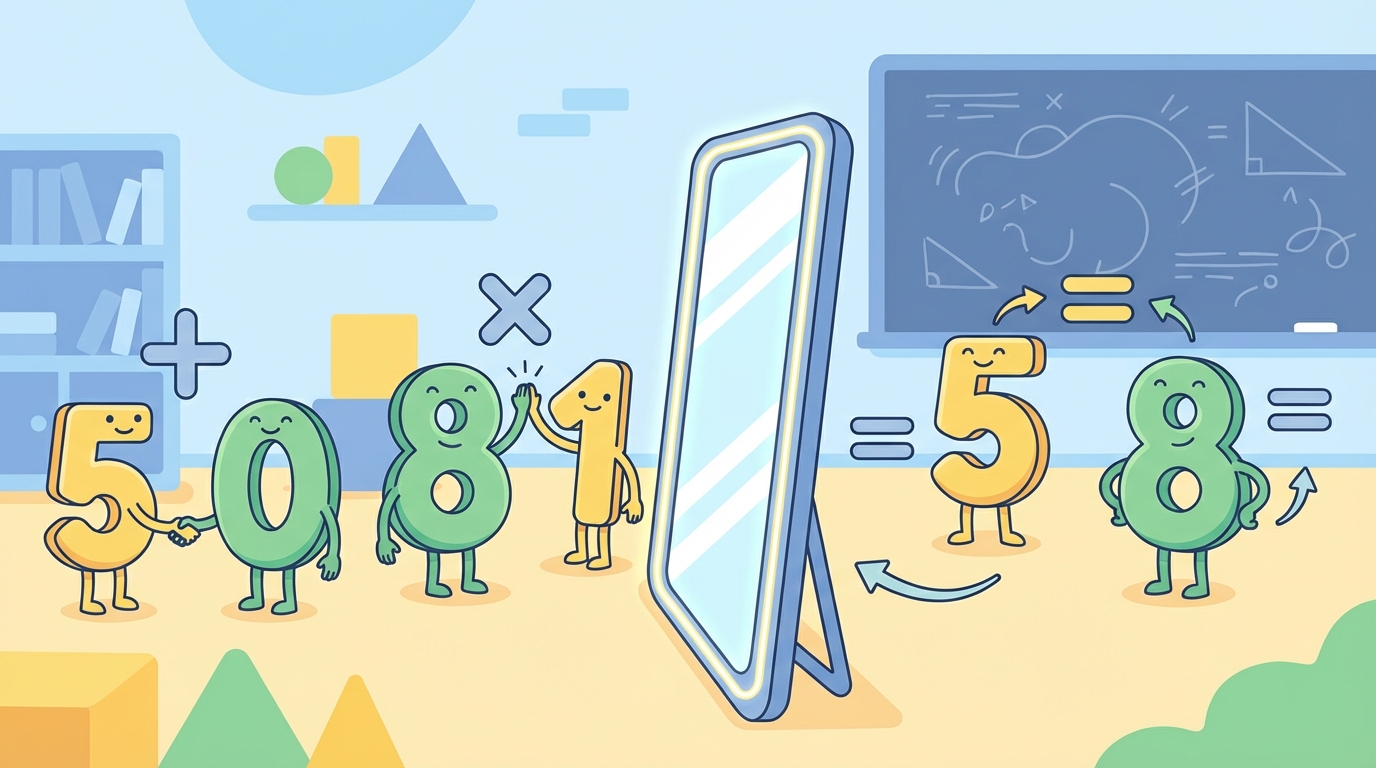
🪞 The Mirror Effect!
Think of the word Identity. Your identity is who you are. In math, the Identity Property is like a mirror: it allows a number to stay exactly the same!
The Additive Identity is the number 0.
When you add zero to any number, the sum is that number. It doesn't change!
a + 0 = a
- 7 + 0 = 7
- 1,000 + 0 = 1,000
Example: You scored 5 goals in the first half and 0 in the second. Your total is still 5! ⚽
The Multiplicative Identity is the number 1.
When you multiply any number by one, the product is that number. It stays its true self!
a × 1 = a
- 9 × 1 = 9
- 345 × 1 = 345
Example: You buy 1 bag of 12 cookies. You have exactly 12 cookies. 🍪
🤔 Why is this important?
Knowing these properties helps us solve algebra equations quickly. If you see y + 0, you instantly know it is just y!
Key Facts
6 The Distributive Property: Breaking Numbers Apart
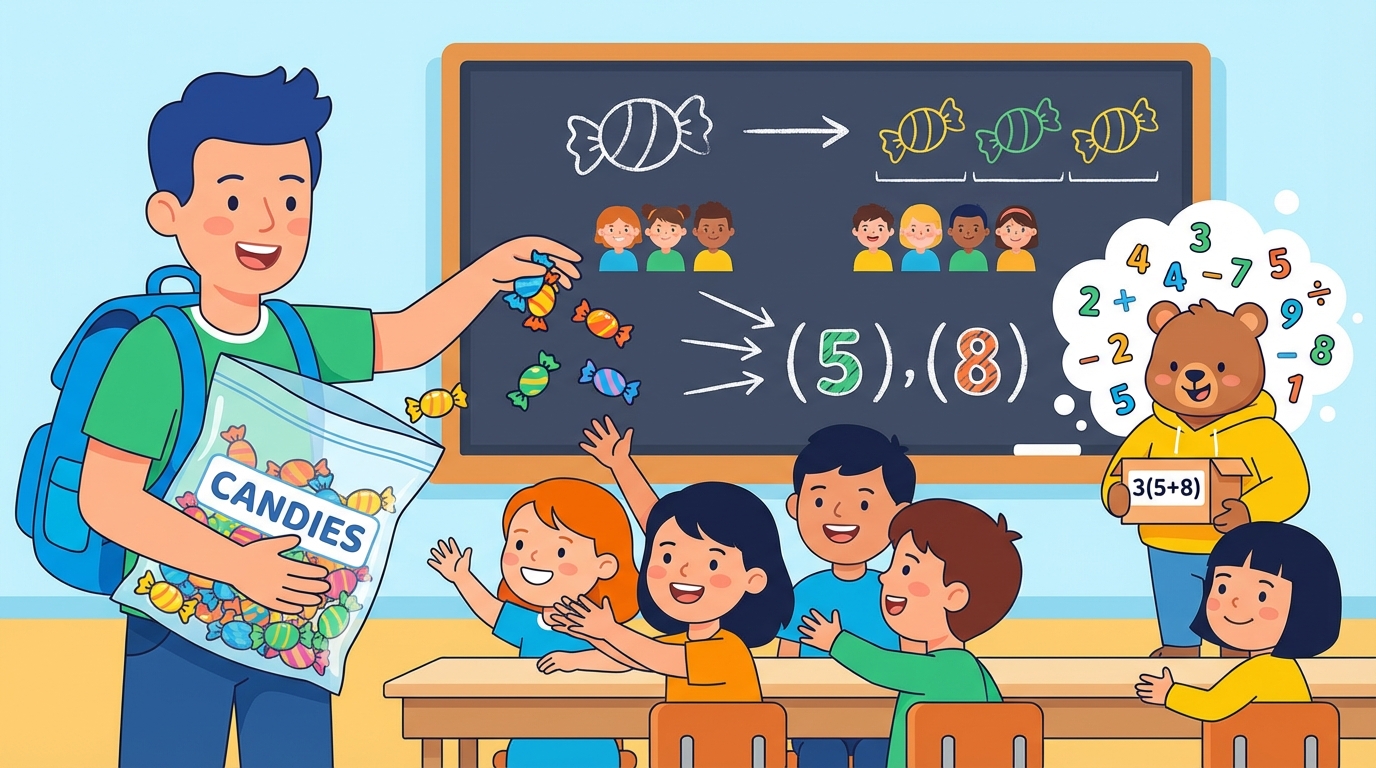
Imagine you have a bag of candy 🍬 and you want to give one to everyone in the room. You have to distribute it, right? In math, the Distributive Property works the same way!
💥 The Golden Rule
To multiply a number by a sum, you can multiply the number by each addend separately and then add the products.
a(b + c) = ab + ac
This property is a superpower for doing mental math. Let's solve 6 × 14 without a calculator.
- Break 14 apart: 10 + 4
- Distribute the 6 to both parts:
6 × (10 + 4) - Multiply: (6 × 10) + (6 × 4)
- Add them up: 60 + 24 = 84
Think of it as finding the area of a large rectangle by splitting it into two smaller ones.
| 4 | 10 | 2 |
| 4 × 10 = 40 | 4 × 2 = 8 |
Total Area: 40 + 8 = 48
Whether you are splitting up rectangle areas or breaking down big numbers in your head, the Distributive Property lets you conquer difficult multiplication problems by breaking them into bite-sized pieces! 🍰
Key Facts
7 Using the Distributive Property with Variables
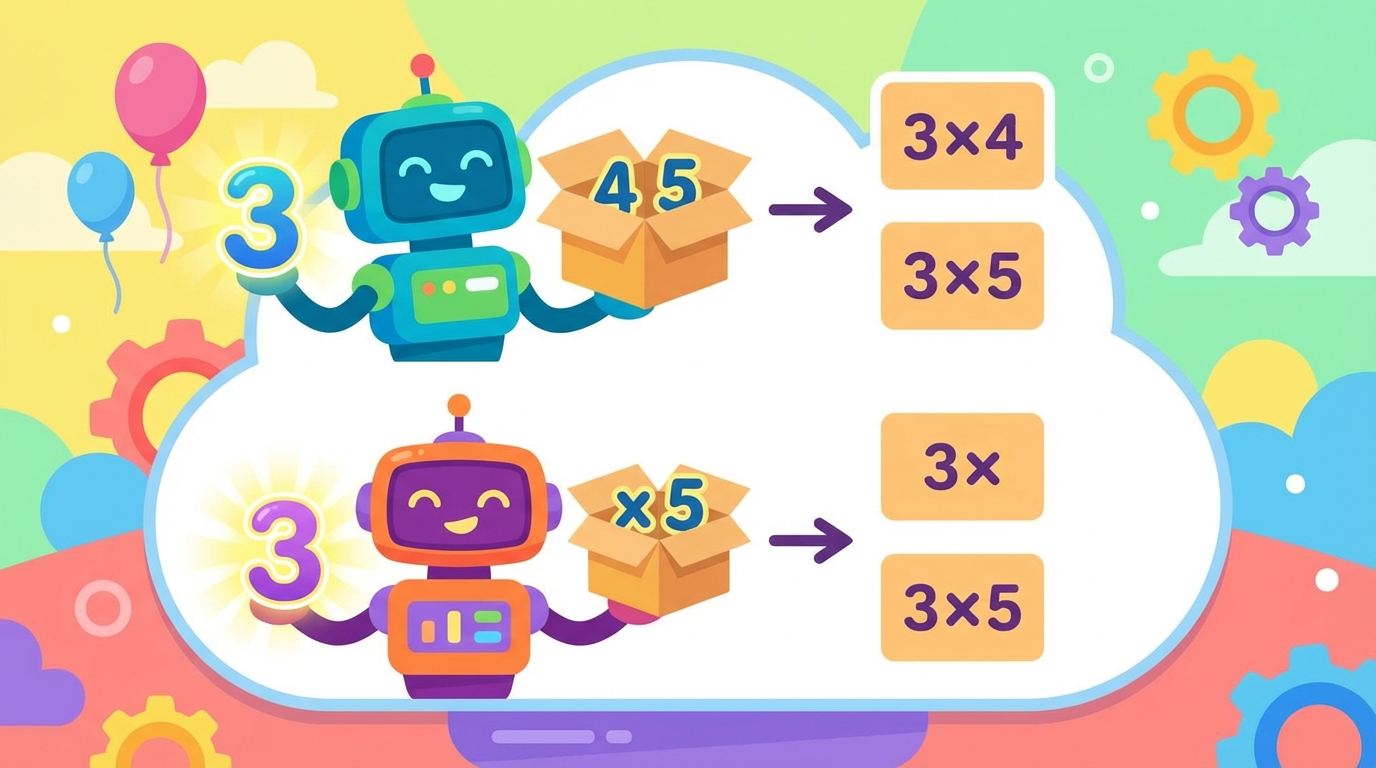
🚀 The Algebra Upgrade
You already know how to distribute numbers, like 3(4 + 5). But what happens when we invite a variable, like x, to the party?
Good news: The rule stays exactly the same! You still multiply the number outside the parentheses by everything inside.
🍔 The Combo Meal Analogy
Imagine a combo meal has 1 Burger (b) and 1 Fry (f).
If you buy 3 combo meals, what do you have?
- Math: 3(b + f)
- Result: 3b + 3f
You have 3 Burgers and 3 Fries!
⚠️ Common Mistake
Don't stop halfway! A common error is forgetting to multiply the second part.
Wrong: 4(x + 3) = 4x + 3
Right: 4(x + 3) = 4x + 12
You must distribute the 4 to the x AND the 3!| Expression | Step 1: Distribute | Step 2: Simplify |
|---|---|---|
| 5(x + 6) | (5 • x) + (5 • 6) | 5x + 30 |
| 2(3y - 4) | (2 • 3y) - (2 • 4) | 6y - 8 |
Key Facts
8 Factoring: The Distributive Property in Reverse
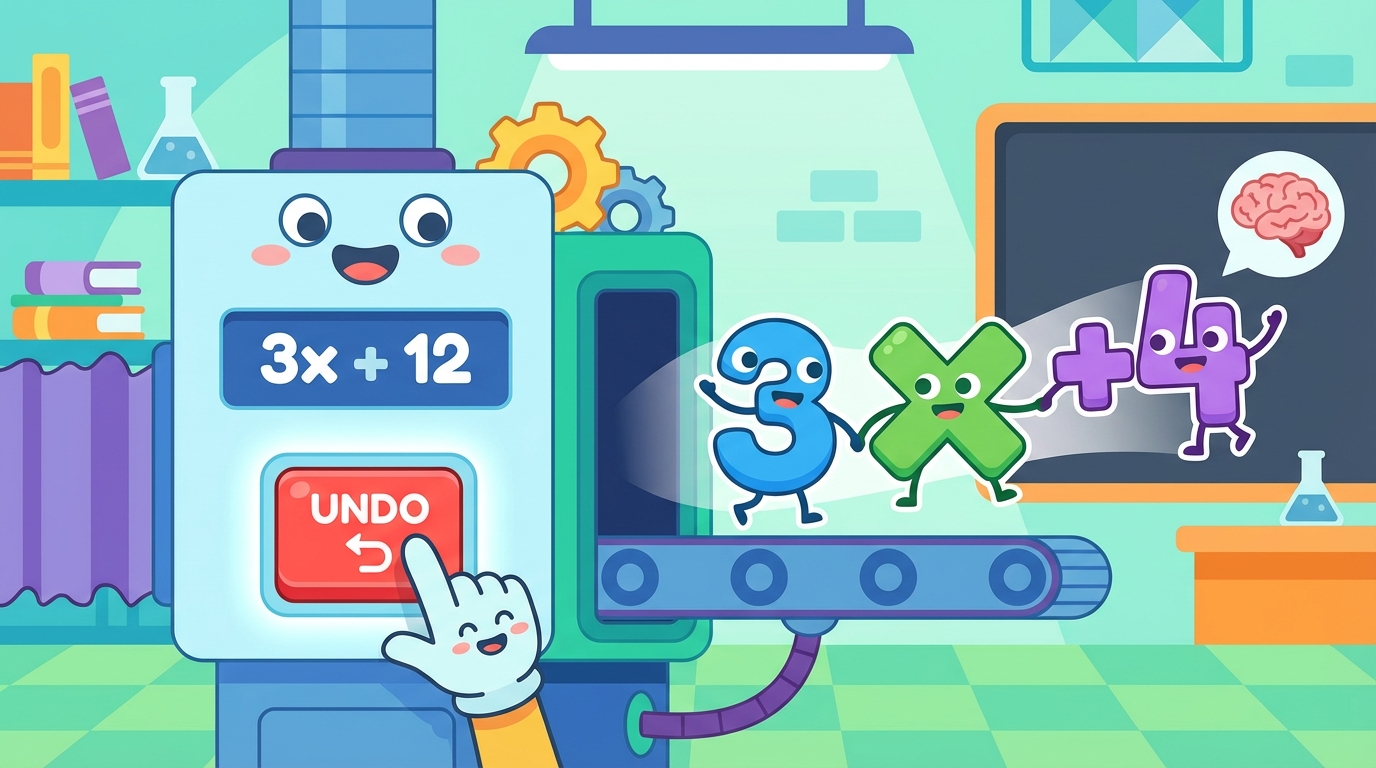
Have you ever wished real life had an 'Undo' button? ↩️ In algebra, Factoring is exactly that! It is the process of taking an expression and breaking it back down into its multiplication parts.
Multiplying a number into the parenthesis.
3(2x + 4) = 6x + 12
We put the 3 inside.
Pulling the common number out of the terms.
6x + 12 = 3(2x + 4)
We take the 3 out.
How to Factor in 2 Steps:
- Find the GCF (Greatest Common Factor): Look at the numbers. What is the biggest number that divides evenly into both?
Example: For10x + 15, the biggest number that fits into 10 and 15 is 5. - Divide and Rewrite: Write the GCF outside, and the leftovers inside the parenthesis.
Example:10x ÷ 5 = 2xand15 ÷ 5 = 3. So, we write 5(2x + 3).
12b + 8c = 4(3b + 2c)Key Facts
9 Identifying Equivalent Expressions
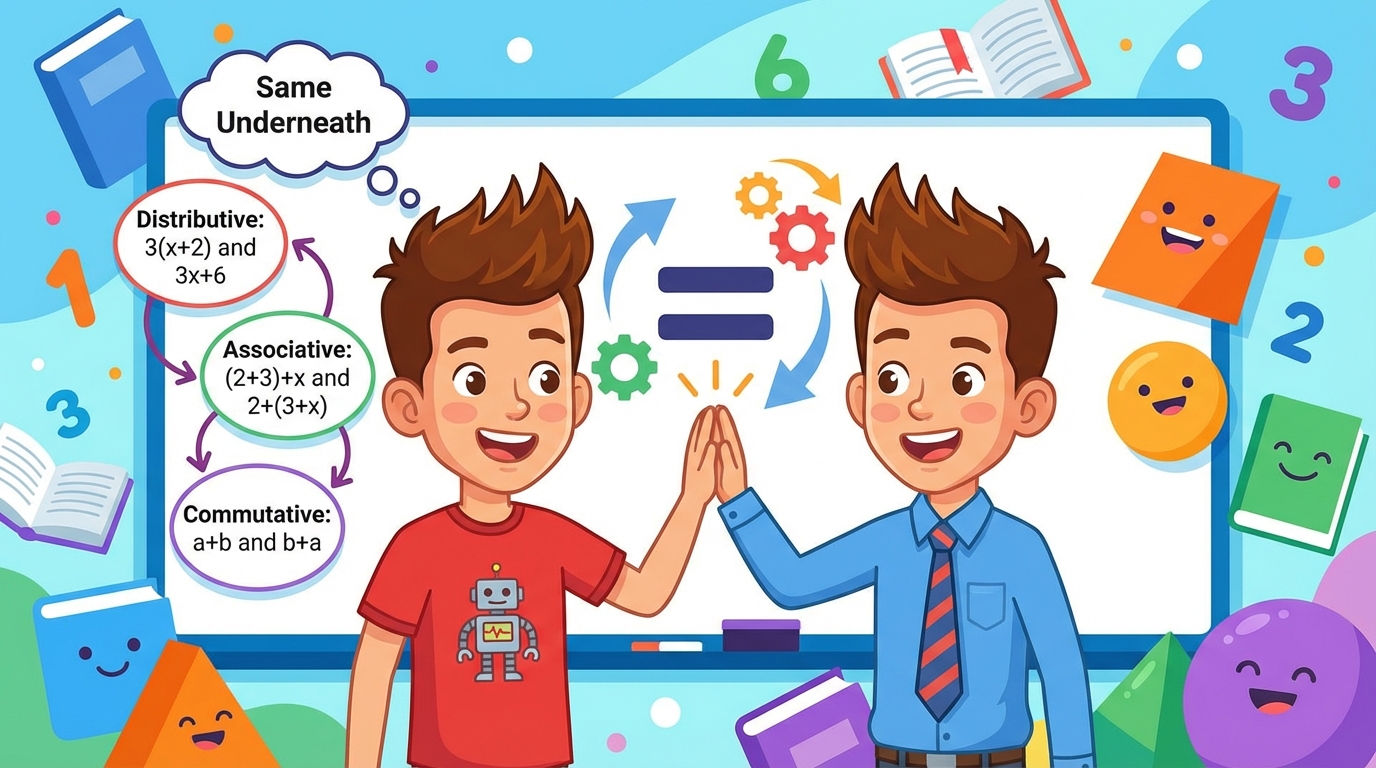
Have you ever seen identical twins wearing different clothes? 👕👔 They look different on the outside, but they are the same person underneath! Equivalent expressions are just like that.
What are Equivalent Expressions? 🤔
Two algebraic expressions are equivalent if they have the same value for every number you plug into the variable. They might look different, but they do the same math job!
Expression A: x + x + x
Expression B: 3x
These are equivalent because adding something three times is the same as multiplying it by 3!
How to be an Expression Detective 🕵️♀️
Method 1: Use Properties 🛠️
We can use the properties we learned (Distributive, Commutative, Associative) to rewrite expressions.
- Problem: Is
2(b + 3)equivalent to2b + 6? - Apply Distributive Property: Multiply the 2 by both terms inside.
2 × b = 2b
2 × 3 = 6- Result:
2b + 6matches! They are equivalent. ✅
Method 2: Substitution Test 🔢
Pick a random number for the variable and solve both sides.
- Let's test:
b = 4 - Expression 1: 2(4 + 3) = 2(7) = 14
- Expression 2: 2(4) + 6 = 8 + 6 = 14
- Conclusion: Since 14 = 14, they are likely equivalent! 🎉
Key Facts
10 Key Vocabulary
Master these important terms for your exam:
| Term | Definition |
|---|---|
|
Commutative Property
Propiedad conmutativa |
The rule that states the order in which numbers are added or multiplied does not change the sum or product (e.g., a + b = b + a).
La regla que establece que el orden en que se suman o multiplican los números no cambia la suma o el producto (ej. a + b = b + a). |
|
Associative Property
Propiedad asociativa |
The rule that states the way numbers are grouped in addition or multiplication does not change the result (e.g., (a + b) + c = a + (b + c)).
La regla que establece que la forma en que se agrupan los números en la suma o multiplicación no cambia el resultado (ej. (a + b) + c = a + (b + c)). |
|
Distributive Property
Propiedad distributiva |
The rule stating that multiplying a number by a sum is the same as multiplying the number by each addend and then adding the products (e.g., a(b + c) = ab + ac).
La regla que establece que multiplicar un número por una suma es lo mismo que multiplicar el número por cada sumando y luego sumar los productos (ej. a(b + c) = ab + ac). |
|
Equivalent Expressions
Expresiones equivalentes |
Expressions that have the same value regardless of the value of the variable.
Expresiones que tienen el mismo valor independientemente del valor de la variable. |
|
Variable
Variable |
A letter or symbol used to represent a number that can change.
Una letra o símbolo que se usa para representar un número que puede cambiar. |
|
Coefficient
Coeficiente |
The numerical factor of a term that contains a variable (the number in front of the letter).
El factor numérico de un término que contiene una variable (el número delante de la letra). |
|
Constant
Constante |
A term that has a specific value and does not contain a variable.
Un término que tiene un valor específico y no contiene una variable. |
|
Term
Término |
A single number, variable, or the product of numbers and variables separated by plus or minus signs in an expression.
Un solo número, variable o el producto de números y variables separados por signos de más o menos en una expresión. |
|
Factor
Factor |
A number or expression that is multiplied by another number or expression.
Un número o expresión que se multiplica por otro número o expresión. |
|
Product
Producto |
The answer to a multiplication problem.
La respuesta a un problema de multiplicación. |
|
Sum
Suma |
The answer to an addition problem.
La respuesta a un problema de adición. |
|
Identity Property of Addition
Propiedad de identidad de la suma |
The rule that states the sum of any number and zero is that number.
La regla que establece que la suma de cualquier número y cero es ese mismo número. |
|
Identity Property of Multiplication
Propiedad de identidad de la multiplicación |
The rule that states the product of any number and one is that number.
La regla que establece que el producto de cualquier número y uno es ese mismo número. |
|
Simplify
Simplificar |
To write an expression in its simplest form by combining like terms.
Escribir una expresión en su forma más simple combinando términos semejantes. |
|
Like Terms
Términos semejantes |
Terms that contain the same variables raised to the same power.
Términos que contienen las mismas variables elevadas a la misma potencia. |
Time to Practice!
There are 7 questions waiting for you. Questions are shuffled each attempt.
Take the Quiz