Greatest Common Divisor
Learn how to find the largest number that divides two or more numbers using listing, prime factorization, and real-world applications.
1 Reviewing Factors: The Building Blocks of Numbers
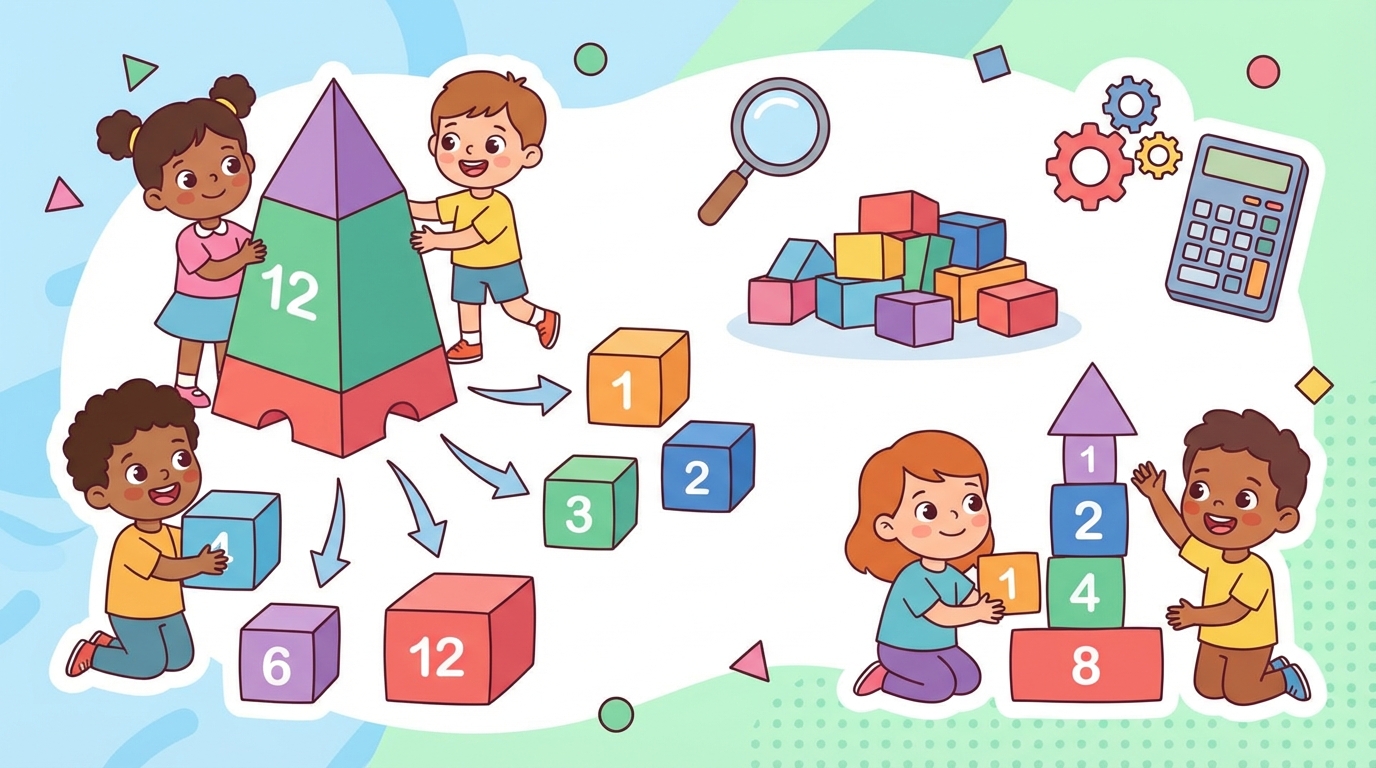
🧱 What are Factors?
Imagine numbers are like LEGO structures. Factors are the individual bricks used to build them!
For example, let's look at the number 12. We can make 12 by multiplying specific pairs of numbers:
So, the factors of 12 are: 1, 2, 3, 4, 6, and 12.
🍕 Real Life Example: The Pizza Party
Imagine you have 20 slices of pizza to share. You want to arrange them on plates so that every plate has the exact same number of slices.
| Number of Plates (Factor) | Slices per Plate (Factor) | Does it work? |
|---|---|---|
| 1 Plate | 20 Slices | ✅ Yes |
| 2 Plates | 10 Slices | ✅ Yes |
| 3 Plates | 6.66... Slices | ❌ No (Messy!) |
| 4 Plates | 5 Slices | ✅ Yes |
| 5 Plates | 4 Slices | ✅ Yes |
The numbers that work (1, 2, 4, 5, 10, 20) are the factors of 20!
Key Facts
2 Finding Common Ground: What are Common Factors?
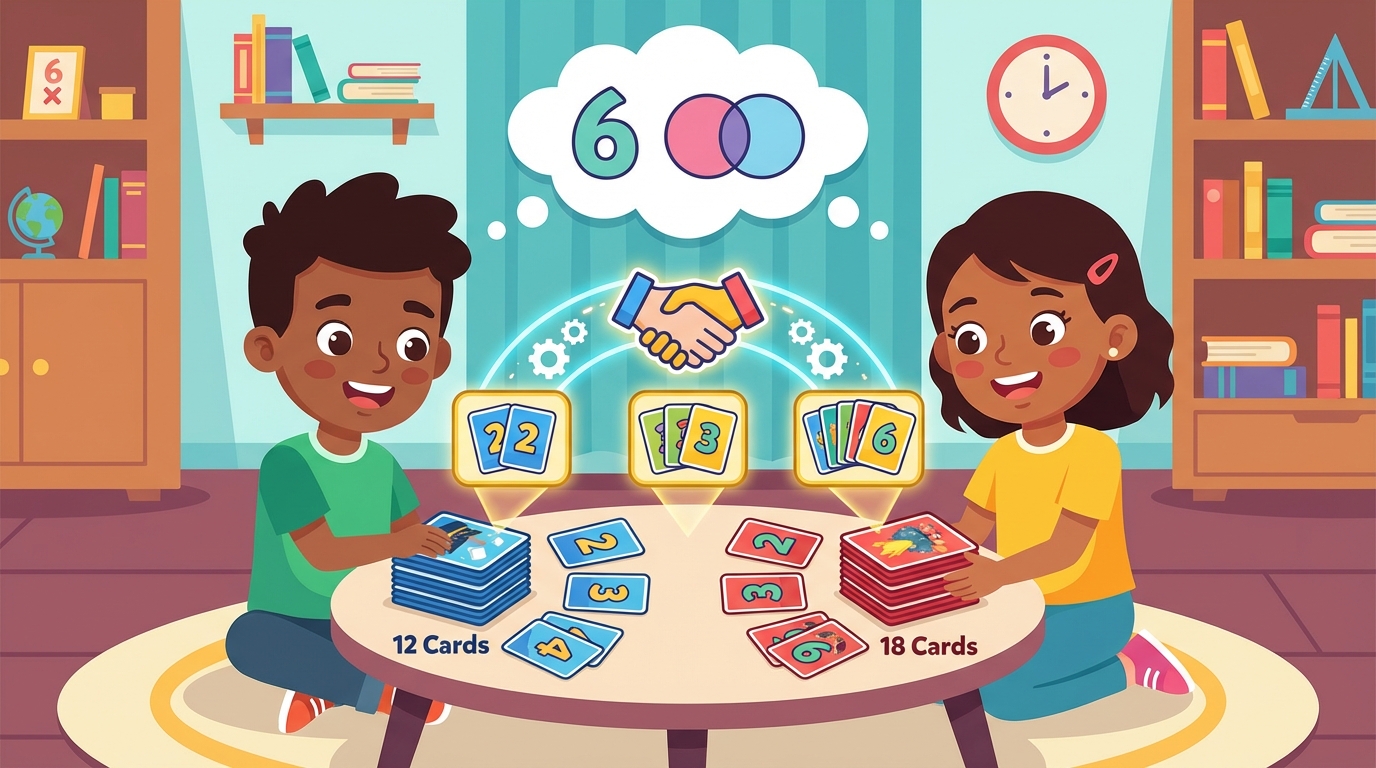
🤝 Sharing is Caring (in Math!)
Imagine you and a friend are organizing two different collections of trading cards. You want to see which group sizes work for both of you. That is what finding a Common Factor is all about!
Let's Look at 12 and 18 🧐
To find the common ground, we list the factors for each number and look for matches.
Factors of 12
1, 2, 3, 4, 6, 12
Factors of 18
1, 2, 3, 6, 9, 18
✨ The Common Factors are: ✨
These numbers appear in both lists!
Key Facts
3 Meeting the GCD: The Greatest Common Divisor
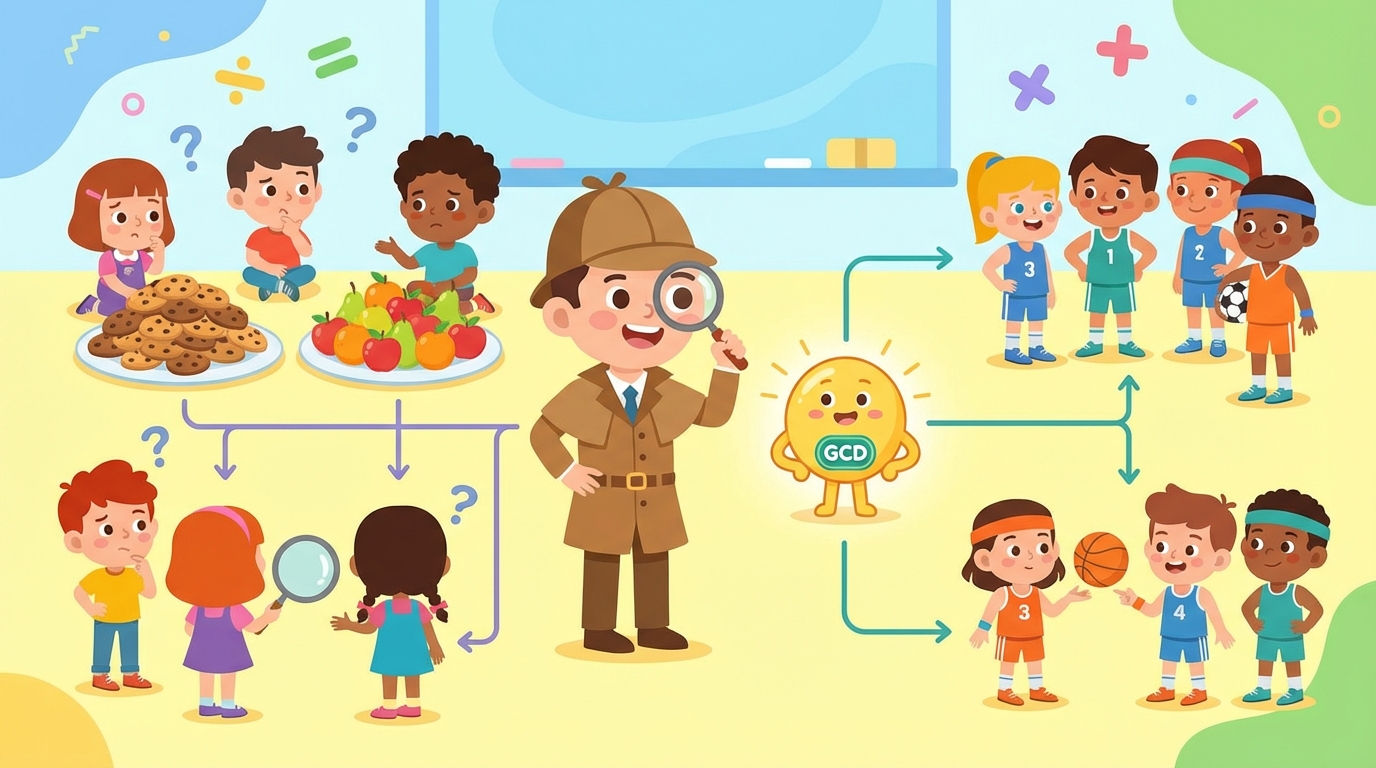
Have you ever tried to share snacks 🍪 or team members 🏃 evenly, but the numbers just didn't match up? That's where the Greatest Common Divisor (GCD) comes to the rescue!
🕵️♂️ What is the GCD?
The GCD is the largest number that divides two or more numbers exactly (without leaving a remainder). Think of it as the 'Greatest Shared Factor'.
🎈 The Party Balloon Problem
Imagine you have 12 Red Balloons and 18 Blue Balloons. You want to make identical balloon arrangements for tables. What is the greatest number of arrangements you can make so that every table has the same number of red and blue balloons with none left over?
1, 2, 3, 4, 6, 12
1, 2, 3, 6, 9, 18
Let's look for the match! The common factors are 1, 2, 3, and 6. The Greatest one is 6.
| Arrangements (GCD) | Red Balloons per Table | Blue Balloons per Table |
|---|---|---|
| 6 Arrangements 🏆 | 12 ÷ 6 = 2 🎈 | 18 ÷ 6 = 3 🔵 |
So, the GCD helps us find the most efficient way to group items!
Key Facts
4 Method 1: The Listing Strategy
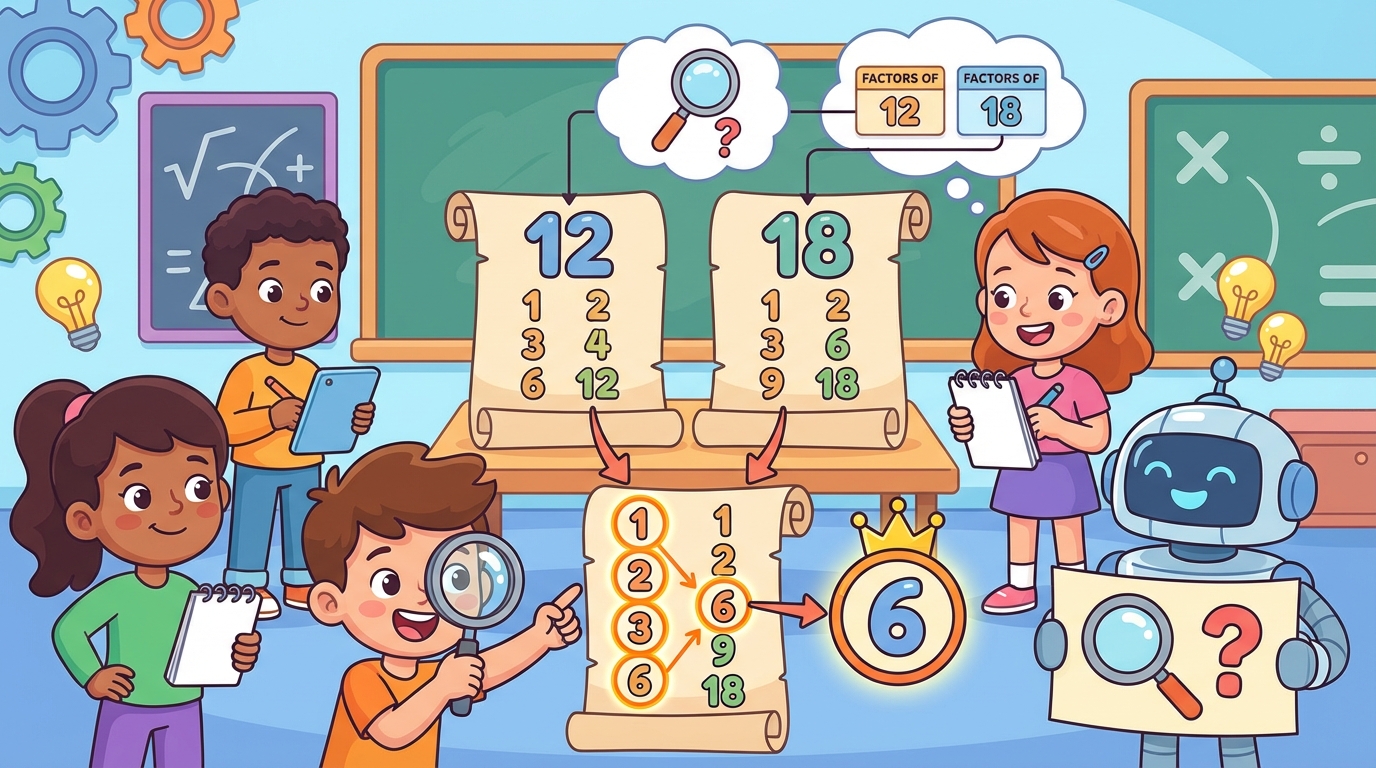
Ready to be a math detective? 🕵️♂️ The Listing Strategy is the most straightforward way to find the GCD. It works exactly like it sounds: we make a list!
📝 How it Works
- List all the factors for the first number.
- List all the factors for the second number.
- Circle (or find) the numbers that appear on both lists.
- Choose the largest circled number. That is your GCD!
Let's Try It: GCD of 12 and 18
| Number | List of Factors |
|---|---|
| 12 | 1, 2, 3, 4, 6, 12 |
| 18 | 1, 2, 3, 6, 9, 18 |
🎉 Success!
The common factors are 1, 2, 3, and 6. The Greatest one is 6.
💡 Real World Example: Party Planning
Imagine you have 12 blue balloons and 18 red balloons. You want to make identical bunches with no balloons left over. Using the GCD (6), you know the biggest bunch you can make has 6 balloons of a specific color, or you can make 6 identical bunches (each with 2 blue and 3 red)!
Key Facts
5 Method 2: Prime Factorization and Factor Trees
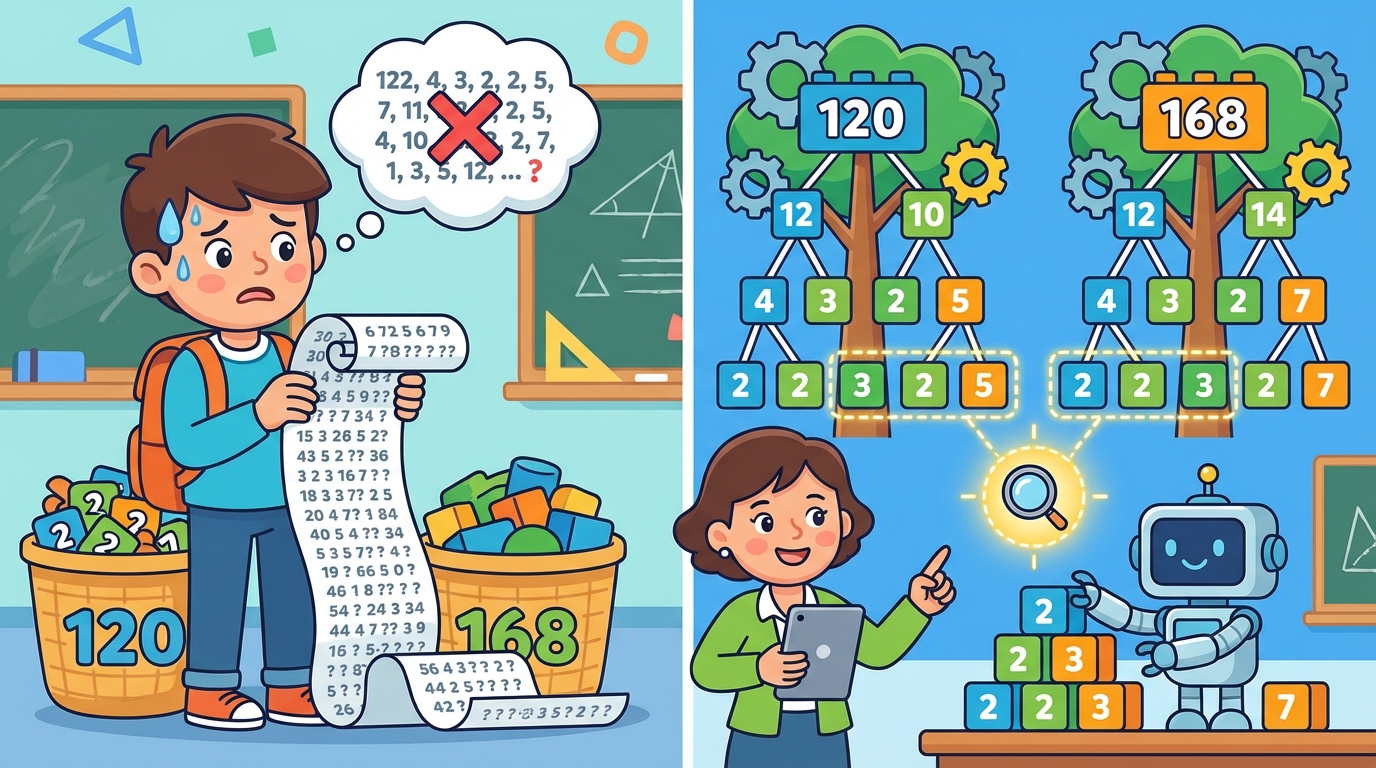
Listing factors works great for small numbers, but what if we need the GCD of 120 and 168? That's a long list! 😰 Instead, we use Prime Factorization. Think of it like breaking a number down into its DNA or Lego blocks.
🌳 How to Build a Factor Tree
- Write your number at the top.
- Draw two branches splitting it into any two factors (e.g., 24 becomes 4 × 6).
- Keep splitting until you only have Prime Numbers (the leaves).
- Circle the primes!
Example: Find GCD of 24 and 36
24
↙ ↘
4 × 6
↙ ↘ ↙ ↘
2 × 2 2 × 3
Primes: 2, 2, 2, 3
36
↙ ↘
4 × 9
↙ ↘ ↙ ↘
2 × 2 3 × 3
Primes: 2, 2, 3, 3
🕵️♀️ The Final Step: Match the Pairs!
Look for prime numbers that appear in BOTH lists.
Matches: A pair of 2s, another pair of 2s, and a pair of 3s.
GCD = 2 × 2 × 3 = 12
Key Facts
6 Visualizing GCD with Venn Diagrams
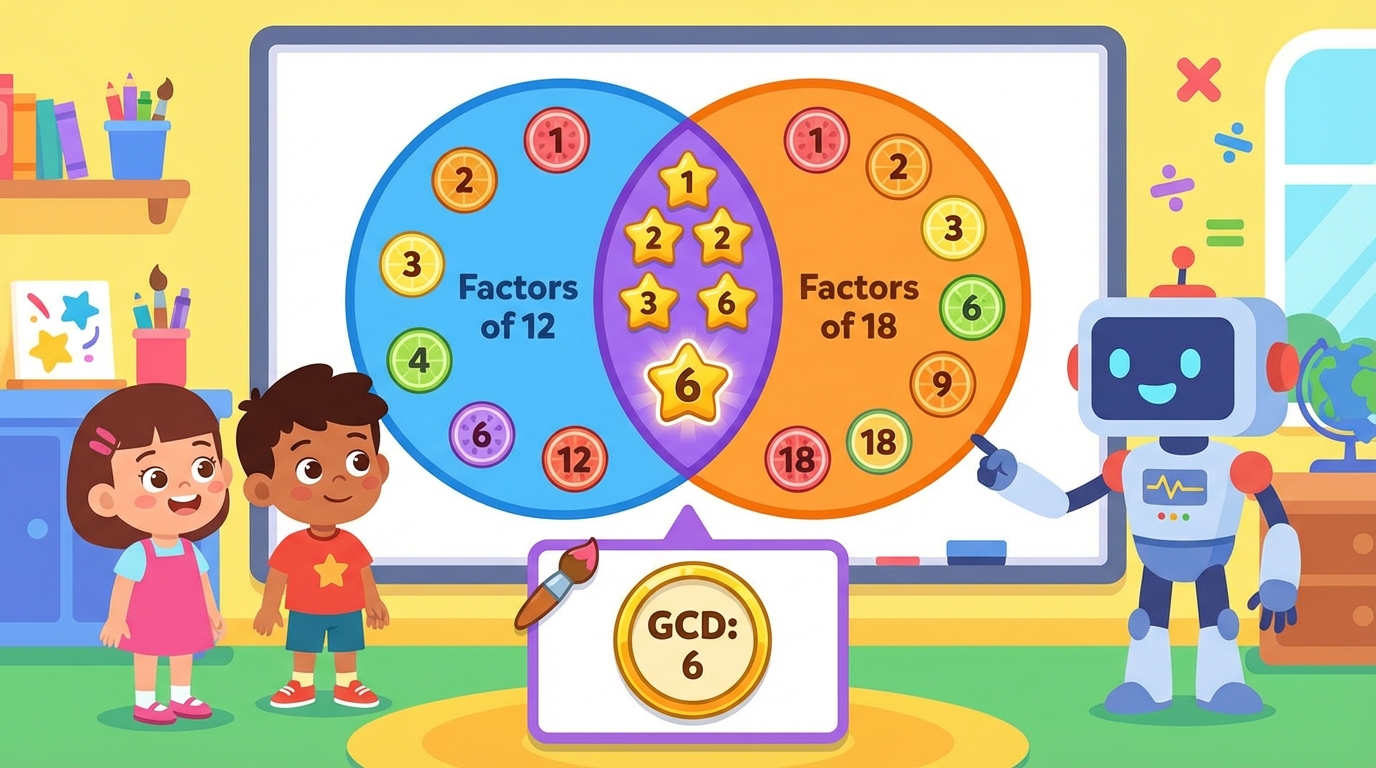
Let's turn math into art! 🎨 A Venn Diagram uses overlapping circles to help us see the relationship between numbers. It is the perfect tool to visualize the Greatest Common Divisor.
Step-by-Step: GCD of 12 and 18
🔵 Blue Circle (12)
Prime Factors of 12:
🤝 The Intersection
What do they share?
2 × 3
GCD = 6
🔴 Red Circle (18)
Prime Factors of 18:
Imagine the circles are like two houses. The intersection is the backyard they share. The GCD lives in that backyard! 🏡
Key Facts
7 Application: Using GCD to Simplify Fractions
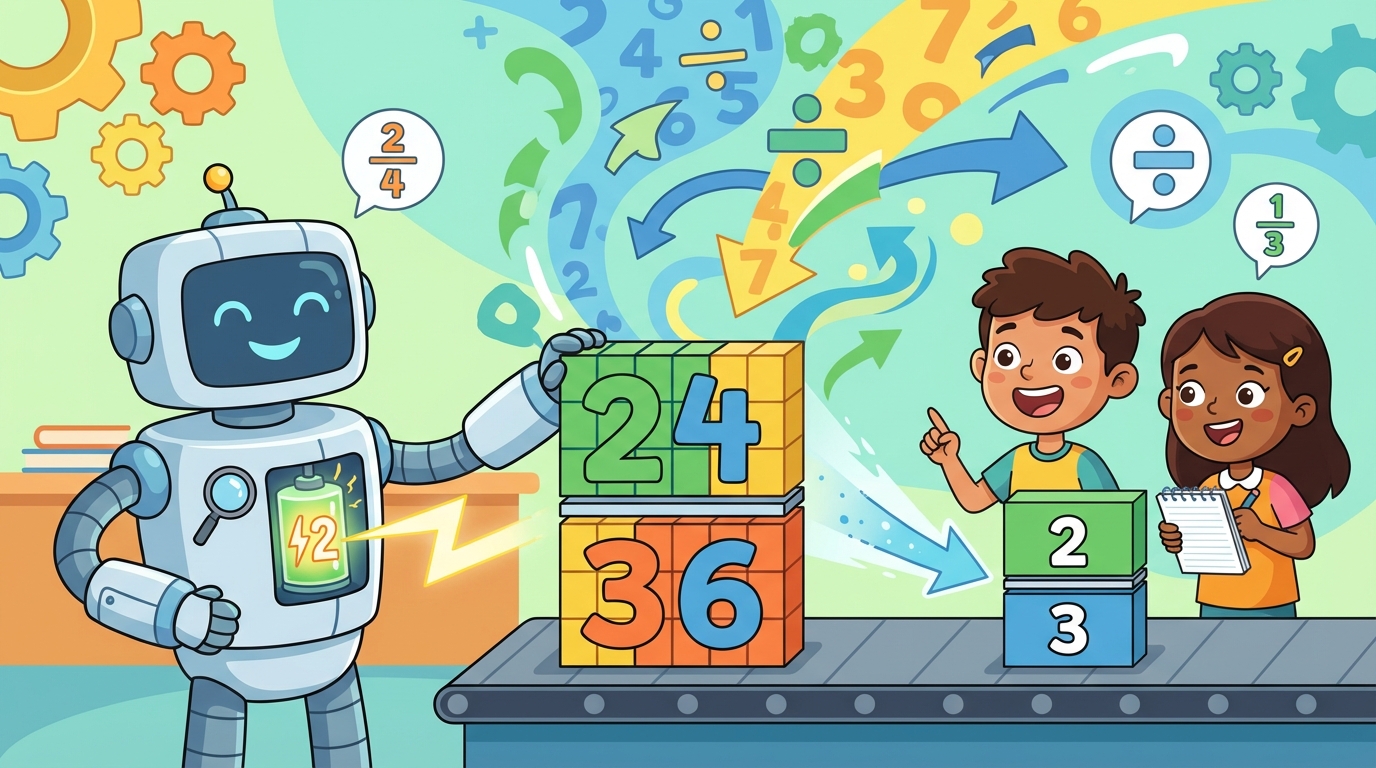
Have you ever looked at a big fraction like 24/36 and thought, 'That looks complicated!'? 😵💫 Don't worry! We can use our new superpower, the Greatest Common Divisor (GCD), to shrink it down to its simplest form in just one step.
🚀 The Super Simplifier Strategy
Usually, you might divide the top and bottom numbers by 2, then by 2 again... that takes forever! Using the GCD is like taking a shortcut.
Example: Simplify 16/24 🍰
Step 1: Find the GCD
Factors of 16: 1, 2, 4, 8, 16
Factors of 24: 1, 2, 3, 4, 6, 8, 12, 24
The GCD is 8!
Step 2: Divide
16 ÷ 8 = 2
24 ÷ 8 = 3
Result: 2/3
| The Long Way 🐢 | The GCD Way 🐇 |
|---|---|
| 16 ÷ 2 = 8 24 ÷ 2 = 12 (Not done yet...) | 16 ÷ 8 = 2 24 ÷ 8 = 3 ✨ DONE! ✨ |
| 8 ÷ 2 = 4 12 ÷ 2 = 6 (Still not done...) | |
| 4 ÷ 2 = 2 6 ÷ 2 = 3 |
Remember: The fraction looks different, but the amount of pizza (or value) stays exactly the same!
Key Facts
8 Solving Real-World Problems with GCD
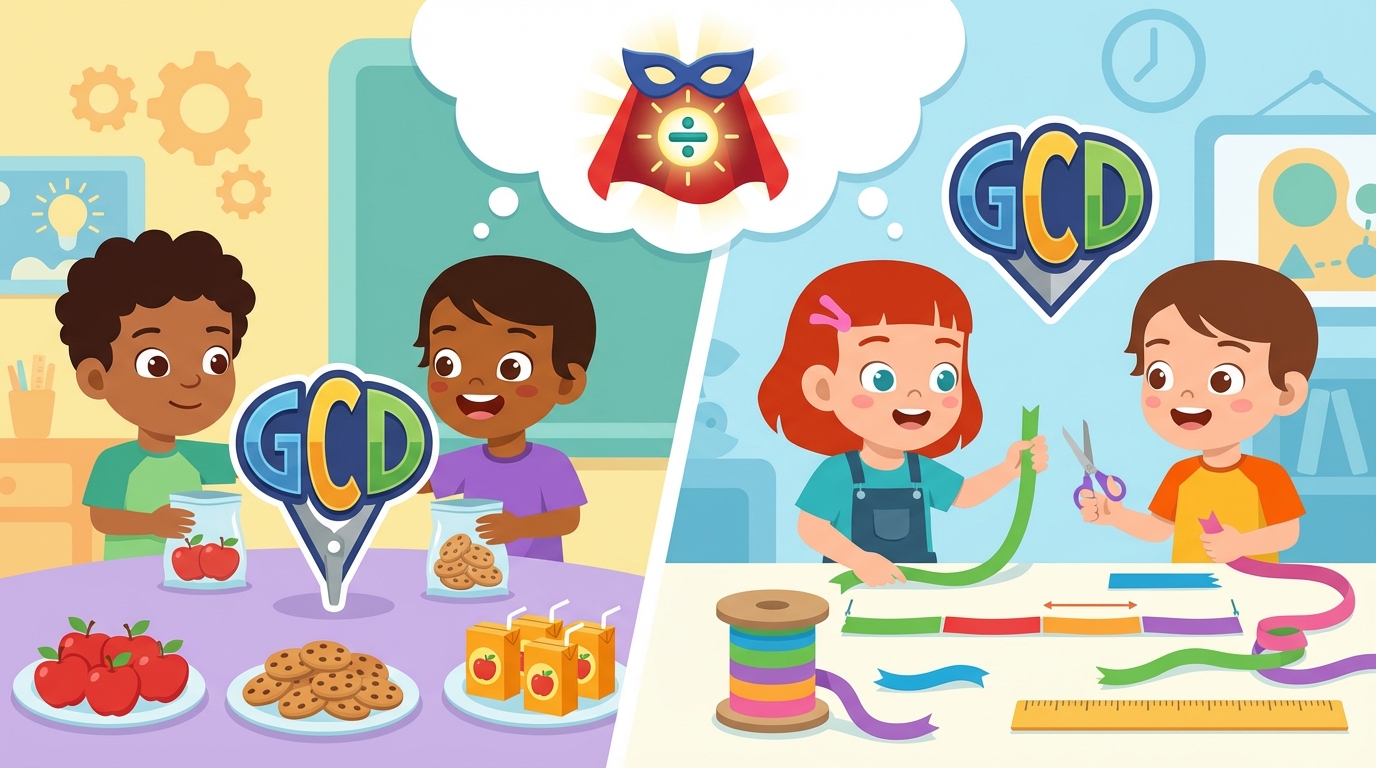
Have you ever tried to share snacks fairly among friends or cut ribbons into equal pieces for a craft project? That's where the Greatest Common Divisor (GCD) becomes a mathematical superpower! 🦸♂️
🕵️♀️ Detective Clues: When to use GCD?
In word problems, put on your detective hat and look for keywords like: 'greatest,' 'largest,' 'maximum,' or 'split into equal groups.' These clues tell you that you need to find the GCD to solve the puzzle!
Imagine you are planning a birthday party. You have 24 chocolates 🍫 and 36 lollipops 🍭. You want to make identical goodie bags with no candy left over. What is the greatest number of bags you can make?
1, 2, 3, 4, 6, 8, 12, 24
1, 2, 3, 4, 6, 9, 12, 18, 36
The Solution: The GCD is 12.
You can make exactly 12 bags!
(Math bonus: 24÷12 = 2 chocolates per bag, 36÷12 = 3 lollipops per bag)
Key Facts
9 Keywords: How to Spot a GCD Problem
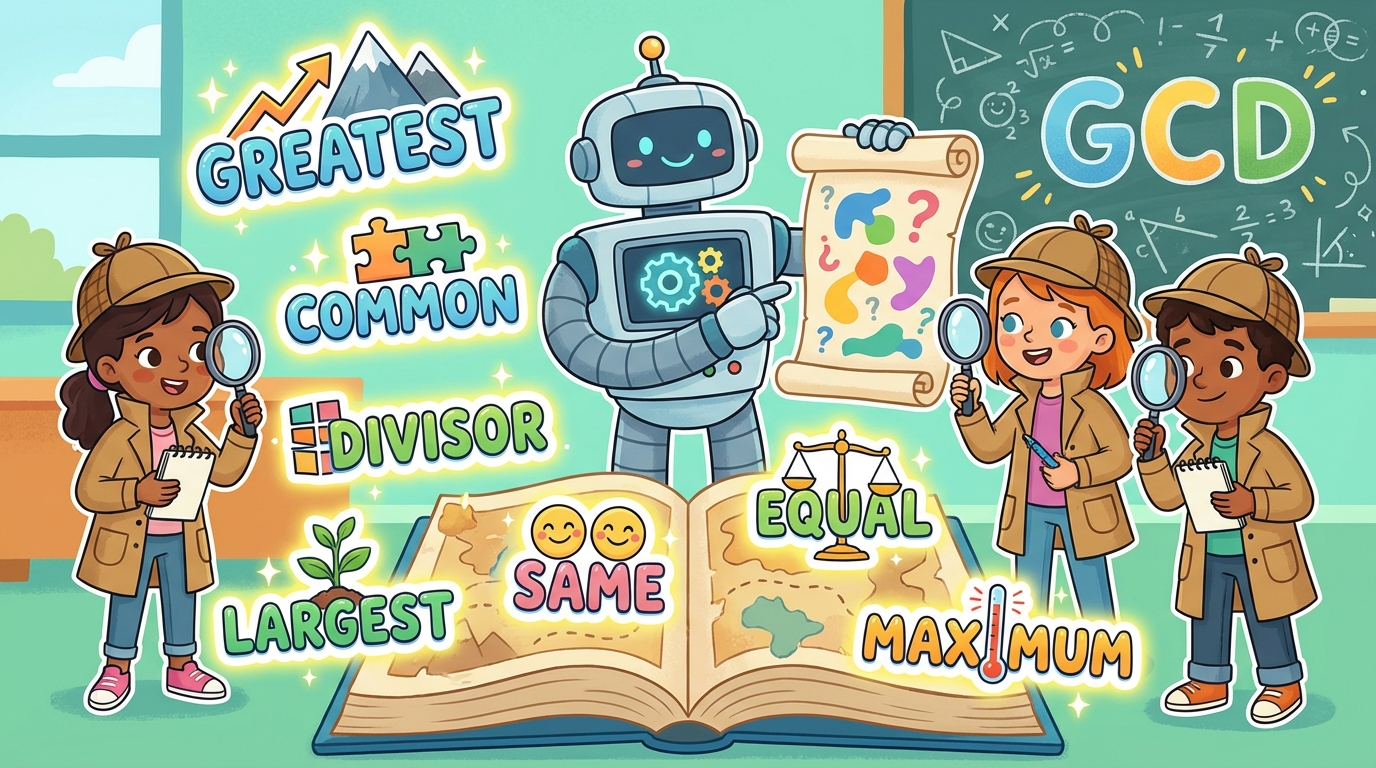
Word problems can be like detective stories 🕵️♀️. You need to look for specific clues to know if you need to find the Greatest Common Divisor!
If you see these words, think GCD:
- ✨ Greatest / Largest / Maximum
- ✂️ Split / Cut / Divide
- 🎁 Equal amounts / Same number
- 🚫 No leftovers / No remainder
In GCD problems, we are taking larger things and breaking them down into smaller, equal groups.
Real-Life Scenario: The Party Planner 🎉
Imagine reading this: 'You have 24 red balloons and 32 blue balloons. You want to make identical bunches with the greatest number of balloons possible, with no leftovers.'
| Keyword Found | What it tells your brain 🧠 |
|---|---|
| 'Identical bunches' | I need to divide items into equal groups. |
| 'Greatest number' | I need the Highest Common Factor. |
| 'No leftovers' | The division must be exact. |
Key Facts
10 Key Vocabulary
Master these important terms for your exam:
| Term | Definition |
|---|---|
|
Greatest Common Divisor (GCD)
Máximo Común Divisor (MCD) |
The largest number that divides two or more numbers exactly without leaving a remainder.
El número más grande que divide a dos o más números exactamente sin dejar residuo. |
|
Factor
Factor |
A number that divides another number evenly. For example, 2 is a factor of 10.
Un número que divide a otro número exactamente. Por ejemplo, 2 es un factor de 10. |
|
Common Factor
Factor Común |
A number that is a factor of two or more numbers.
Un número que es factor de dos o más números. |
|
Prime Number
Número Primo |
A whole number greater than 1 that has exactly two factors: 1 and itself.
Un número entero mayor que 1 que tiene exactamente dos factores: el 1 y él mismo. |
|
Composite Number
Número Compuesto |
A number that has more than two factors.
Un número que tiene más de dos factores. |
|
Prime Factorization
Factorización Prima |
Breaking down a composite number into a product of prime numbers.
Descomponer un número compuesto en un producto de números primos. |
|
Factor Tree
Árbol de Factores |
A diagram used to break down a number by its factors until all numbers are prime.
Un diagrama usado para descomponer un número en sus factores hasta que todos los números sean primos. |
|
Divisible
Divisible |
When a number can be divided by another number without leaving a remainder.
Cuando un número puede ser dividido por otro número sin dejar residuo. |
|
Remainder
Residuo / Resto |
The amount left over after division. For GCD, the remainder must be zero.
La cantidad que sobra después de una división. Para el MCD, el residuo debe ser cero. |
|
Product
Producto |
The result or answer of multiplying two or more numbers.
El resultado o respuesta de multiplicar dos o más números. |
|
Quotient
Cociente |
The answer to a division problem.
El resultado de una división. |
|
Multiple
Múltiplo |
The product of a given number and any whole number.
El producto de un número dado por cualquier número entero. |
|
Venn Diagram
Diagrama de Venn |
A visual tool using overlapping circles to show relationships between sets, often used to find shared factors.
Una herramienta visual que usa círculos superpuestos para mostrar relaciones entre conjuntos, usada a menudo para encontrar factores compartidos. |
|
Relatively Prime
Primos entre sí |
Two numbers that have no common factors other than 1.
Dos números que no tienen factores comunes aparte del 1. |
|
Listing Method
Método de Listado |
A strategy where you write out all factors of the numbers to find the common ones.
Una estrategia donde escribes todos los factores de los números para encontrar los comunes. |
Time to Practice!
There are 7 questions waiting for you. Questions are shuffled each attempt.
Take the Quiz