Least Common Multiple
Learn how to find the smallest multiple shared by two or more numbers using various strategies and solve real-world synchronization problems.
1 Multiples Madness: What is a Multiple?
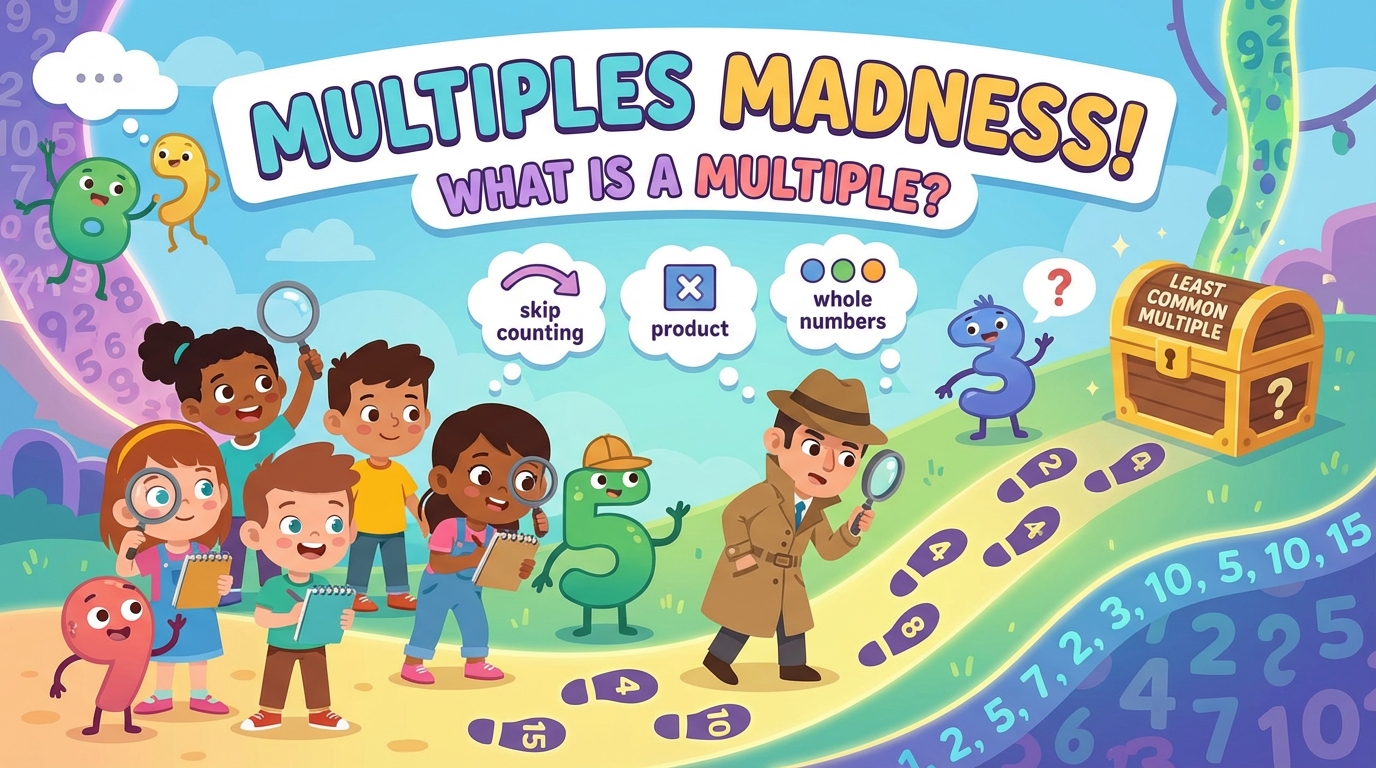
Ready to become a math detective? 🕵️♂️ Multiples are everywhere!
📚 The Definition
A multiple is the product of a specific number and any whole number. Think of it like skip counting or looking at the results in your multiplication tables!
Example: 5 × 3 = 15 (15 is a multiple of 5)
Let's Look at the Multiples of 4 🐸
Imagine a frog jumping 4 steps at a time on a number line:
| Multiply by... | × 1 | × 2 | × 3 | × 4 | × 5 | ... |
|---|---|---|---|---|---|---|
| Multiples of 4 | 4 | 8 | 12 | 16 | 20 | Infinity 🚀 |
🌭 Real Life Example: Hot Dogs!
Hot dogs usually come in packs of 10. If you buy packs of hot dogs, you can have 10, 20, 30, or 40 hot dogs. You cannot buy 15 hot dogs because 15 is not a multiple of 10!
Key Facts
2 Spotting the Match: Introduction to Common Multiples
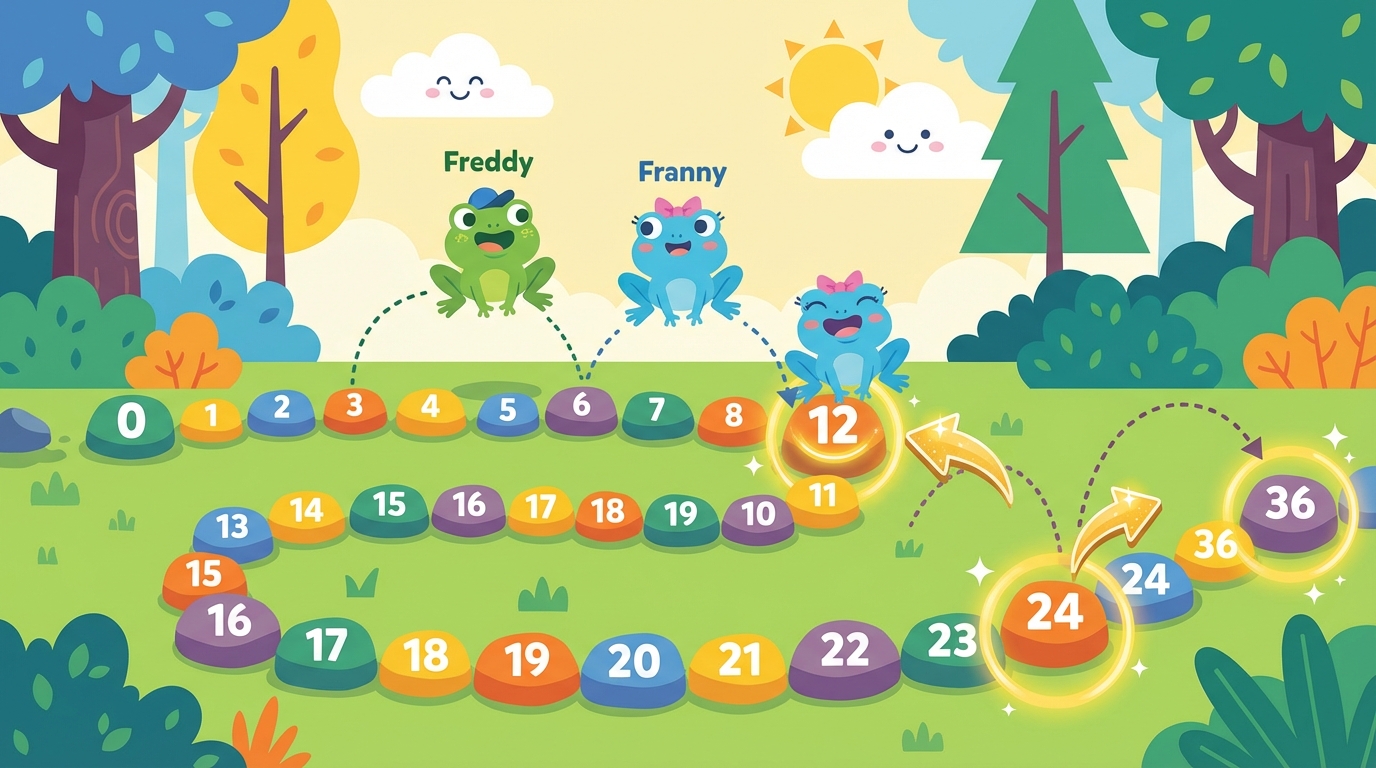
🐸 The Jumping Frog Challenge
Imagine two frogs, Freddy and Franny, jumping along a number line.
Freddy jumps every 3 steps, and Franny jumps every 4 steps. They both start at zero. The big question is: On which stones will they land at the exact same time? 🤔
🌟 What is a Common Multiple?
A Common Multiple is a number that appears in the list of multiples for two or more different numbers. It's like a meeting point for numbers!
Multiples of 3
3, 6, 9, 12, 15, 18, 21, 24, 27...
Multiples of 4
4, 8, 12, 16, 20, 24, 28, 32...
🌭 Real Life Example: The Hot Dog Dilemma
Have you ever noticed that hot dogs come in packs of 10, but the buns come in packs of 8? To have a perfect match with no leftovers, you need to find a common multiple of 8 and 10!
If you list them out, you'll see they match at 40. That means you need 40 hot dogs and 40 buns to make everyone happy! 😋
Key Facts
3 Meet the LCM: Defining the Least Common Multiple
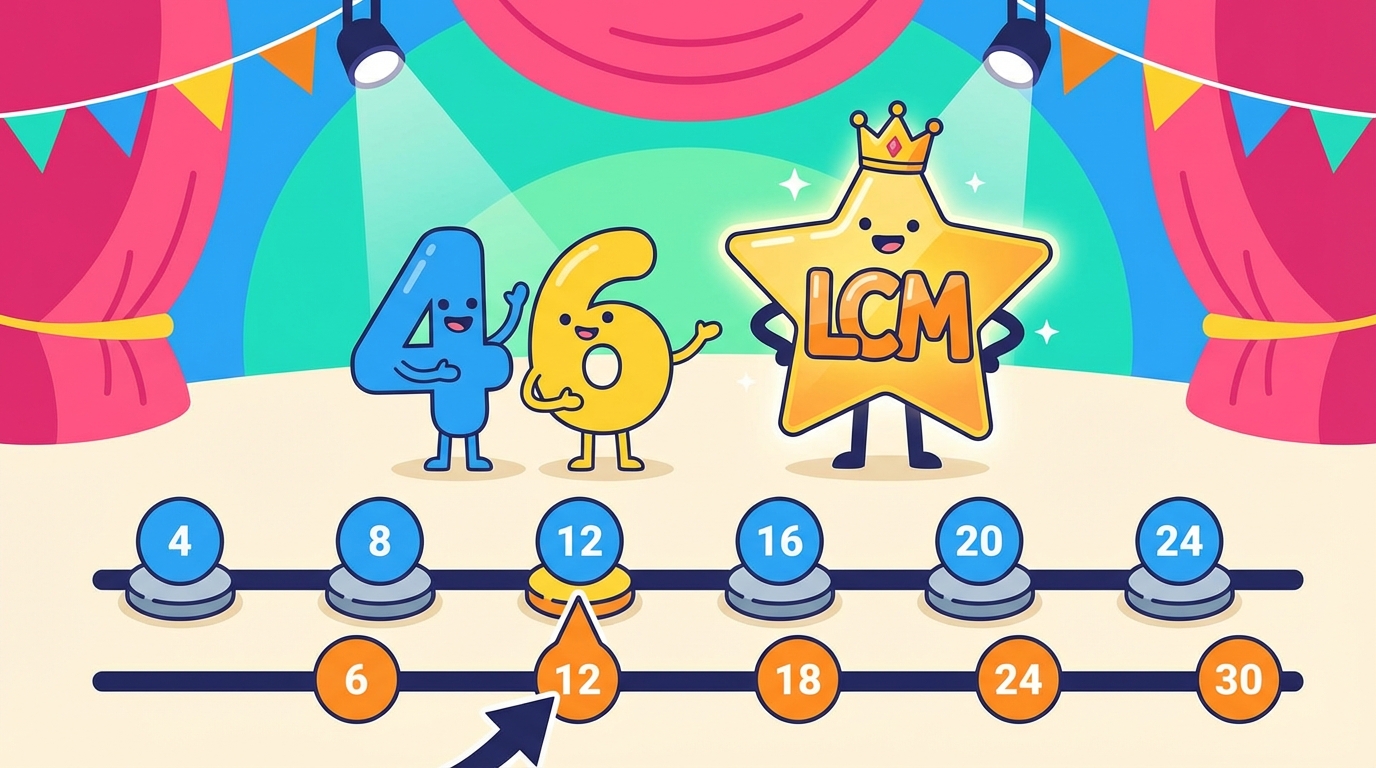
Welcome to the main event! 🌟 Now that we are experts on multiples, it's time to meet the star of the show: the Least Common Multiple, or LCM for short.
What does LCM actually mean?
Let's break down the name word by word to uncover the secret:
The smallest number.
Shared by both numbers.
In the multiplication list.
Imagine two frogs jumping along a number line. 🐸 One frog jumps every 3 steps, and the other jumps every 4 steps. The LCM is the very first spot where they both land at the same time!
Multiples of 3:
3 6 9 12 15 18 21 24...
Multiples of 4:
4 8 12 16 20 24...
🎉 We found it!
Both lists have 12 and 24 in common. But since we want the Least (smallest) one, the winner is 12!
Key Facts
4 Strategy 1: The Listing Method

Let's start with the most straightforward way to find the LCM: The Listing Method! 📝 It is exactly what it sounds like—making a list.
How to do it in 3 Steps 🚀
- List the first few multiples of each number.
- Circle (or spot) the numbers that appear in both lists.
- Identify the smallest number they share. That is your LCM! 🎯
Example: Find the LCM of 4 and 6
Multiples of 4: 4, 8, 12, 16, 20, 24...
Multiples of 6: 6, 12, 18, 24, 30...
🌭 Real World Math
Have you ever noticed hot dogs come in packs of 10, but buns come in packs of 8? To have a perfect match with no leftovers, you use this method!
- 10, 20, 30, 40...
- 8, 16, 24, 32, 40...
You need to buy enough for 40 hot dogs!
Key Facts
5 Strategy 2: Using Prime Factorization
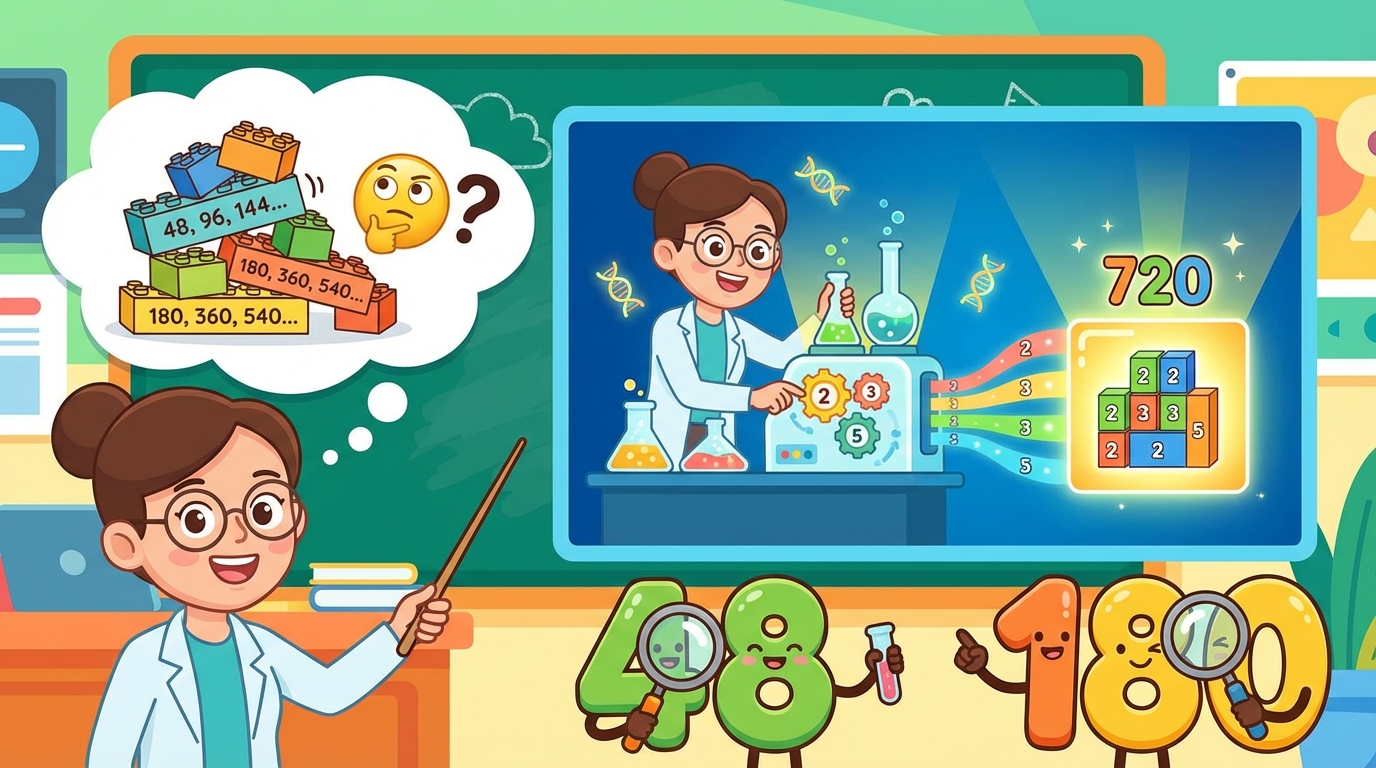
Listing multiples is great for small numbers, but what if you need to find the LCM of 48 and 180? That list would be huge! 🤯 Instead, we use the DNA of numbers: Prime Factorization.
🧪 The Science Lab Method
Think of the LCM as a 'Master Container' that must be big enough to hold the ingredients (prime factors) of both numbers.
- Break it down: Find the prime factorization of each number (using a factor tree).
- Line them up: Write the factors using exponents.
- The Rule of Maximums: For every unique prime number you see, pick the one with the highest exponent.
- Multiply: Multiply your chosen 'winners' together to get the LCM.
Example: LCM of 12 and 18
2 × 2 × 3
2² × 3¹
2 × 3 × 3
2¹ × 3²
🏆 Battle of the Exponents!
| Prime Number | Contestants | Winner (Highest Power) |
|---|---|---|
| 2 | 2² vs 2¹ | 2² (4) |
| 3 | 3¹ vs 3² | 3² (9) |
LCM = 2² × 3² = 4 × 9 = 36
Key Facts
6 Strategy 3: The Ladder Method (Cake Method)
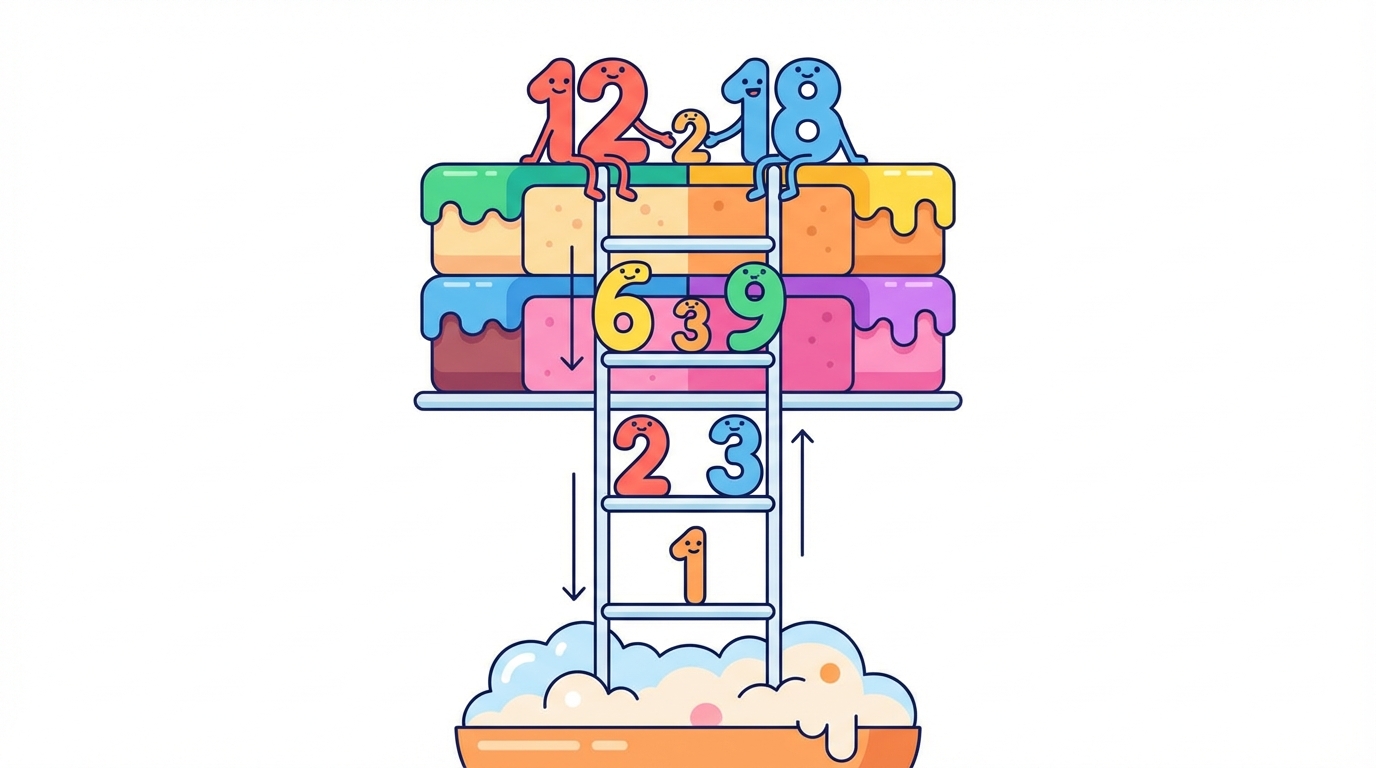
Imagine baking a cake upside down! 🎂 The Ladder Method (also known as the Cake Method) is a super clean way to find the LCM without making a mess with lists.
- Write your numbers side-by-side.
- Draw a step (like an upside-down division box).
- Pull out a prime factor (2, 3, 5...) that goes into both numbers.
- Write the answer underneath.
- Repeat until the only number that goes into both is 1.
Let's find the LCM of 12 and 18.
| 2 | 12 | 18 |
| 3 | 6 | 9 |
| 2 | 3 |
To find the LCM, draw a big L covering the side and bottom numbers!
Key Facts
7 Level Up: Finding LCM of Three Numbers
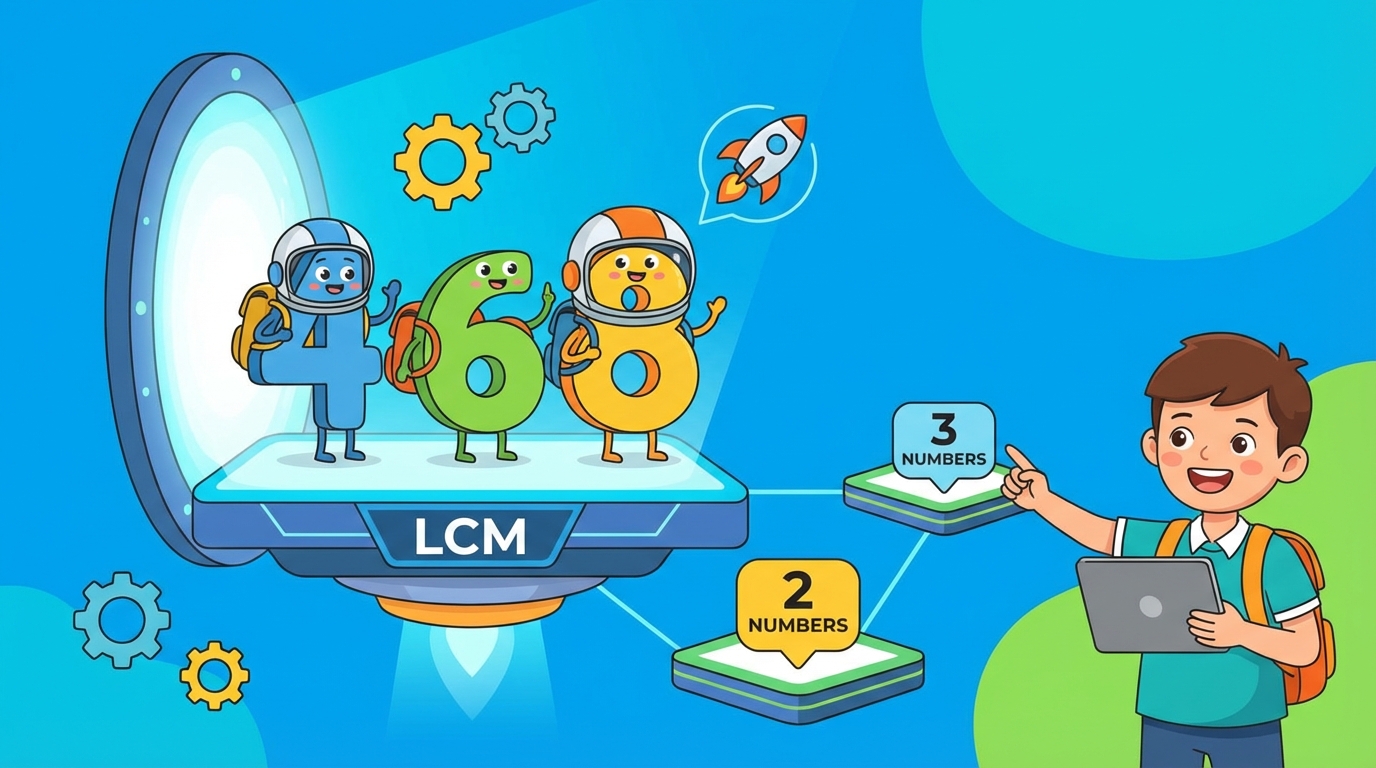
You've mastered finding the Least Common Multiple for two numbers. Now, it's time to level up! 🚀 Finding the LCM of three numbers follows the exact same rules, but we need to be a little more organized.
Let's find the LCM of 3, 4, and 6. We list the multiples for all three until we find a match that appears in all three lists.
| Number | Multiples |
|---|---|
| 3 | 3, 6, 9, 12, 15, 18, 21, 24... |
| 4 | 4, 8, 12, 16, 20, 24... |
| 6 | 6, 12, 18, 24... |
Both 12 and 24 are common multiples, but the Least Common Multiple is 12!
For bigger numbers, listing takes too long. Let's use prime factorization for 8, 12, and 15.
- 8 = 2 × 2 × 2 = 2³
- 12 = 2 × 2 × 3 = 2² × 3
- 15 = 3 × 5 = 3 × 5
To win, we take the highest power of each prime factor we see:
- Twos: 2³ is the winner (bigger than 2²)
- Threes: 3¹ is the winner
- Fives: 5¹ is the winner
LCM = 2³ × 3 × 5 = 8 × 3 × 5 = 120
Key Facts
8 Don't Get Tricked: LCM vs. GCF
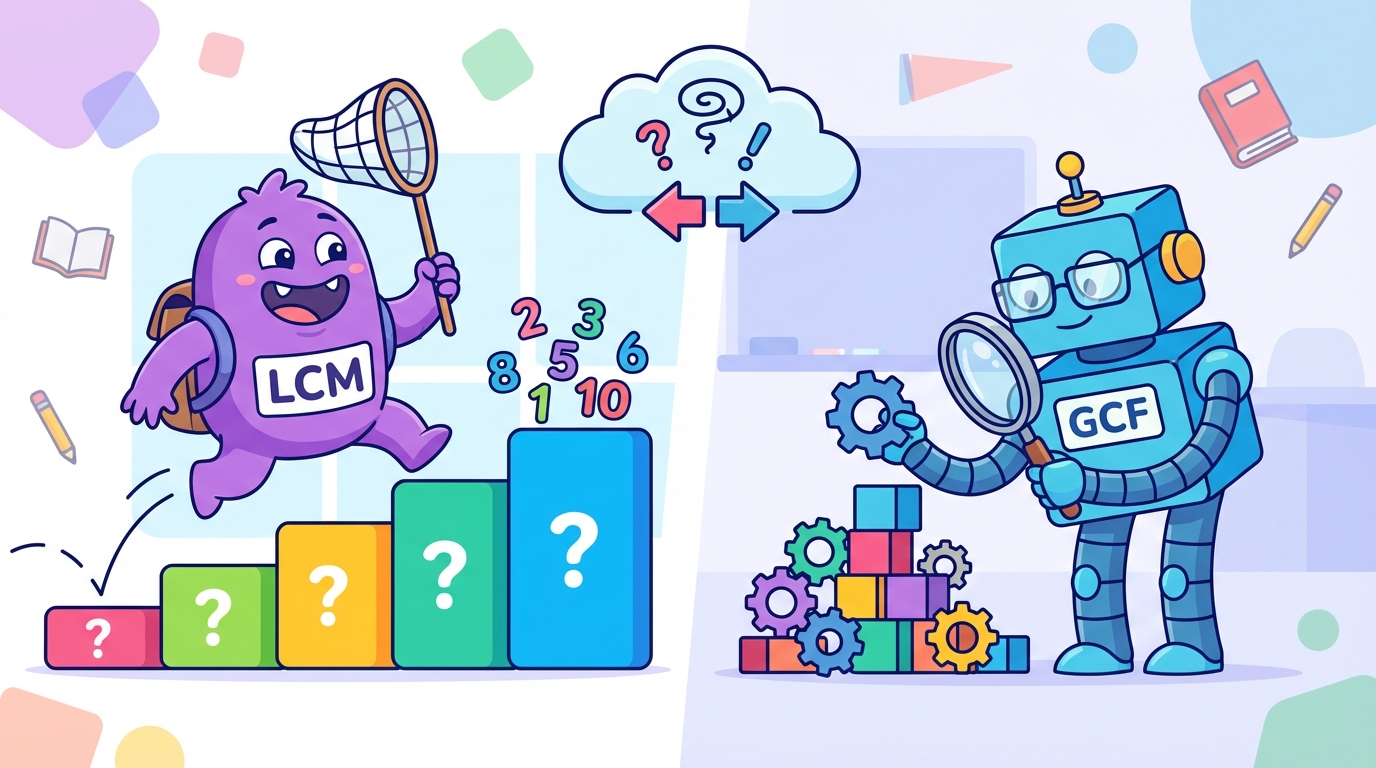
It is the most common mistake in 6th Grade math: confusing the LCM with the GCF! 😵💫 But don't worry, we can fix that right now.
🔍 The Big Difference
| Feature | GCF (Greatest Common Factor) | LCM (Least Common Multiple) |
|---|---|---|
| The Numbers Get... | Smaller 👇 (or stay the same) | Bigger 👆 (or stay the same) |
| Operation | Division / Breaking things apart ➗ | Multiplication / Repeating cycles ✖️ |
| Key Question | What is the biggest group we can make? | When will they meet again? |
🕵️ Word Problem Clues: LCM
Look for words about time and repetition:
- 'Every 3 days...'
- 'Both at the same time'
- 'When will they happen again?'
- 'Cycles'
🕵️ Word Problem Clues: GCF
Look for words about grouping and splitting:
- 'Split into equal groups'
- 'Cut into pieces'
- 'Greatest amount possible'
- 'Arranging rows'
Key Facts
9 Real-World Problems: Cycles and Synchronization

Have you ever noticed how the turn signals on two cars flash at different speeds, but every once in a while, they flash at the exact same time? 🚗💡 That is synchronization, and math can predict exactly when it happens!
Imagine two friends running around a circular track. They start at the same time.
- Leo takes 6 minutes to complete one lap.
- Mia takes 8 minutes to complete one lap.
Question: How many minutes will pass until they meet again at the starting line?
| Runner | Lap 1 | Lap 2 | Lap 3 | Lap 4 |
|---|---|---|---|---|
| Leo (Multiples of 6) | 6 min | 12 min | 18 min | 24 min |
| Mia (Multiples of 8) | 8 min | 16 min | 24 min | 32 min |
Answer: They will meet again in 24 minutes. This is the Least Common Multiple (LCM) of 6 and 8!
🌭 The Hot Dog Dilemma
This is a classic LCM problem! Hot dogs come in packs of 10, but buns come in packs of 8.
To have the same number of hot dogs and buns with zero leftovers, you need to find the LCM of 10 and 8.
LCM(10, 8) = 40. You need to buy enough packs to make 40 hot dogs!
🕵️ Detective Tips
Look for these clues in word problems to know you need LCM:
- 'When will they happen together again?'
- 'What is the shortest time until...?'
- 'Find the smallest number that can be divided by...'
- Events repeating in cycles.
Key Facts
10 Key Vocabulary
Master these important terms for your exam:
| Term | Definition |
|---|---|
|
Least Common Multiple (LCM)
Mínimo Común Múltiplo (MCM) |
The smallest whole number that is a multiple of two or more numbers.
El número entero más pequeño que es múltiplo de dos o más números. |
|
Multiple
Múltiplo |
The product of a given number and any non-zero whole number.
El producto de un número dado por cualquier número entero distinto de cero. |
|
Common Multiple
Múltiplo Común |
A number that is a multiple of two or more numbers.
Un número que es múltiplo de dos o más números. |
|
Factor
Factor |
A number that divides another number evenly without a remainder.
Un número que divide a otro número exactamente sin dejar residuo. |
|
Prime Number
Número Primo |
A whole number greater than 1 that has exactly two factors: 1 and itself.
Un número entero mayor que 1 que tiene exactamente dos factores: el 1 y él mismo. |
|
Composite Number
Número Compuesto |
A number that has more than two factors.
Un número que tiene más de dos factores. |
|
Prime Factorization
Descomposición en Factores Primos |
Breaking down a composite number into a product of prime numbers.
Desglosar un número compuesto en un producto de números primos. |
|
Factor Tree
Árbol de Factores |
A diagram used to find the prime factors of a number.
Un diagrama utilizado para encontrar los factores primos de un número. |
|
Product
Producto |
The answer to a multiplication problem.
El resultado de una multiplicación. |
|
Divisible
Divisible |
Capable of being divided by another number without a remainder.
Capaz de ser dividido por otro número sin dejar residuo. |
|
Remainder
Residuo (o Resto) |
The amount left over when a number cannot be divided evenly.
La cantidad que sobra cuando un número no se puede dividir exactamente. |
|
Exponent
Exponente |
A small number showing how many times the base number is multiplied by itself.
Un número pequeño que indica cuántas veces se multiplica el número base por sí mismo. |
|
Infinite
Infinito |
Limitless or endless; multiples of a number go on forever.
Sin límites o sin fin; los múltiplos de un número continúan para siempre. |
|
Common Denominator
Denominador Común |
A shared multiple of the denominators of two or more fractions.
Un múltiplo compartido de los denominadores de dos o más fracciones. |
|
Venn Diagram
Diagrama de Venn |
A visual tool using overlapping circles to show relationships between sets of numbers.
Una herramienta visual que usa círculos superpuestos para mostrar relaciones entre conjuntos de números. |
Time to Practice!
There are 7 questions waiting for you. Questions are shuffled each attempt.
Take the Quiz