Magic squares
Explore the patterns and logic behind number grids where every row, column, and diagonal adds up to the same magic number.
1 The Mystery of the Grid: What is a Magic Square?
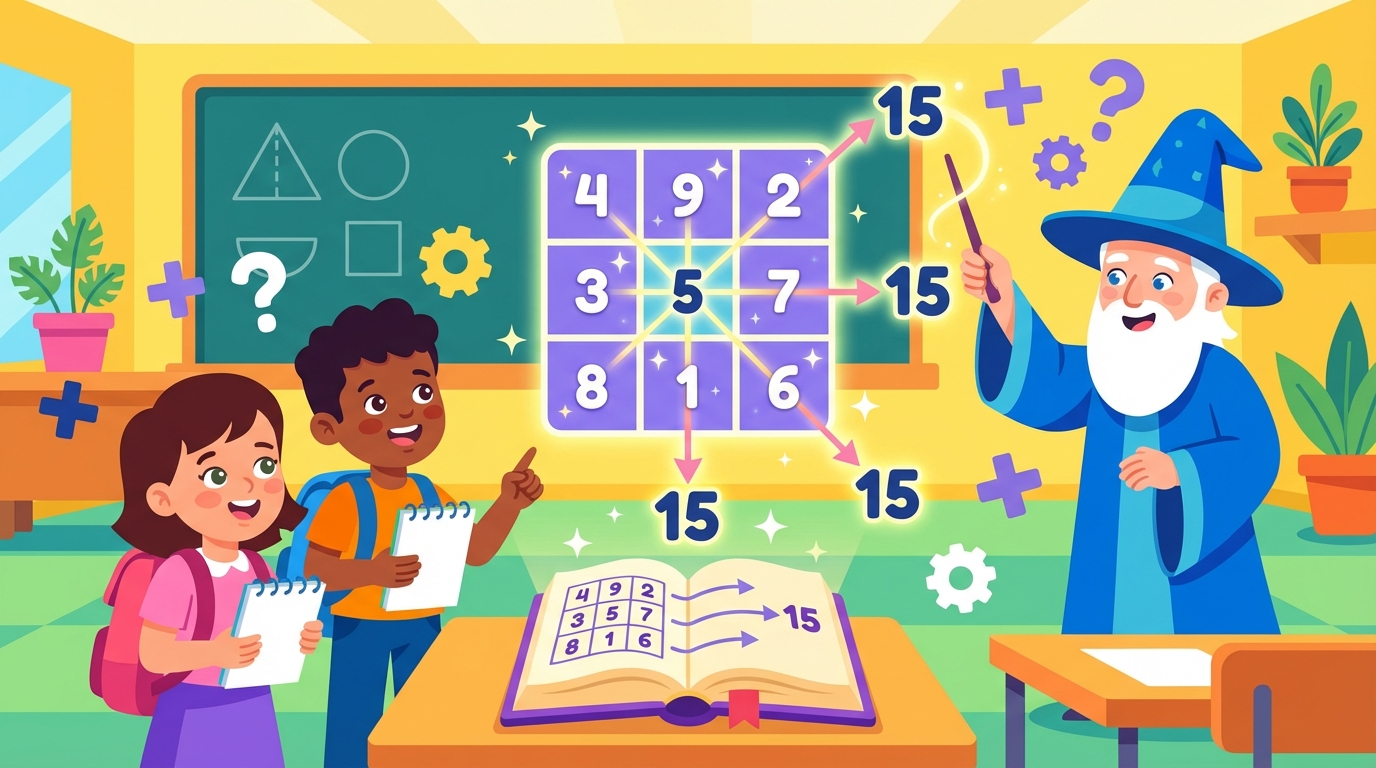
Have you ever seen a square that is... magic? 🎩✨
It sounds like a magic trick, but it is actually pure mathematics! A Magic Square is a special grid filled with numbers. But these aren't just random numbers thrown together. They follow a secret code.
Thousands of years ago in ancient China, a legend tells of a turtle that crawled out of the River Lo. On its shell, people saw a pattern of dots. When they counted the dots, they realized they formed a grid where every direction added up to the same number! This was the first known Magic Square.
🌟 The Golden Rules
- You must use a sequence of numbers (like 1 to 9).
- You cannot repeat any number.
- The Magic Constant: Every row (↔️), column (↕️), and diagonal (↘️ ↙️) must add up to the same sum.
A 3x3 Magic Square
| 8 | 1 | 6 | = 15 |
| 3 | 5 | 7 | = 15 |
| 4 | 9 | 2 | = 15 |
Try adding them up! Even the diagonals (8+5+2) equal 15!
Key Facts
2 The Three Golden Rules
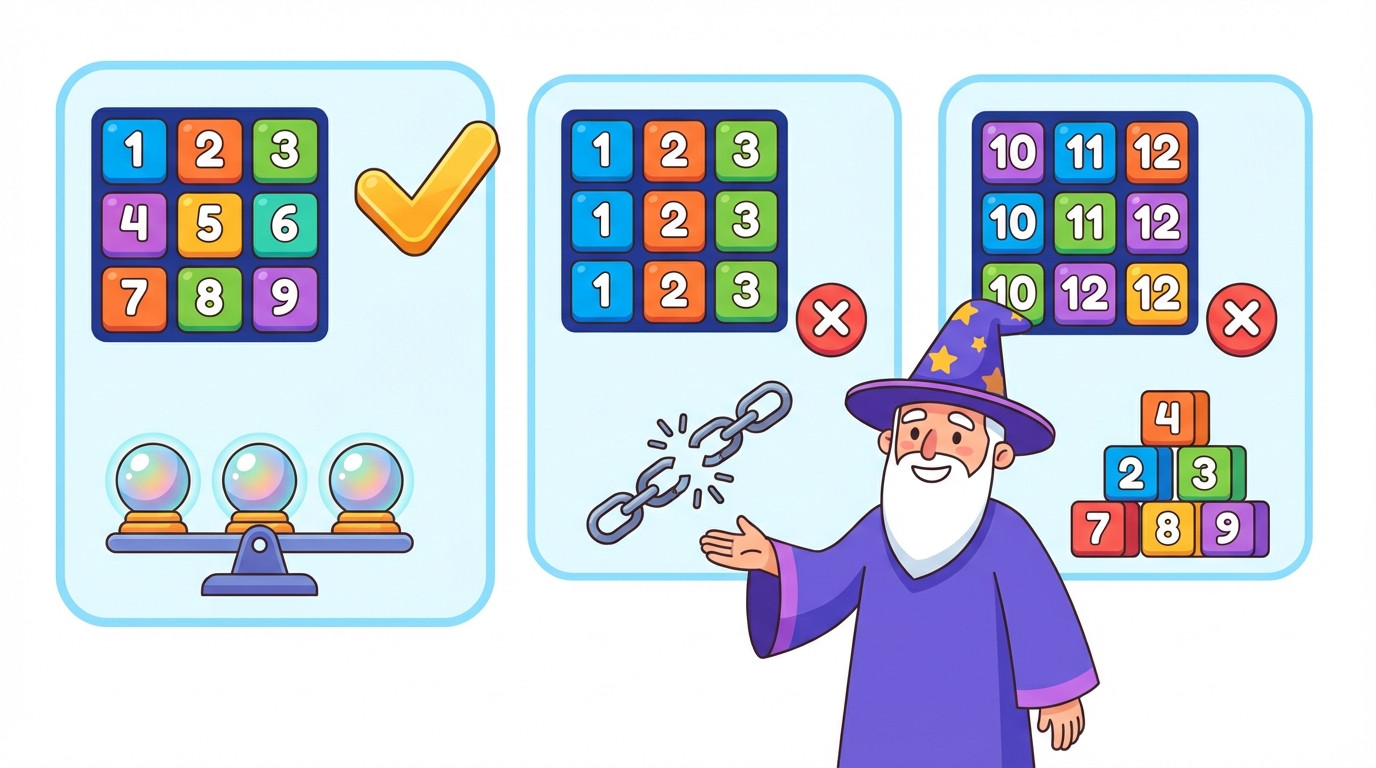
Not every grid of numbers is magical! 🧙♂️ To earn the title of a Magic Square, a grid must obey three strict laws. If it breaks even one rule, the magic is broken! 🚫
- ➡️ Rule 1: Add up the numbers in every row (horizontal).
- ⬇️ Rule 2: Add up the numbers in every column (vertical).
- ↘️ Rule 3: Add up the numbers in both diagonals (corner to corner).
Let's Check a 3x3 Square!
Target Number (Magic Constant): 15
| 8 | 1 | 6 | = 15 |
| 3 | 5 | 7 | = 15 |
| 4 | 9 | 2 | = 15 |
| 15 | 15 | 15 | 🎉 |
Check the diagonals: 8+5+2=15 and 6+5+4=15!
Key Facts
3 The Magic Constant: Finding the Sum
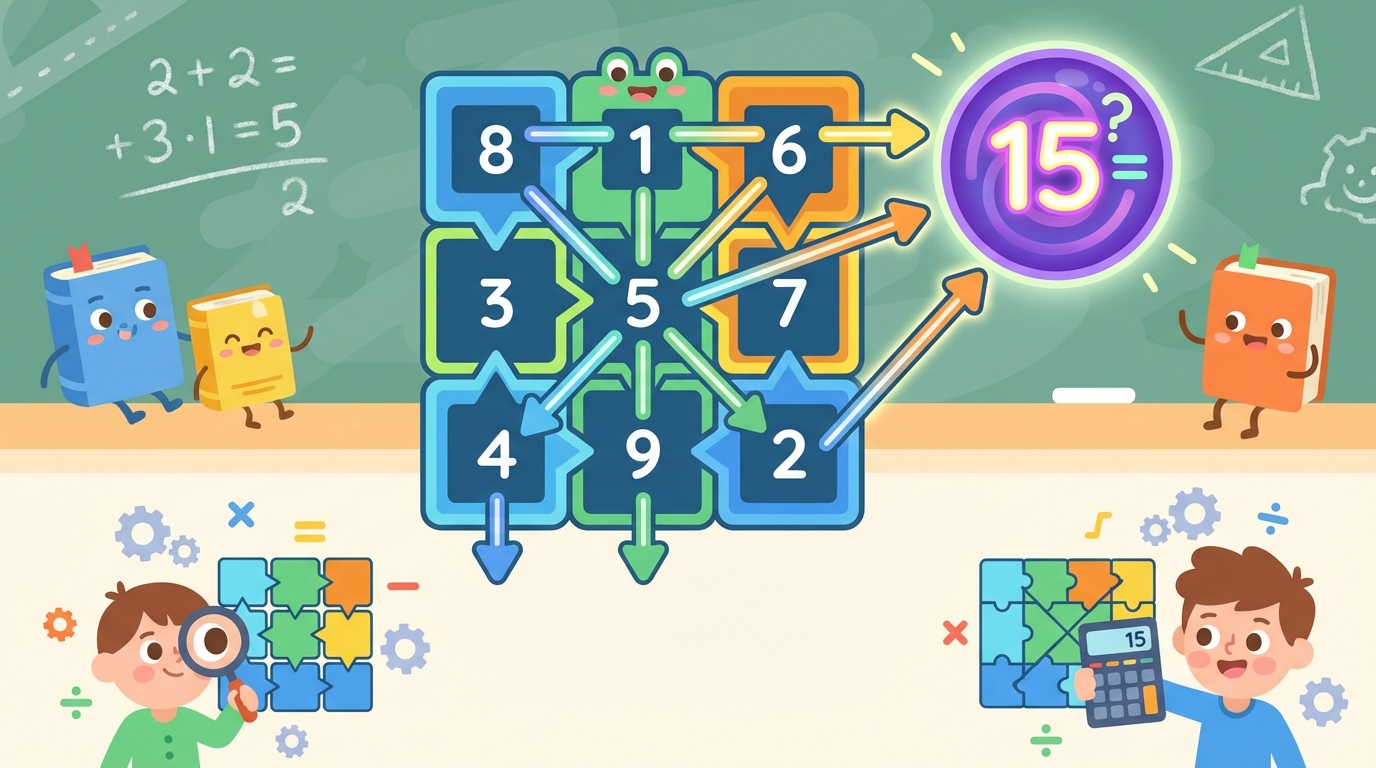
Every Magic Square has a secret number known as the Magic Constant. It represents the target sum for every row, column, and diagonal!
How to Find It?
There are two ways to find this magical number:
- The Detective Method 🕵️: If the square is already solved, just add up one row!
- The Wizard Method 🧙♂️: If the square is empty, add all the numbers you will use, then divide by the number of rows.
Example: 3x3 Square
Let's use the numbers 1 through 9.
1 + 2 + 3 + ... + 9 = 45
45 ÷ 3 = 15
So, the Magic Constant is 15!
Key Facts
4 The Classic 3x3: The Lo Shu Square

Travel back in time to ancient China! 🇨🇳 Legend has it that around 650 BC, Emperor Yu was walking by the River Lo when he saw a magical turtle emerging from the water. 🐢✨
The Turtle's Secret 🤫
The pattern on the turtle's shell was made of dots that represented numbers. This pattern is known as the Lo Shu Square.
It is the simplest (and most famous) magic square. It uses the numbers 1 through 9 exactly once.
Let's check the math below. 👇
| 4 | 9 | 2 | = 15 |
| 3 | 5 | 7 | = 15 |
| 8 | 1 | 6 | = 15 |
| 15 | 15 | 15 | ↘️ 15 |
Did you notice? The number 5 is right in the center! In a 3x3 magic square using numbers 1-9, the middle number is always one-third of the magic constant (15 ÷ 3 = 5). 🧠💡
Key Facts
5 The Secret of the Center Number
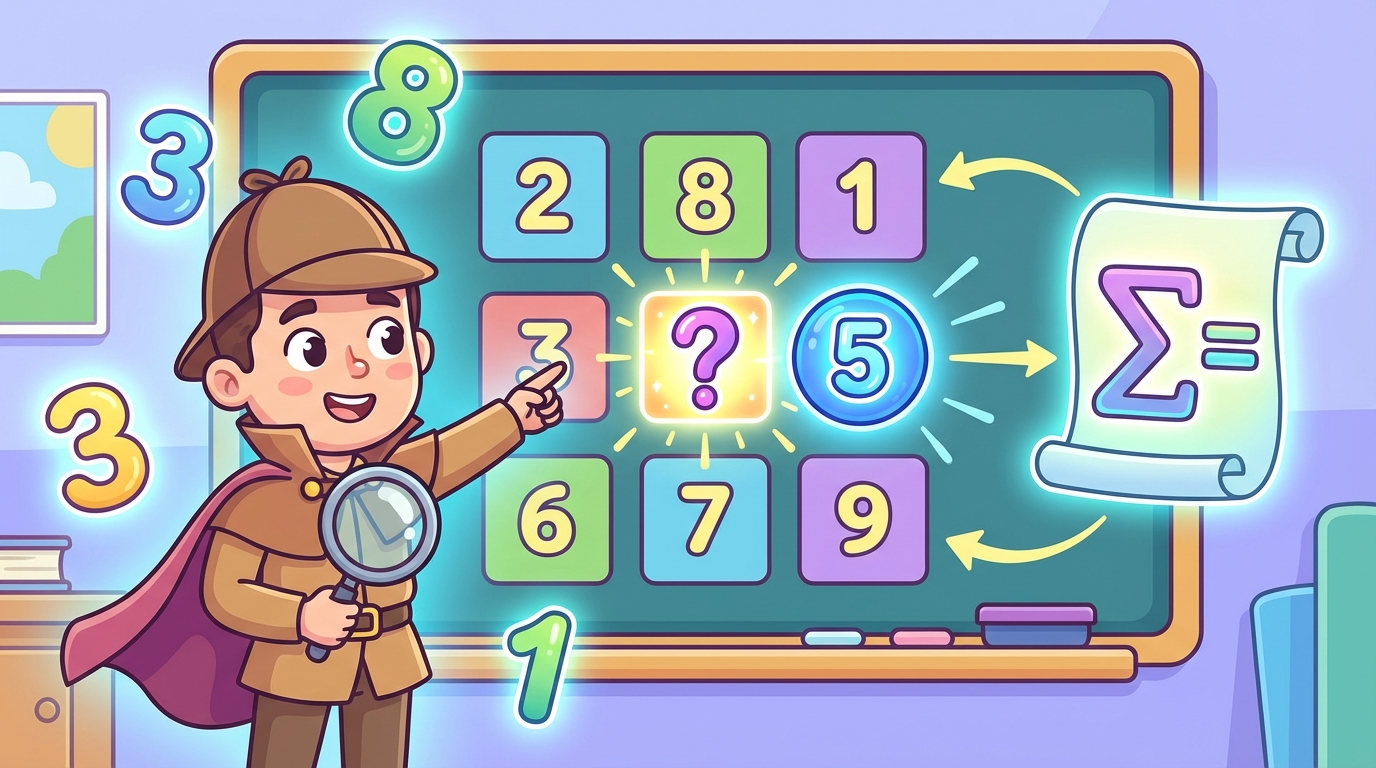
🕵️♂️ Become a Magic Detective!
In a 3x3 Magic Square, the center number is the most powerful clue of all. If you know the center number, you can instantly find the Magic Constant (the sum)!
For any odd-numbered magic square (like 3x3), there is a simple rule:
Center Number × 3 = Magic Constant
It works in reverse too! If you know the Magic Constant, just divide by 3 to find the center number.
Think of the center number as the 'average' of the whole square! ⚖️
| 8 | 1 | 6 |
| 3 | 5 | 7 |
| 4 | 9 | 2 |
Center: 5 × 3 = Sum: 15
🌟 Challenge Time
Imagine a huge magic square where the Magic Constant is 45. Can you predict what number is hiding in the center?
(Hint: What is 45 divided by 3?)
Key Facts
6 Solving Puzzles: Finding Missing Numbers
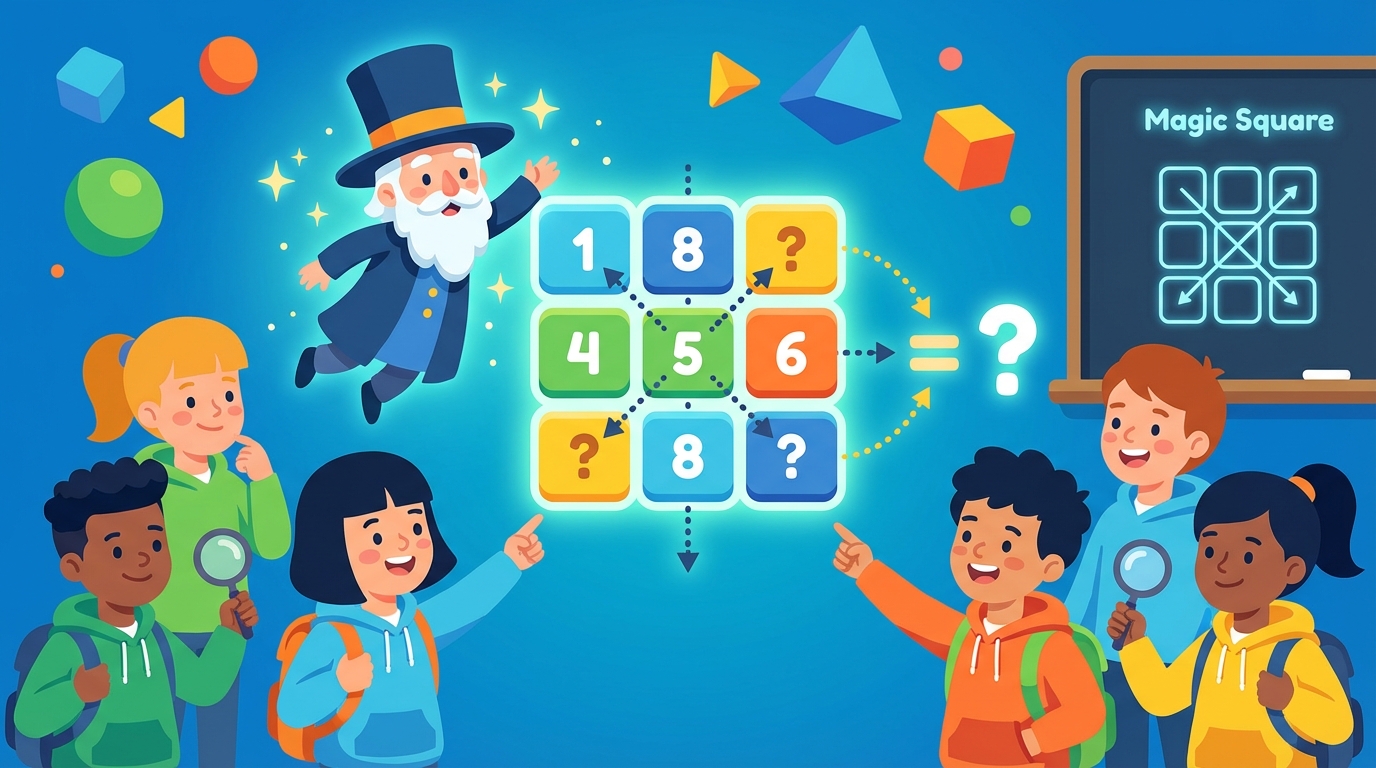
Welcome to the world of Magic Squares! 🎩✨ Imagine a number grid where every row, every column, and even the diagonals add up to the exact same number. That number is called the Magic Constant.
Look at this 3x3 grid. The Magic Constant is 15.
| 8 | 1 | 6 |
| 3 | ? | 7 |
| 4 | 9 | 2 |
To find the missing number in the middle, act like a math detective!
- Look at the middle row: We have 3 and 7.
- Add them up: 3 + 7 = 10.
- We know the total must be 15.
- Subtract the current sum from the magic number: 15 - 10 = 5.
Key Facts
7 Level Up: Introduction to 4x4 Magic Squares

Welcome to the Big Leagues! 🚀
You have mastered the classic 3x3 grid. Now, it is time to double the challenge. A 4x4 Magic Square has 4 rows and 4 columns, creating a total of 16 cells.
In a standard 4x4 square, we use the numbers 1 through 16 exactly once. But what do they add up to?
Every row, every column, and the two main diagonals must equal 34.
The most famous 4x4 square is found in an engraving called Melencolia I by the artist Albrecht Dürer. He created it way back in the year 1514.
Look at the grid below. Can you find the year 1514 hidden in the bottom row?
| 16 | 3 | 2 | 13 |
| 5 | 10 | 11 | 8 |
| 9 | 6 | 7 | 12 |
| 4 | 15 | 14 | 1 |
The Dürer Square: Rows, columns, and diagonals sum to 34. Even the four corners sum to 34! 🤯
Key Facts
8 Strategy: How to Build Your Own 3x3 Square
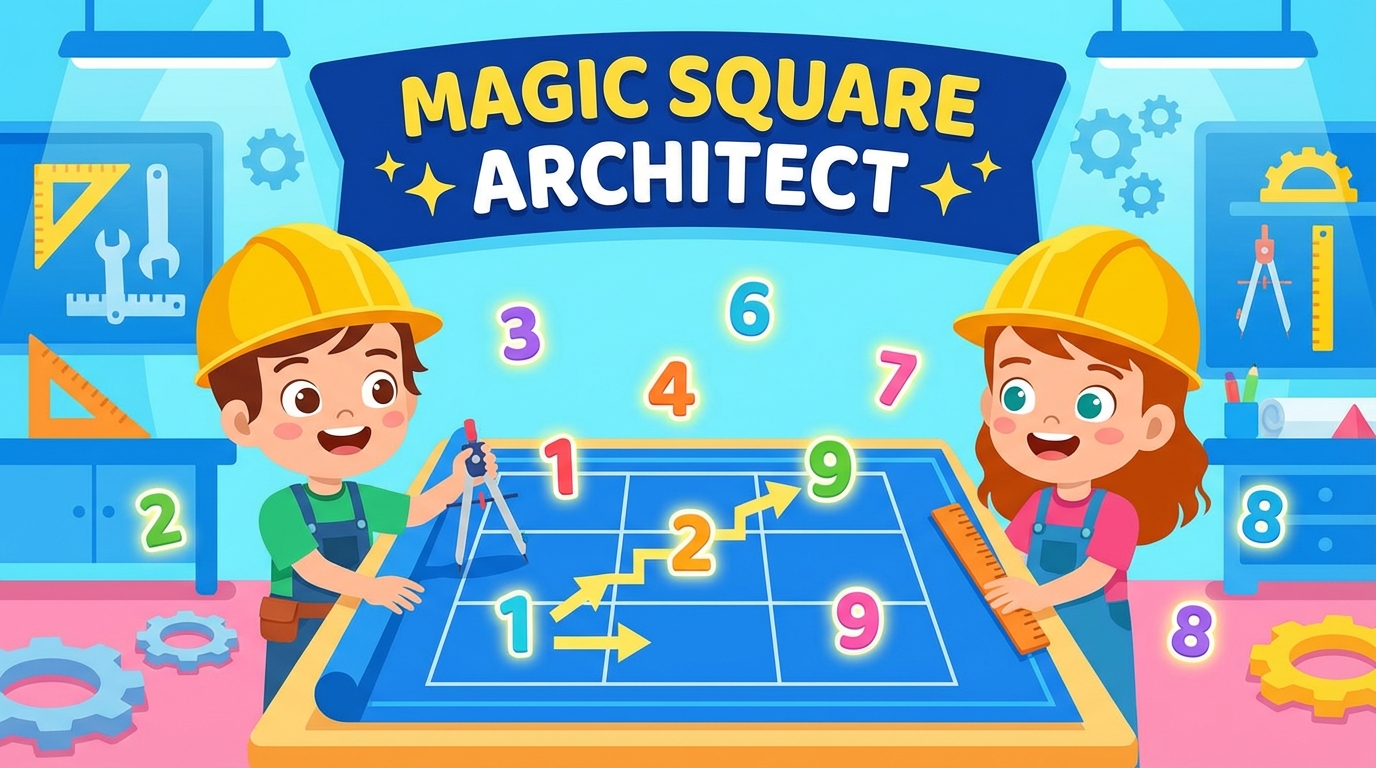
Ready to become a Magic Square Architect? 🏗️✨ You don't need to guess the numbers; you just need a secret map! We use a famous technique called the Siamese Method (or the Staircase Method) to build odd-numbered squares (3x3, 5x5, etc.).
- Start at the Top: Place the number 1 in the middle box of the top row.
- Move Up and Right: Always try to move diagonally ↗️ (one box up, one box right) to place the next number.
- The 'Pac-Man' Wrap: If you go off the grid, wrap around to the opposite side (like in a video game!).
- Off the top? Go to the bottom of that column.
- Off the right? Go to the left of that row.
🚧 What if I get stuck?
Sometimes, the square you want to move into is already occupied by a number! 🛑
The Fix: If the spot is taken (or you are at the top-right corner), do not go diagonal. Instead, drop down one box directly below the number you just wrote.
🏆 The Result: The Lo Shu Grid
If you follow the steps with numbers 1-9, you get this famous arrangement where every row, column, and diagonal adds up to 15!
| 8 | 1 | 6 |
| 3 | 5 | 7 |
| 4 | 9 | 2 |
Key Facts
9 Symmetry in Math: Rotating and Reflecting Squares

Did you know that one Magic Square is actually eight different squares in disguise? 🎭 Thanks to the power of symmetry, we can transform a square without breaking its magic!
🔄 The Art of Rotation
Imagine holding a Magic Square like a steering wheel. If you turn it 90 degrees to the right, the rows become columns, and the columns become rows. But guess what? The numbers still add up to the same Magic Constant!
| 4 | 9 | 2 |
| 3 | 5 | 7 |
| 8 | 1 | 6 |
| 8 | 3 | 4 |
| 1 | 5 | 9 |
| 6 | 7 | 2 |
*Check the sums! In the rotated square, 8+3+4 = 15. The magic is still there!
🪞 Reflection: Looking in the Mirror
Reflection is when you flip the square over a line, just like looking in a mirror. You can flip it horizontally, vertically, or diagonally.
- ↔️ Horizontal Flip: Top row swaps with bottom row.
- ↕️ Vertical Flip: Left column swaps with right column.
Key Facts
10 Key Vocabulary
Master these important terms for your exam:
| Term | Definition |
|---|---|
|
Magic Square
Cuadrado mágico |
A square grid of numbers where the sum of each row, column, and diagonal is the same.
Una cuadrícula cuadrada de números donde la suma de cada fila, columna y diagonal es la misma. |
|
Magic Constant
Constante mágica |
The specific number that every row, column, and diagonal adds up to in a magic square.
El número específico al que suman todas las filas, columnas y diagonales en un cuadrado mágico. |
|
Order
Orden |
The number of rows or columns in the square (e.g., a 3x3 grid has an order of 3).
El número de filas o columnas en el cuadrado (por ejemplo, una cuadrícula de 3x3 tiene un orden de 3). |
|
Grid
Cuadrícula |
A pattern of horizontal and vertical lines that form squares.
Un patrón de líneas horizontales y verticales que forman cuadrados. |
|
Cell
Celda / Casilla |
An individual box within the grid that holds a single number.
Un cuadro individual dentro de la cuadrícula que contiene un solo número. |
|
Row
Fila |
A horizontal line of numbers going from left to right.
Una línea horizontal de números que va de izquierda a derecha. |
|
Column
Columna |
A vertical line of numbers going from top to bottom.
Una línea vertical de números que va de arriba a abajo. |
|
Diagonal
Diagonal |
A straight line of cells connecting opposite corners through the center.
Una línea recta de celdas que conecta esquinas opuestas pasando por el centro. |
|
Sum
Suma |
The total amount resulting from adding two or more numbers together.
La cantidad total resultante de sumar dos o más números. |
|
Integer
Número entero |
A whole number that is not a fraction or a decimal.
Un número completo que no es una fracción ni un decimal. |
|
Normal Magic Square
Cuadrado mágico normal |
A magic square that uses consecutive integers starting from 1.
Un cuadrado mágico que utiliza números enteros consecutivos comenzando desde el 1. |
|
Distinct
Distinto |
Different or unique; no number is repeated in the grid.
Diferente o único; ningún número se repite en la cuadrícula. |
|
Center Number
Número central |
The number located in the exact middle cell of an odd-ordered magic square.
El número ubicado en la celda del medio exacto de un cuadrado mágico de orden impar. |
|
Pattern
Patrón |
A repeated arrangement or sequence that follows a rule.
Una disposición o secuencia repetida que sigue una regla. |
|
Formula
Fórmula |
A mathematical rule describing the relationship between quantities.
Una regla matemática que describe la relación entre cantidades. |
Time to Practice!
There are 7 questions waiting for you. Questions are shuffled each attempt.
Take the Quiz