Order of Operations
Learn the correct sequence to solve mathematical expressions using the PEMDAS method.
1 Why Order Matters: The Traffic Rules of Math
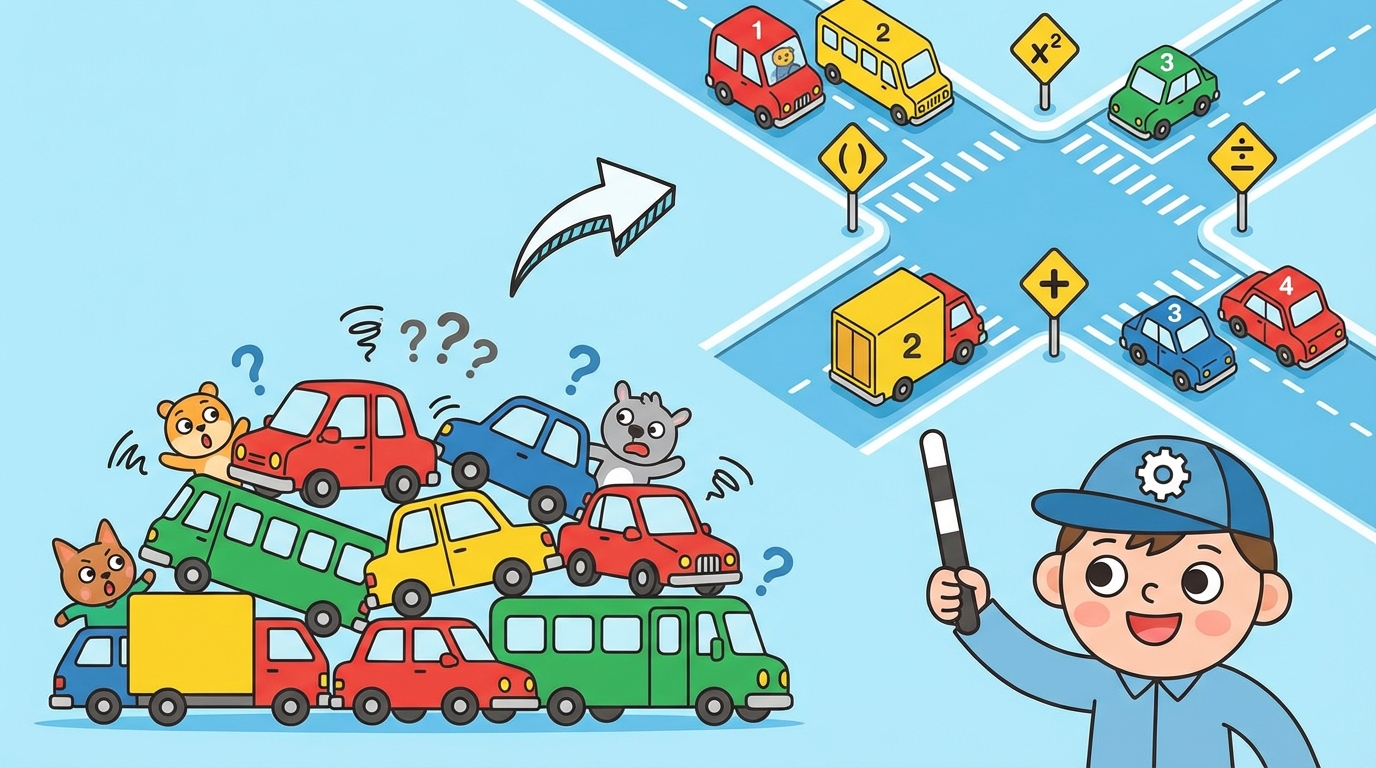
Imagine a busy intersection with no stop signs and no traffic lights. 🚗💥 Chaos, right? Just like drivers need rules to stay safe, numbers need rules to make sense!
🤔 The Big Question
Let's look at this math problem: 3 + 5 × 2. What is the answer?
They added 3 + 5 first (to get 8), then multiplied by 2.
They multiplied 5 × 2 first (to get 10), then added 3.
Who is right? Without rules, we cannot agree on the answer!
🚦 The Traffic Lights of Math
In mathematics, we have a specific set of rules called the Order of Operations. These rules tell us which part of an equation to solve first, second, and last. It ensures that a student in New York gets the exact same answer as a student in Tokyo!
Key Facts
2 Meet PEMDAS: The Roadmap for Success
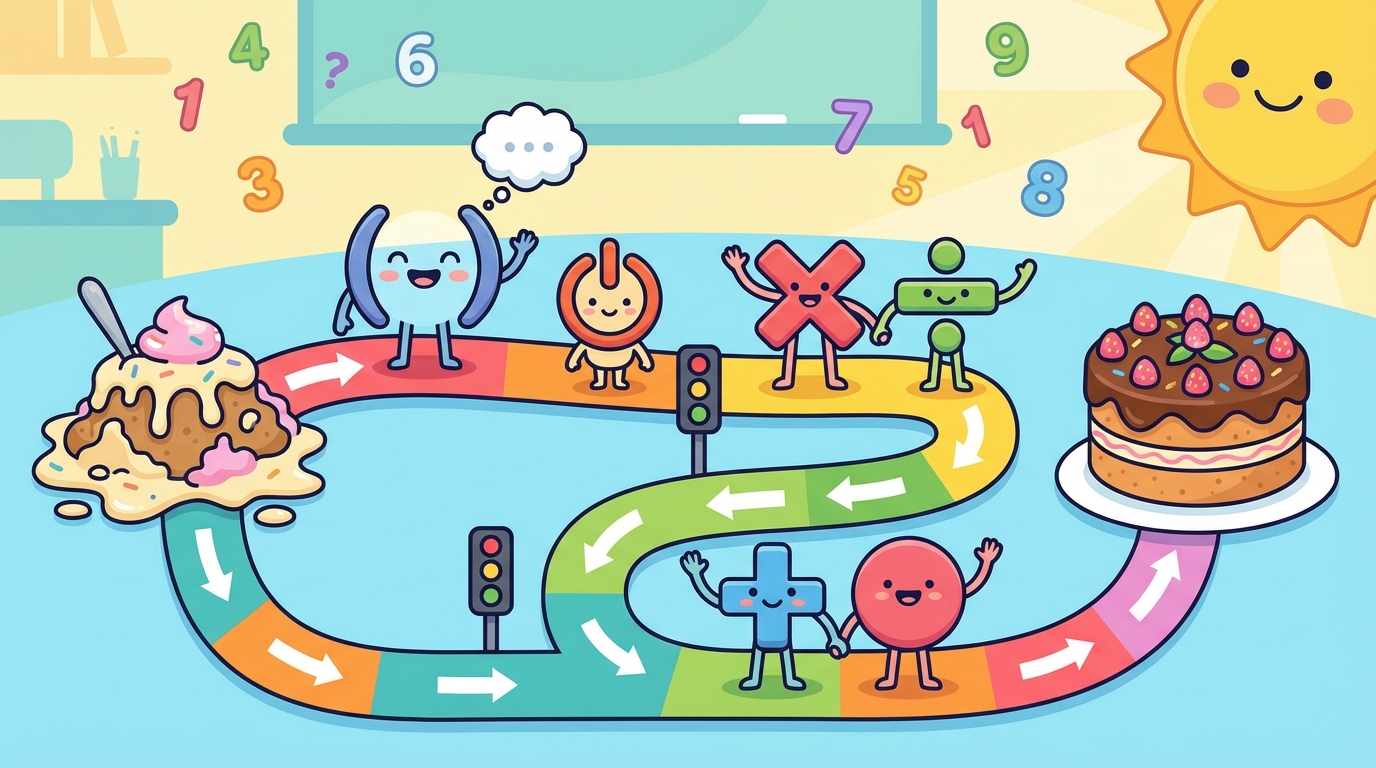
Imagine trying to bake a cake 🎂 but you put the frosting on before you bake it! It would be a mess, right? Math is the same way. We need a specific order to solve problems correctly.
🚦 What is PEMDAS?
PEMDAS is an acronym (a word made from the first letters of other words) that acts as our roadmap. It tells us exactly which part of a math problem to solve first.
| Letter | Stands For | Action |
|---|---|---|
| P | Parentheses | ( ) or [ ] - Do this FIRST! |
| E | Exponents | x² - Powers and roots |
| M / D | Multiply / Divide | ✖️ or ➗ (Left to Right) |
| A / S | Add / Subtract | ➕ or ➖ (Left to Right) |
⚠️ The 'Left-to-Right' Rule
This is the trickiest part! Multiplication and Division are tied for 3rd place. Addition and Subtraction are tied for last place. When you see ties, just solve them from left to right, like reading a book!
10 - 2 + 3 = ?If we just follow PEMDAS letters strictly, we might add (A) before subtracting (S). But they are tied! So we go left to right:
1.
10 - 2 = 82.
8 + 3 = 11 ✅ (Correct answer)Key Facts
3 Step 1: Parentheses, Brackets, and Braces
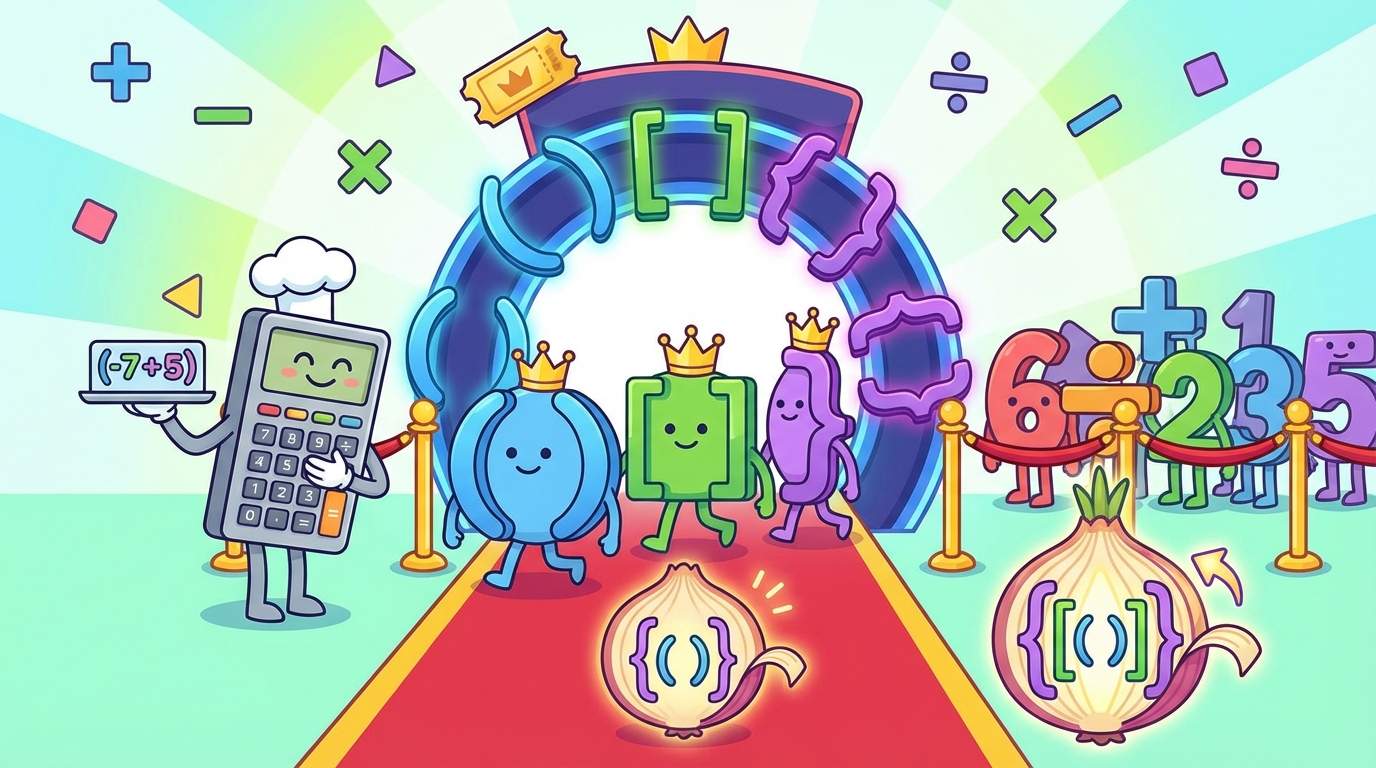
Welcome to the VIP Section of mathematics! 🎟️ In the Order of Operations, grouping symbols are the most important guests—they always get served first.
🧅 The Inside-Out Rule
Think of grouping symbols like layers of an onion or a set of nesting boxes. You must always solve the innermost group first and work your way out!
()
Parentheses
Start here!
[]
Brackets
Solve these next.
{}
Braces
Solve these last.
- Find the innermost ( ):
3 + 1 = 4 → 4 + { 10 - [ 2 + 4 ] } - Now solve the [ ]:
2 + 4 = 6 → 4 + { 10 - 6 } - Next, solve the { }:
10 - 6 = 4 → 4 + 4 - Finish:
4 + 4 = 8 ✅
Key Facts
4 Step 2: Exponents and Powers
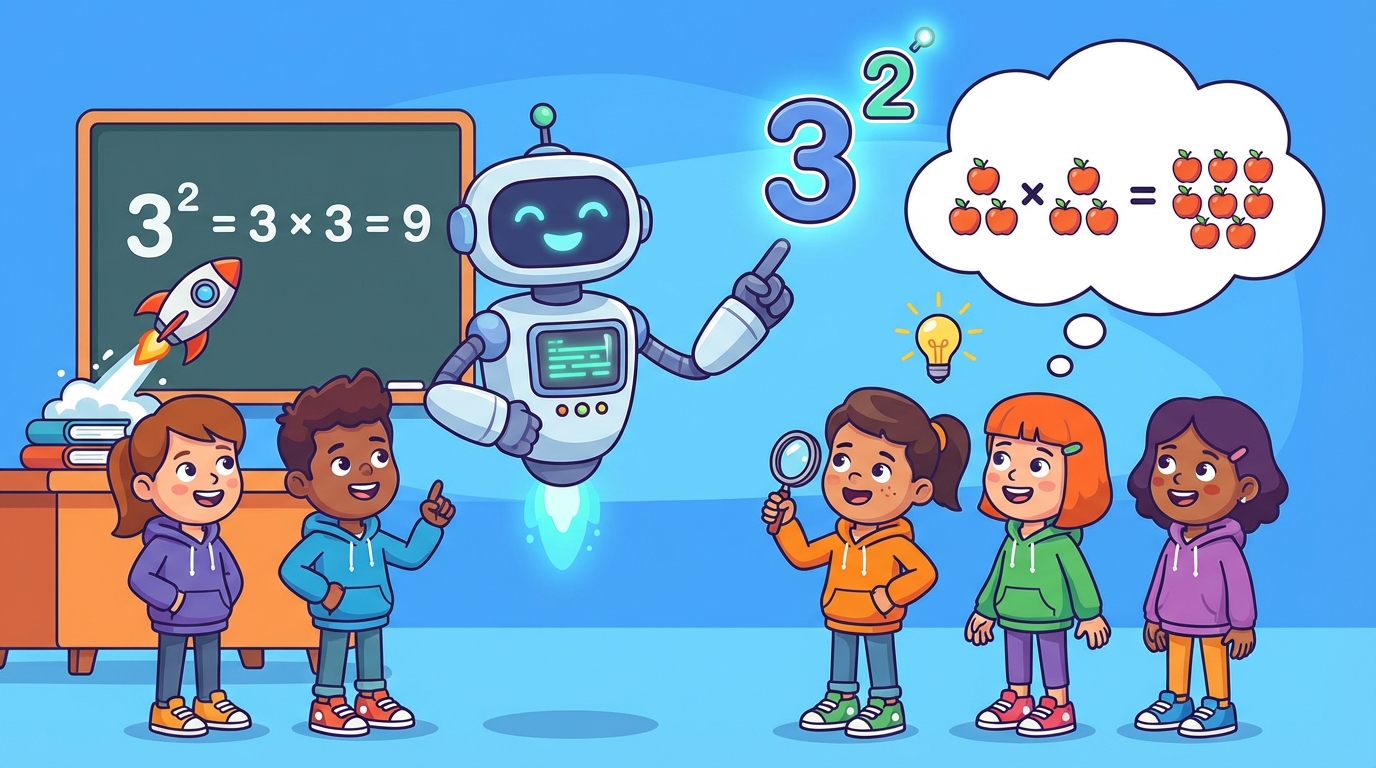
Welcome to the 'E' in PEMDAS! After you finish the Parentheses, look for Exponents. These are the tiny numbers that float above the big numbers. 🚀
An exponent tells you how many times to multiply the base (the big number) by itself.
34
Means: 3 × 3 × 3 × 3
(The base '3' is multiplied 4 times)Don't get tricked! A common mistake is multiplying the big number by the little number.
| Expression | ❌ Wrong Way | ✅ Right Way |
|---|---|---|
| 52 | 5 × 2 = 10 | 5 × 5 = 25 |
| 23 | 2 × 3 = 6 | 2 × 2 × 2 = 8 |
💡 Pro Tip:
Think of exponents as 'Power Ups' in a video game. They make the number grow much faster than normal multiplication!
Key Facts
5 Step 3: Multiplication and Division (Left to Right!)
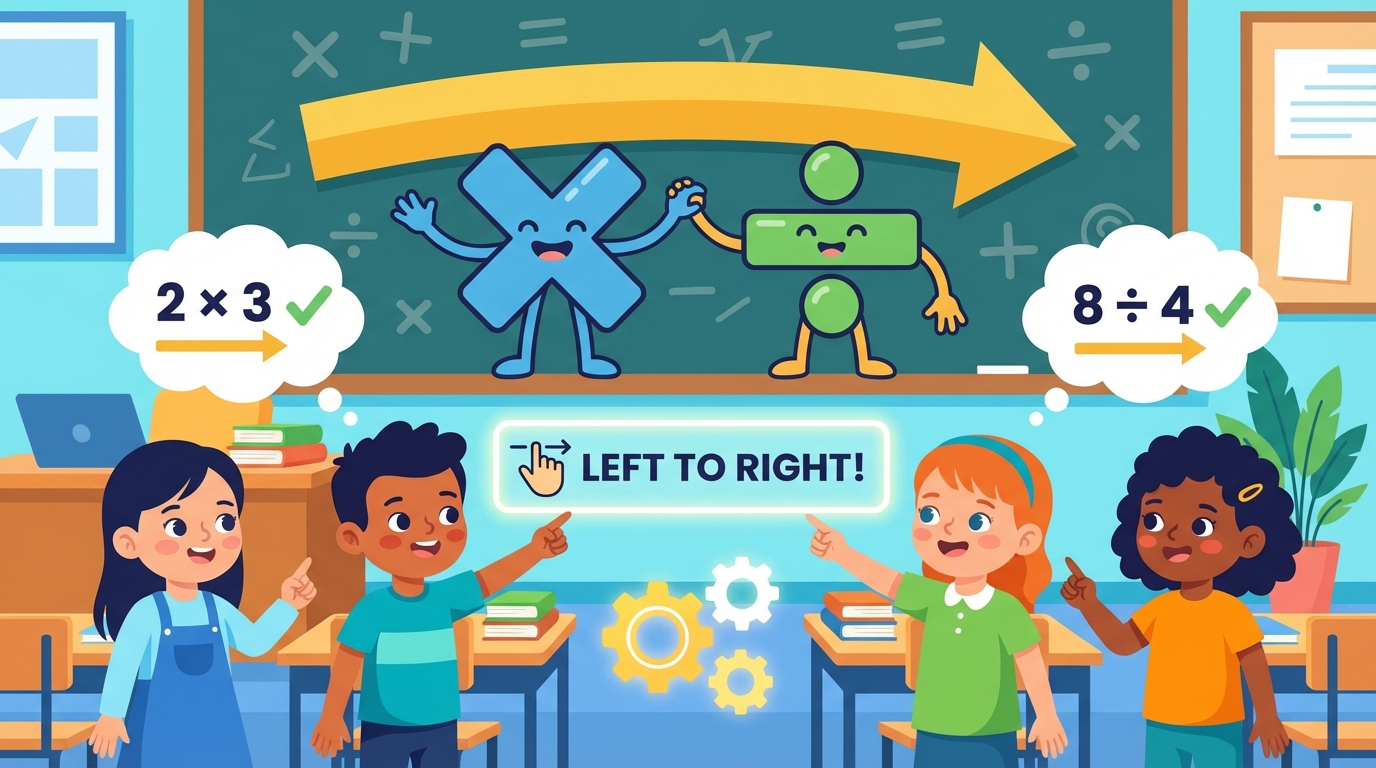
Now that we have handled Parentheses and Exponents, we meet the Power Couple of math: Multiplication and Division! 🤝
⚠️ The Golden Rule
Multiplication and Division have equal power. One is not stronger than the other! You must solve them from left to right, just like reading a sentence in a book.
✅ The Correct Way (Left to Right)
First, we see division on the left:
20 ÷ 5 = 4
Then, we multiply by 2:
4 × 2 = 8
Result: 8
❌ The Wrong Way (Skipping Ahead)
If you multiply first just because 'M' comes before 'D' in PEMDAS:
5 × 2 = 10
20 ÷ 10 = 2
Result: 2 (Oops!)
Think of Multiplication and Division as siblings who share a room. Neither is the boss; whoever gets to the door first (on the left) goes first! 🏃💨
Key Facts
6 Step 4: Addition and Subtraction (Left to Right!)
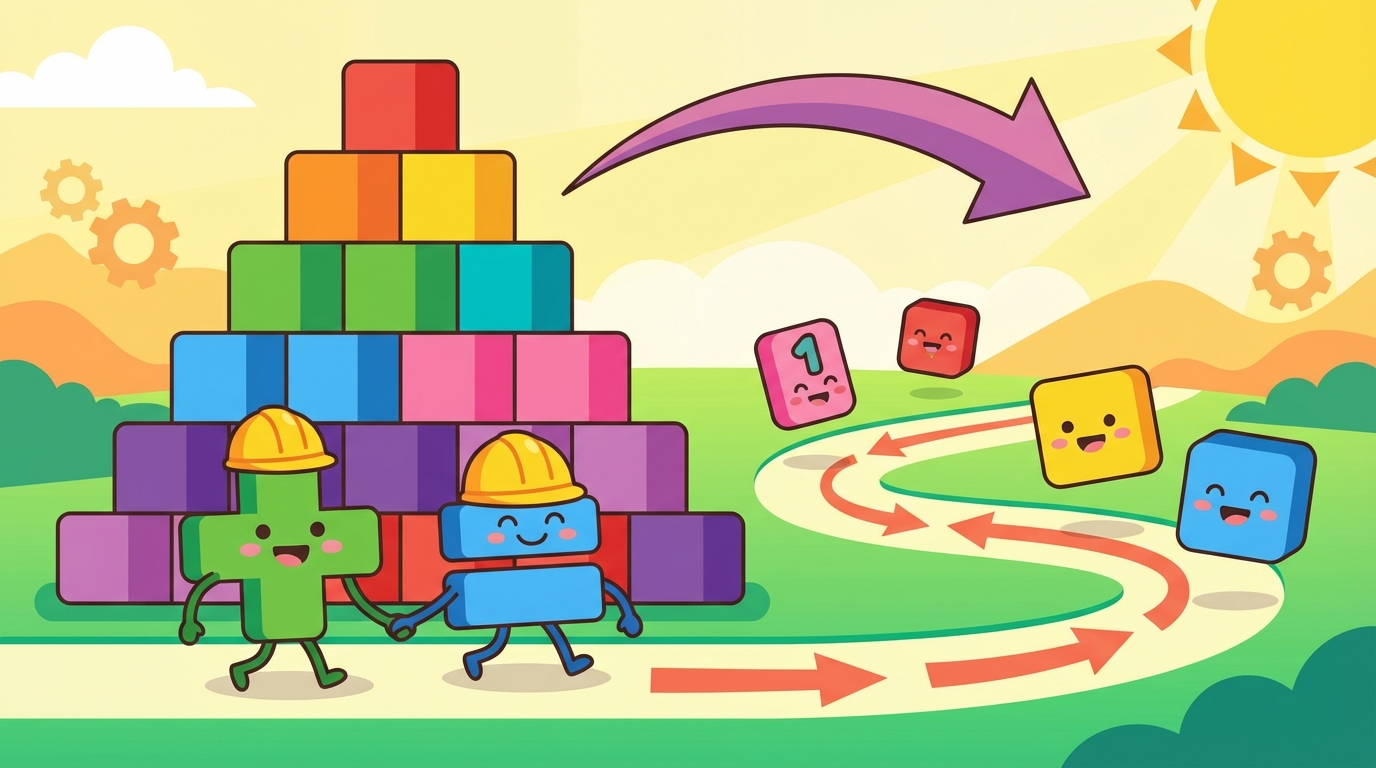
We have finally reached the bottom of the Order of Operations pyramid! 🏗️ Here sit Addition and Subtraction.
⚠️ The Big Secret
Even though 'A' comes before 'S' in PEMDAS, Addition is NOT more important than Subtraction. They are equal partners!
When you only have addition and subtraction left in your math problem, you must solve them exactly like you read a book: from Left to Right ➡️.
10 - 4 + 3
1. Start at the left: 10 - 4 = 6
2. Then add: 6 + 3 = 9
Result: 9
10 - 4 + 3
1. Adding first (oops!): 4 + 3 = 7
2. Then subtracting: 10 - 7 = 3
Result: 3
Think of it like a Bus Route 🚌:
Imagine a bus starts with 10 people. At the first stop, 4 people get off (minus). At the next stop, 3 people get on (plus). You have to count the passengers in the order the stops happen!
Key Facts
7 Level Up: Solving Nested Parentheses
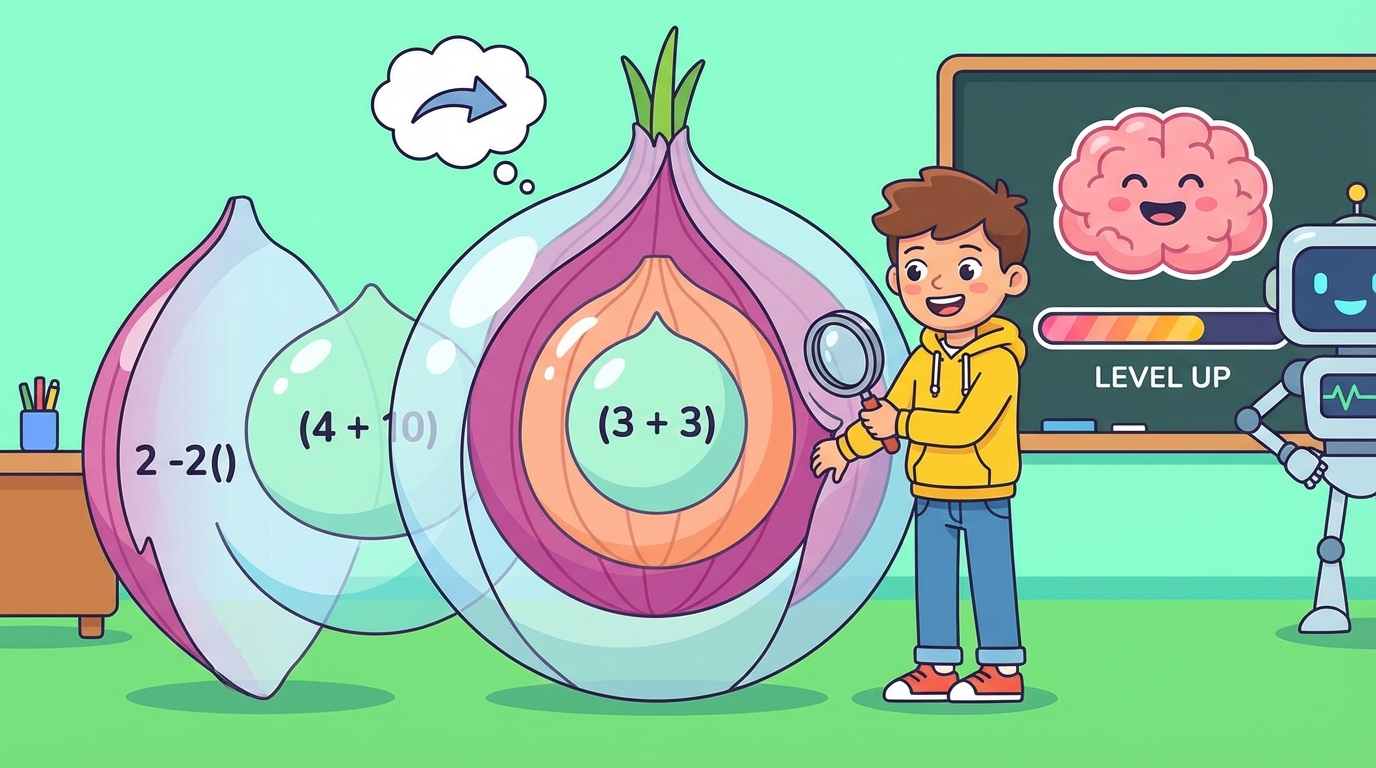
You've mastered basic parentheses, but what happens when they are inside each other? Welcome to the world of Nested Parentheses! 🎁
🧅 The 'Onion' Rule
Think of nested parentheses like layers of an onion or a gift box inside another box. You must always solve the innermost (deepest) set first and work your way outwards.
Here we have parentheses ( ) inside of brackets [ ].
| Step | Action | Equation |
|---|---|---|
| 1 | Find the innermost group | 40 - [2 + (3 × 4)] |
| 2 | Solve the inside: 3 × 4 = 12 | 40 - [2 + 12] |
| 3 | Now solve the outer brackets | 40 - [2 + 12] |
| 4 | Solve the brackets: 2 + 12 = 14 | 40 - 14 |
| 5 | Finish the math! | 26 ✅ |
Key Facts
8 The Fraction Bar: Invisible Grouping Symbols
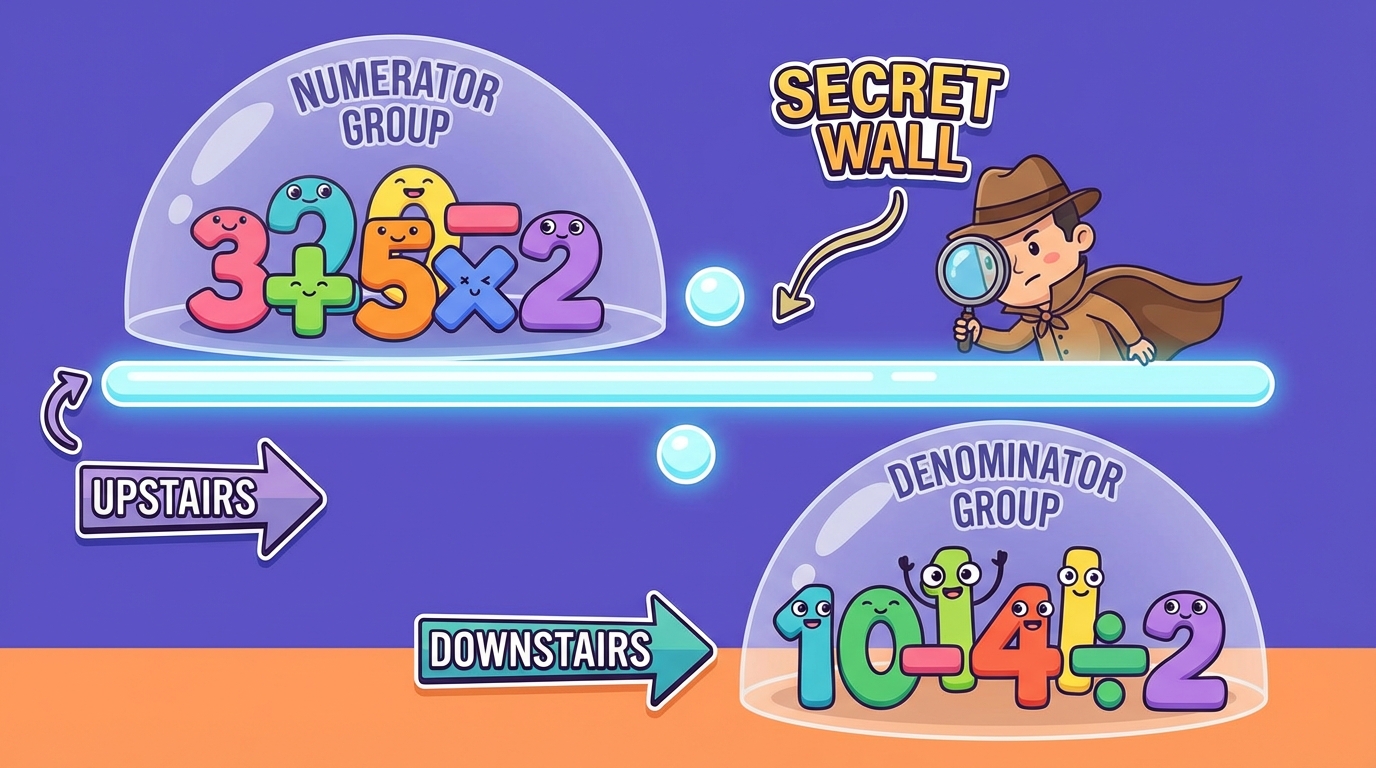
The Sneaky Separator!
Did you know the fraction bar is actually a secret grouping symbol? 🕵️♀️
When you see a long fraction bar, it acts like a wall between the upstairs (numerator) and the downstairs (denominator). It tells you: 'Hey! Solve everything on top and everything on the bottom BEFORE you divide!'
$$\frac{4 + 6}{2}$$ is the same as $$(4 + 6) \div 2$$
Let's Solve a Mystery: The Two-Story House 🏠
The Problem:
$$\frac{10 + 2 \times 3}{8 - 4}$$
| Step | Action | Result |
|---|---|---|
| 1. Upstairs | Multiply then add ($10 + 6$) | 16 |
| 2. Downstairs | Subtract ($8 - 4$) | 4 |
| 3. Divide | Divide the top by the bottom ($16 \div 4$) | 4 |
* Remember: If you try to divide too early, the whole house collapses! Finish the floors first.
Key Facts
9 Warning: Common Mistakes to Avoid
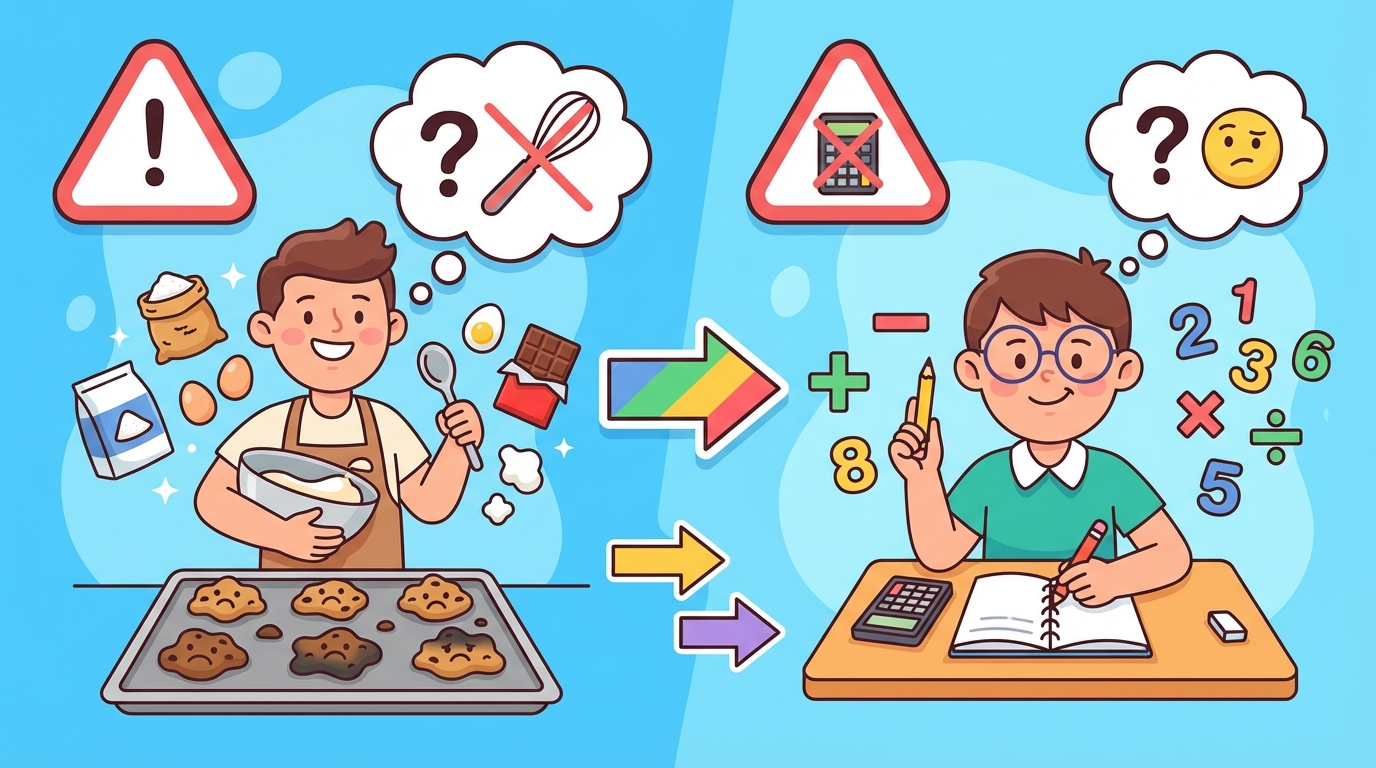
Math is like a recipe 🍪: if you mix the ingredients in the wrong order, the cookies won't taste right! In the Order of Operations, skipping steps or guessing can lead to completely different answers. Watch out for these common traps!
The biggest mistake is solving a problem exactly like you read a sentence (left to right) without checking for multiplication or division first.
Multiplication (M) and Division (D) are siblings with equal power. The same goes for Addition (A) and Subtraction (S). When they appear together, you must go left to right!
💡 Pro Tip: The 'Hidden' Multiplication
Sometimes multiplication is invisible! If you see a number touching a parenthesis like 2(3+1), it means 2 × (3+1). Don't forget to multiply after you solve the inside!
Key Facts
10 Writing Numerical Expressions from Words
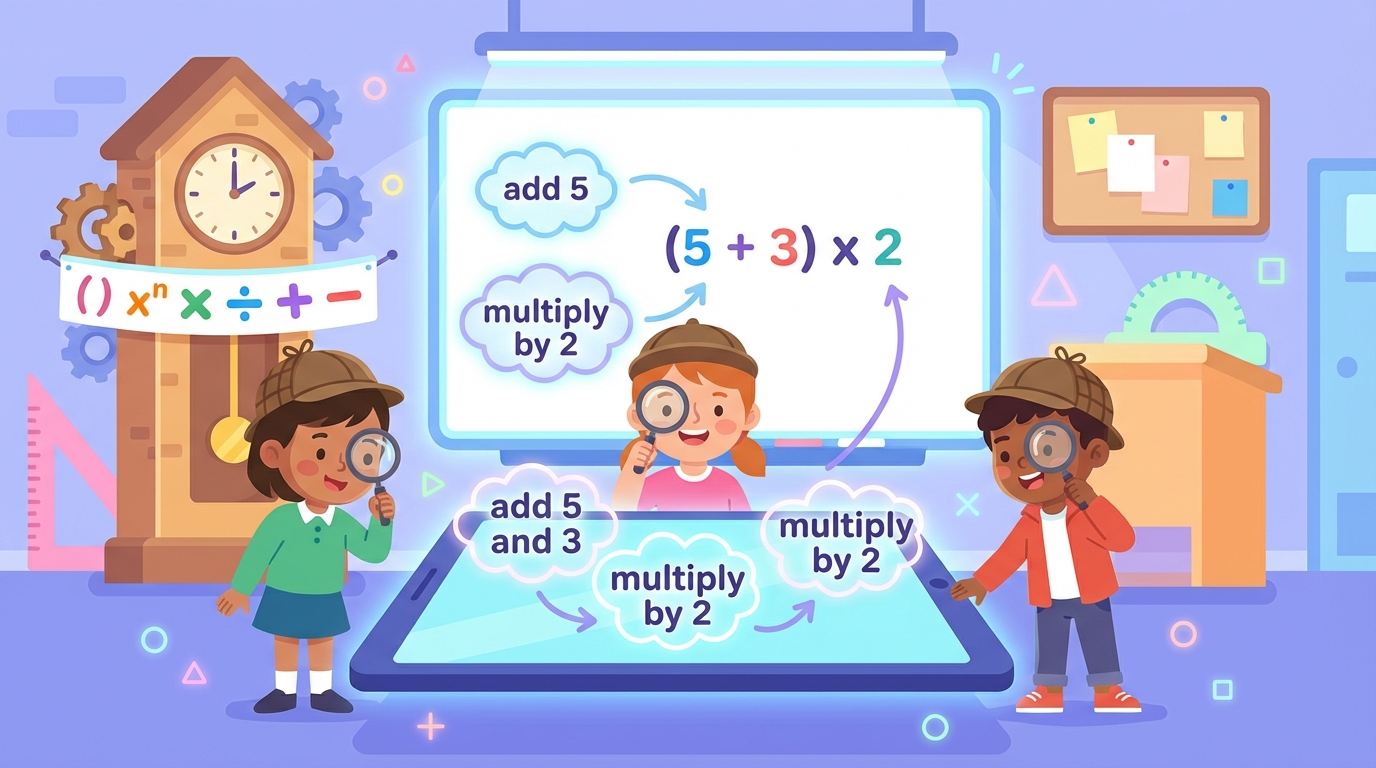
🕵️♀️ Be a Math Translator!
Mathematics is its own language! Just like you translate Spanish to English, you can translate words into numbers and symbols. This is the first step before we use the Order of Operations to solve a problem.
🔑 Keyword Decoder
| Operation | Clue Words |
|---|---|
| + (Add) | Sum, plus, increased by, more than, total |
| - (Subtract) | Difference, minus, decreased by, less than |
| × (Multiply) | Product, times, twice, double, 'of' |
| ÷ (Divide) | Quotient, split, ratio, shared equally |
🛡️ The Power of Parentheses
In the Order of Operations (PEMDAS), parentheses come first. In words, phrases like 'the sum of' or 'the difference of' often act like a verbal hug—they tell you to group those numbers together inside parentheses!
'Twice the sum of 4 and 5'
❌ Wrong: 2 × 4 + 5
✅ Right: 2 × (4 + 5)
⚠️ Watch Out: The 'Less Than' Trap!
The phrase 'less than' is tricky. It switches the order!
'3 less than 10' is written as 10 - 3, not 3 - 10.
Key Facts
11 Key Vocabulary
Master these important terms for your exam:
| Term | Definition |
|---|---|
|
Order of Operations
Orden de las operaciones |
The set of rules that determines the sequence in which calculations should be done.
El conjunto de reglas que determina la secuencia en la que se deben realizar los cálculos. |
|
PEMDAS
PEMDAS |
An acronym to remember the order: Parentheses, Exponents, Multiplication, Division, Addition, Subtraction.
Un acrónimo para recordar el orden: Paréntesis, Exponentes, Multiplicación, División, Suma, Resta. |
|
Numerical Expression
Expresión numérica |
A mathematical phrase involving numbers and operation symbols, but no variables.
Una frase matemática que incluye números y símbolos de operación, pero sin variables. |
|
Evaluate
Evaluar |
To find the value of a numerical expression.
Encontrar el valor de una expresión numérica. |
|
Simplify
Simplificar |
To perform operations to combine numbers and get a single value.
Realizar operaciones para combinar números y obtener un solo valor. |
|
Grouping Symbols
Símbolos de agrupación |
Symbols like parentheses ( ), brackets [ ], and braces { } that tell you which operations to perform first.
Símbolos como paréntesis ( ), corchetes [ ] y llaves { } que indican qué operaciones realizar primero. |
|
Parentheses
Paréntesis |
Curved symbols ( ) used to group parts of an expression together.
Símbolos curvos ( ) utilizados para agrupar partes de una expresión. |
|
Brackets
Corchetes |
Square symbols [ ] used as a second level of grouping outside of parentheses.
Símbolos cuadrados [ ] utilizados como un segundo nivel de agrupación fuera de los paréntesis. |
|
Exponents
Exponentes |
A small number placed to the upper right of a base number that shows how many times the base is multiplied by itself.
Un número pequeño colocado en la parte superior derecha de un número base que muestra cuántas veces se multiplica la base por sí misma. |
|
Base
Base |
The number that is being multiplied by itself when using an exponent.
El número que se multiplica por sí mismo cuando se usa un exponente. |
|
Power
Potencia |
The result of using an exponent; for example, 3 to the power of 2.
El resultado de usar un exponente; por ejemplo, 3 a la potencia de 2. |
|
Squared
Al cuadrado |
A number raised to the second power (exponent of 2).
Un número elevado a la segunda potencia (exponente de 2). |
|
Cubed
Al cubo |
A number raised to the third power (exponent of 3).
Un número elevado a la tercera potencia (exponente de 3). |
|
Left to Right
De izquierda a derecha |
The direction you must follow when solving multiplication and division, or addition and subtraction.
La dirección que debes seguir al resolver multiplicación y división, o suma y resta. |
|
Product
Producto |
The answer to a multiplication problem.
El resultado de un problema de multiplicación. |
|
Quotient
Cociente |
The answer to a division problem.
El resultado de un problema de división. |
Time to Practice!
There are 7 questions waiting for you. Questions are shuffled each attempt.
Take the Quiz