Place Value
Understand the base-10 system, including reading, writing, and comparing multi-digit whole numbers and decimals.
1 The Base-10 System: How Numbers Work
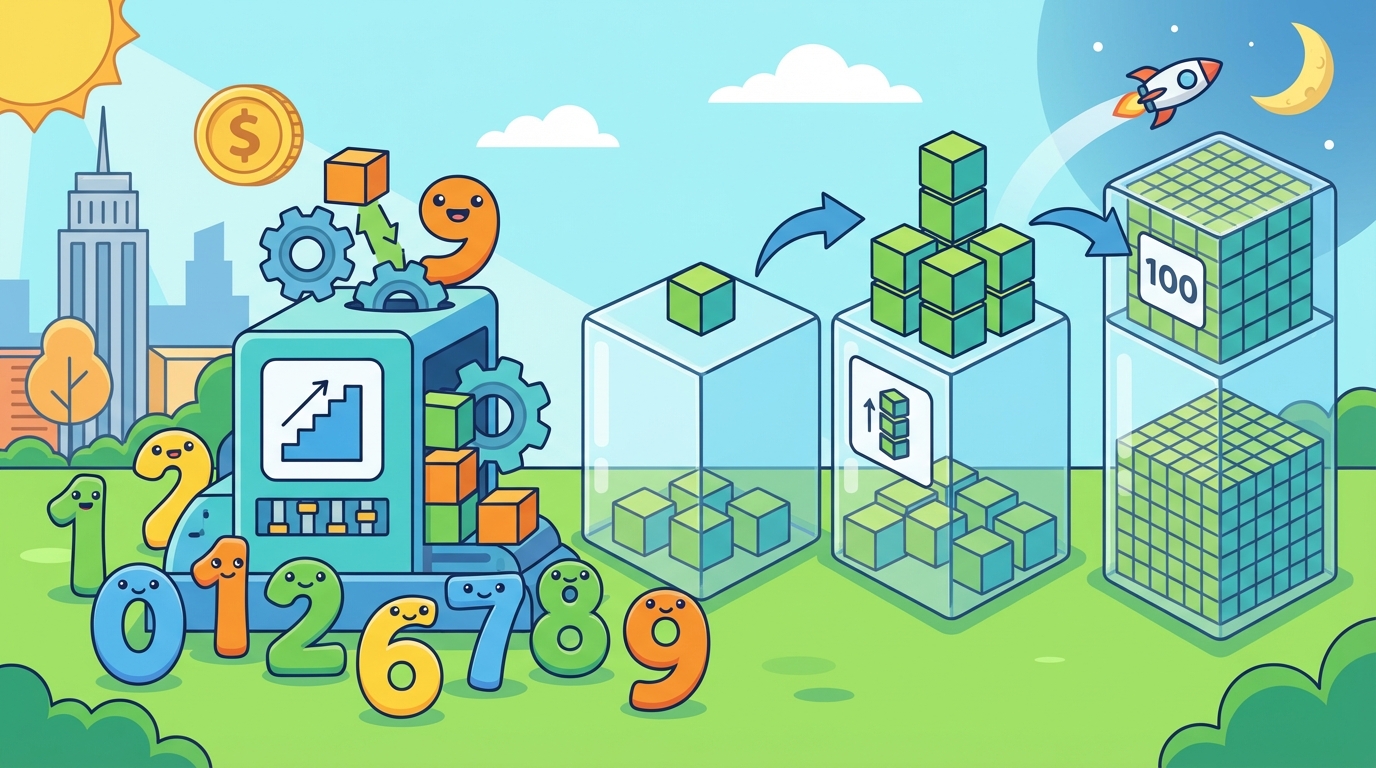
👋 Welcome to the Decimal System!
Did you know that every number used to build skyscrapers, calculate money, or measure the distance to the moon is made of the same 10 symbols? These are called digits: 0, 1, 2, 3, 4, 5, 6, 7, 8, and 9.
In our system, the value of a digit depends on where it is sitting. This is called Place Value.
Imagine the digit 5:
- In the Ones place: It is just 5.
- In the Tens place: It becomes 50.
- In the Hundreds place: It becomes 500!
Why is it called Base-10? Because every time you move one step to the left, the value gets 10 times bigger.
It is like leveling up in a video game; each level is 10x harder (and worth more) than the last!
📊 Place Value Chart Example
| Thousands (1,000) | Hundreds (100) | Tens (10) | Ones (1) |
|---|---|---|---|
| 2 | 4 | 7 | 5 |
| 2 × 1,000 = 2,000 | 4 × 100 = 400 | 7 × 10 = 70 | 5 × 1 = 5 |
Total Value: Two thousand, four hundred seventy-five (2,475)
Key Facts
2 Big Numbers: Millions, Billions, and Beyond

Have you ever tried to count the stars in the sky? 🌟 Once we get past thousands, we enter the world of huge numbers! Let's explore how we organize them.
In our number system, digits are grouped into families called periods. Each period has three spots (Hundreds, Tens, Ones) and is separated by a comma.
| Billions Period | Millions Period | Thousands Period | Ones Period |
|---|---|---|---|
| B, H T O | M, H T O | Th, H T O | O, H T O |
| 2 | 450 | 123 | 789 |
Read as: Two billion, four hundred fifty million, one hundred twenty-three thousand, seven hundred eighty-nine.
It's hard to imagine! Think about time:
- 1 Million seconds is about 11 and a half days.
- 1 Billion seconds is about 31 years and 8 months!
When writing these big numbers, we use commas to help us read.
Standard: 5,000,000,000
Word: Five Billion
Expanded: 5 × 1,000,000,000
Key Facts
3 The Decimal Point: Understanding Parts of a Whole
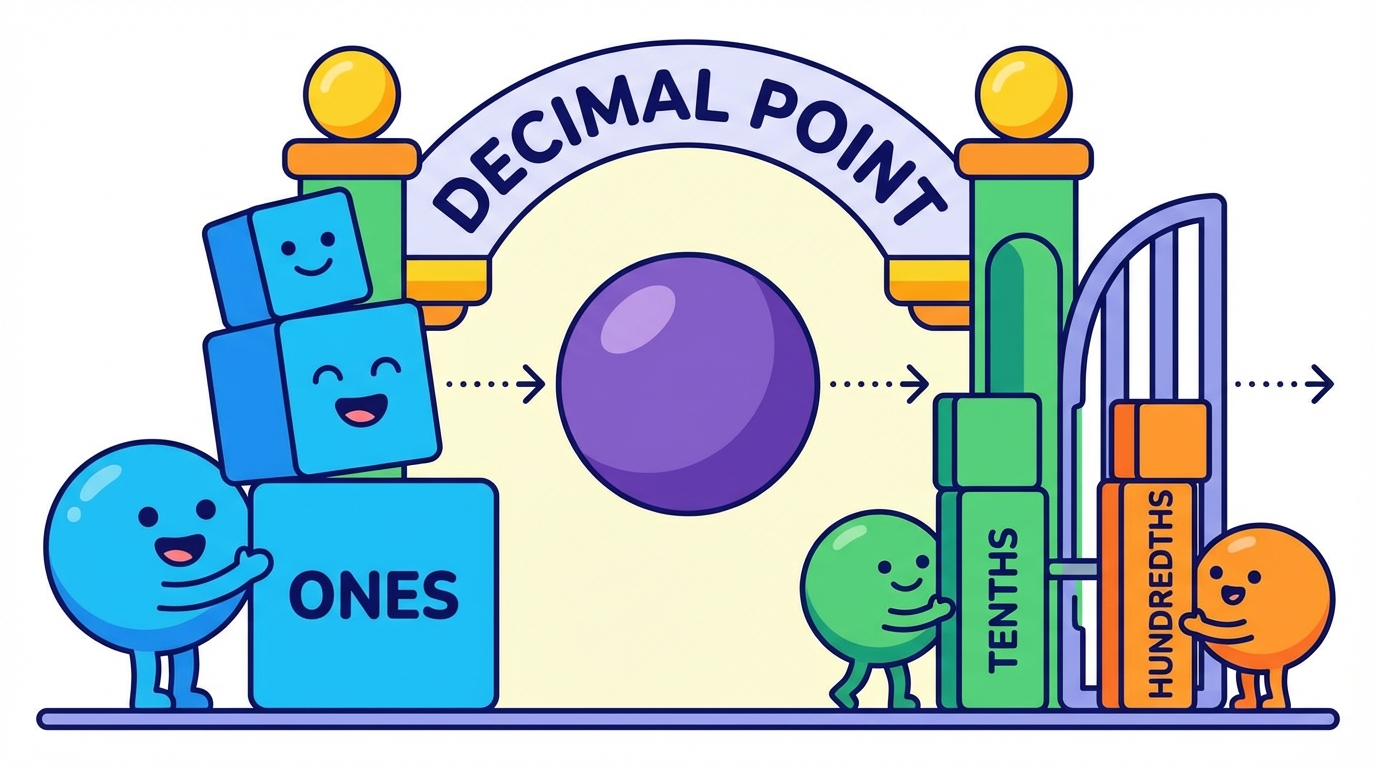
Think of the decimal point as a powerful separator or a gatekeeper! 🛡️
📍 The Magic Dot
The decimal point sits right between the Ones place and the Tenths place. It has a very important job:
- 👈 To the Left: These are Whole Numbers (like whole pizzas 🍕).
- 👉 To the Right: These are Parts of a Whole (like slices 🍰).
💰 Real Life Example: Money
Money is the easiest way to understand decimals. The decimal point separates the dollars from the cents.
| Number | Whole Dollars | Point | Parts (Cents) |
|---|---|---|---|
| $5.25 | 5 (Wholes) | . | 25 (Parts) |
| $0.99 | 0 (None) | . | 99 (Parts) |
| $100.00 | 100 (Wholes) | . | 00 (No parts) |
Key Facts
4 Decimal Place Value: Tenths, Hundredths, and Thousandths

🔍 Zooming In on Numbers!
You already know about whole numbers (Ones, Tens, Hundreds). But what happens when we have less than one whole? We use decimals! The decimal point is like a gatekeeper that separates the whole numbers from the tiny pieces.
| Ones 1 | . | Tenths 1/10 | Hundredths 1/100 | Thousandths 1/1000 |
|---|---|---|---|---|
| 5 | . | 2 | 4 | 8 |
| Read as: 'Five and two hundred forty-eight thousandths' | ||||
🍕 Breaking it Down
- Tenths (0.1): Imagine a pizza cut into 10 slices. One slice is one tenth.
- Hundredths (0.01): Imagine that pizza cut into 100 tiny bites. One bite is one hundredth.
- Thousandths (0.001): Imagine 1,000 crumbs! These are super small.
🏃 Real Life: The Olympics
In race times, every second counts! If a runner finishes in 9.583 seconds:
- 9 seconds (Ones)
- 5 tenths of a second
- 8 hundredths of a second
- 3 thousandths of a second (The difference between Gold and Silver!)
Key Facts
5 Moving Values: Multiplying and Dividing by 10
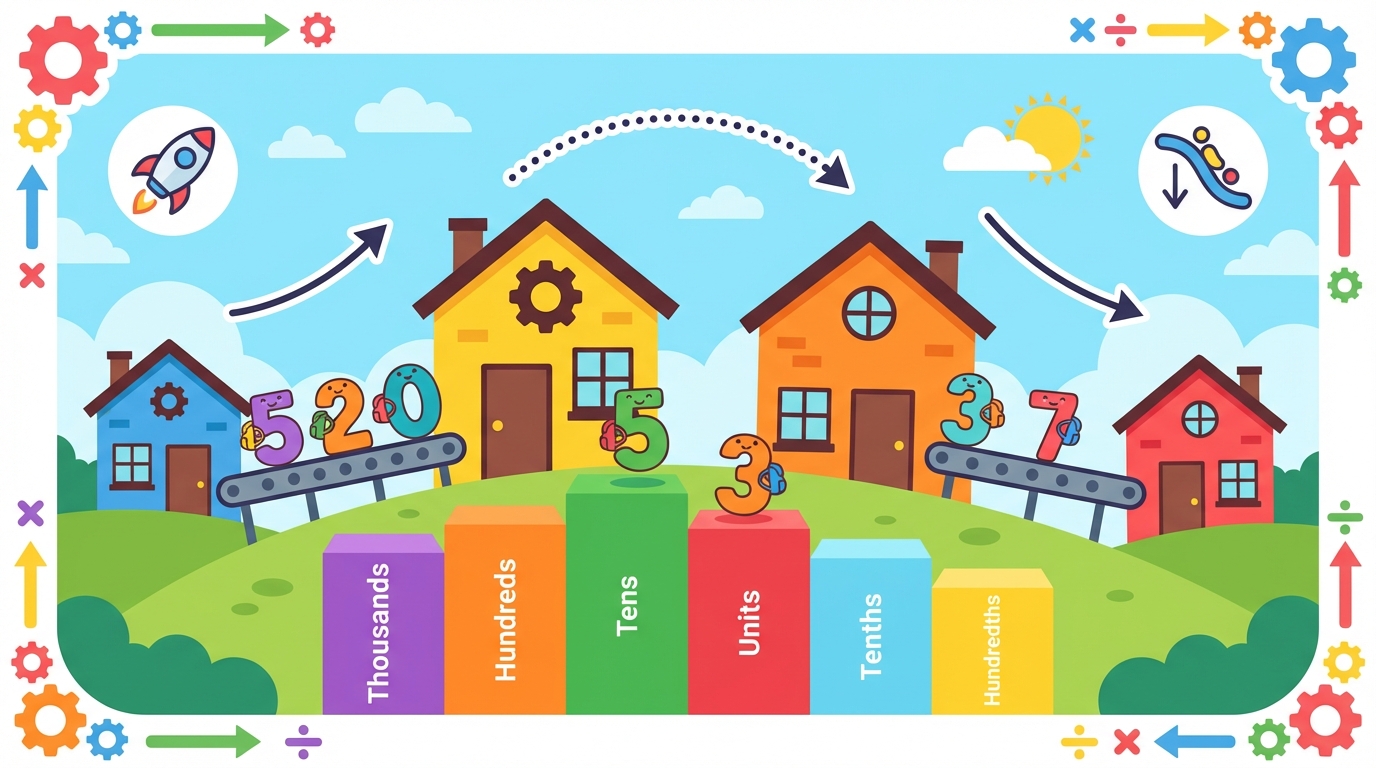
Imagine numbers effectively moving houses! When we multiply or divide by 10, the digits don't change, but their address (place value) does.
When you multiply a whole number by 10, the value becomes 10 times larger. Every digit shifts one place to the LEFT.
Think of it as adding a zero to the end of a whole number, or moving the decimal point one jump to the right!
When you divide by 10, the value becomes 10 times smaller. Every digit shifts one place to the RIGHT.
This is like removing a zero from the end, or moving the decimal point one jump to the left.
👀 Watch the Shift: The Number 50
| Operation | Hundreds | Tens | Ones | Result |
|---|---|---|---|---|
| Start | 5 | 0 | 50 | |
| × 10 (Shift Left) | 5 | 0 | 0 | 500 |
| ÷ 10 (Shift Right) | 5 | 5 |
Key Facts
6 Writing Numbers: Standard, Word, and Expanded Form
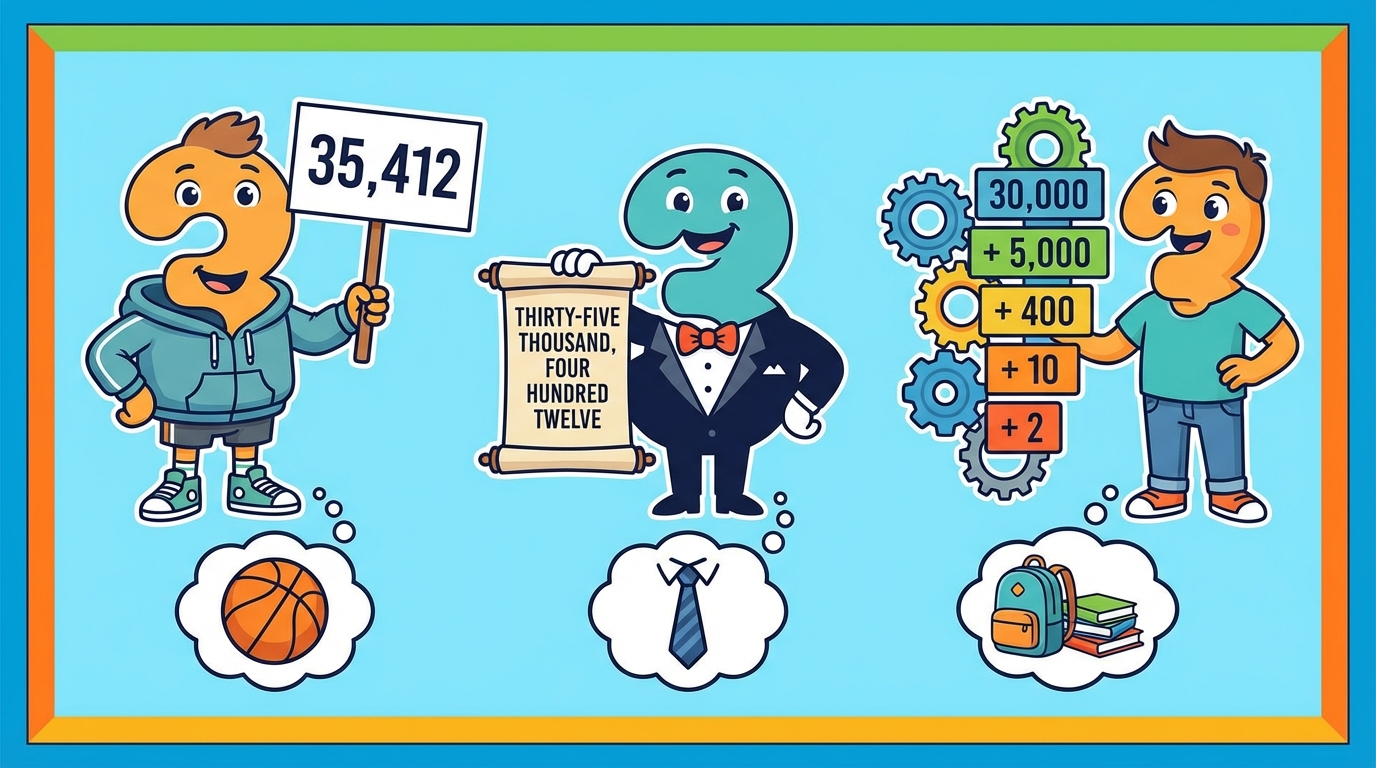
Just like you can change your outfit for different occasions (like sports gear 🏀 or formal wear 👔), numbers can be written in different ways depending on how we need to use them!
The common way we write numbers using digits.
45,209
Shows the number as the sum of the value of its digits.
40,000 + 5,000 + 200 + 9
Writing the number out using words, just like you say it.
'Forty-five thousand, two hundred nine'
Let's Breakdown a Big Number! 🚀
Imagine a video game score of 3,602,517. Here is how we break it down:
| Form | Example |
|---|---|
| Standard | 3,602,517 |
| Expanded | 3,000,000 + 600,000 + 2,000 + 500 + 10 + 7 (Notice we skip the 0 in the ten-thousands place!) |
| Word | Three million, six hundred two thousand, five hundred seventeen. |
Correct: One hundred five.
Incorrect: One hundred
Key Facts
7 Advanced Expanded Notation: Using Powers of 10

Ready to unlock a math superpower? 🦸♂️🦸♀️ Writing huge numbers can take a lot of space. Scientists and mathematicians use Powers of 10 to write numbers faster and cleaner. This is the first step toward Scientific Notation!
A power (or exponent) tells you how many times to multiply the number 10 by itself. It's a shortcut for writing zeros!
- 103 = 10 × 10 × 10 = 1,000 (3 zeros)
- 102 = 10 × 10 = 100 (2 zeros)
- 101 = 10 = 10 (1 zero)
- 100 = 1 (0 zeros - Special Rule! ⭐)
💡 The Trick
The tiny number (exponent) matches the number of zeros behind the 1.
If you see 10,000 (which has 4 zeros), you can write it as 104.
Let's Break Down a Number: 42,305
| Digit | Place Value | Standard Form | Using Powers of 10 ⚡ |
|---|---|---|---|
| 4 | Ten Thousands | 4 × 10,000 | 4 × 10⁴ |
| 2 | Thousands | 2 × 1,000 | 2 × 10³ |
| 3 | Hundreds | 3 × 100 | 3 × 10² |
| 0 | Tens | 0 | (Skip) |
| 5 | Ones | 5 × 1 | 5 × 100 |
Key Facts
8 Comparing and Ordering Decimals

Have you ever wondered who won a race by a split second or which video game has the higher high score? To find out, we need to compare decimals! 🏁
The most important rule is to line up the decimal points vertically.
Imagine a straight line going down through the dots. This ensures you are comparing tenths to tenths and hundredths to hundredths.
If numbers have different amounts of digits, add placeholder zeros at the end so they look the same length.
Let's Compare: 3.42 vs. 3.425 🧐
| Step | Number A | Symbol | Number B |
|---|---|---|---|
| Line Up | 3.42 | ? | 3.425 |
| Add Zeros | 3.420 | ? | 3.425 |
| Compare | 3.420 | < | 3.425 |
Since 0 is less than 5 in the thousandths place, 3.42 < 3.425.
🏃♀️ Real World Example: The 100m Dash
Order these race times from fastest (smallest number) to slowest (largest number):
- Runner A: 12.09 sec
- Runner B: 12.1 sec
- Runner C: 11.95 sec
Answer: 11.95 (1st) ➔ 12.09 (2nd) ➔ 12.10 (3rd)
Key Facts
9 Rounding Decimals to Specific Places

🎢 The Rounding Rollercoaster!
Rounding decimals makes numbers simpler and easier to use in real life, like when we buy things at the store! 🛒
To round a decimal, follow these steps:
- Underline the place value you are rounding to.
- Look at the digit to the right 👉.
- Decide:
5, 6, 7, 8, 9 ➔ Round Up (Add 1 to the underlined digit).
0, 1, 2, 3, 4 ➔ Stay the Same (Keep the underlined digit). - Drop all the digits to the right. 🗑️
| Round to... | Number | Think 🤔 | Result |
|---|---|---|---|
| Tenths | 3.46 | 6 is > 5 (Up) | 3.5 |
| Hundredths | 9.123 | 3 is < 5 (Stay) | 9.12 |
| Whole | 7.89 | 8 is > 5 (Up) | 8 |
Key Facts
10 Key Vocabulary
Master these important terms for your exam:
| Term | Definition |
|---|---|
|
Place Value
Valor posicional |
The value of a digit based on its position within a number.
El valor de un dígito basado en su posición dentro de un número. |
|
Digit
Dígito |
Any of the symbols 0, 1, 2, 3, 4, 5, 6, 7, 8, or 9 used to write numbers.
Cualquiera de los símbolos 0, 1, 2, 3, 4, 5, 6, 7, 8 o 9 utilizados para escribir números. |
|
Standard Form
Forma estándar |
The common way of writing numbers using digits (e.g., 4,500).
La forma común de escribir números usando dígitos (por ejemplo, 4,500). |
|
Expanded Form
Forma desarrollada |
A way to write numbers by showing the sum of the value of each digit (e.g., 4,000 + 500).
Una forma de escribir números mostrando la suma del valor de cada dígito (por ejemplo, 4,000 + 500). |
|
Word Form
Forma escrita |
A way to write numbers using words (e.g., four thousand five hundred).
Una forma de escribir números usando palabras (por ejemplo, cuatro mil quinientos). |
|
Decimal Point
Punto decimal |
A dot separating the whole number part from the fractional part.
Un punto que separa la parte entera de la parte fraccionaria. |
|
Tenths
Décimas |
The first place value to the right of the decimal point (1/10).
El primer valor posicional a la derecha del punto decimal (1/10). |
|
Hundredths
Centésimas |
The second place value to the right of the decimal point (1/100).
El segundo valor posicional a la derecha del punto decimal (1/100). |
|
Thousandths
Milésimas |
The third place value to the right of the decimal point (1/1000).
El tercer valor posicional a la derecha del punto decimal (1/1000). |
|
Period
Período |
A group of three digits separated by commas in a multi-digit number (e.g., millions period).
Un grupo de tres dígitos separados por comas en un número de varios dígitos (por ejemplo, el período de los millones). |
|
Rounding
Redondeo |
Changing a number to a nearby value that is easier to work with, based on a specific place value.
Cambiar un número a un valor cercano que sea más fácil de usar, basado en un valor posicional específico. |
|
Exponent
Exponente |
A small number placed to the upper-right of a base number indicating how many times the base is multiplied by itself.
Un número pequeño colocado en la parte superior derecha de un número base que indica cuántas veces se multiplica la base por sí misma. |
|
Base
Base |
The number that is being multiplied by itself when using an exponent.
El número que se multiplica por sí mismo cuando se usa un exponente. |
|
Power of 10
Potencia de 10 |
A number that results from multiplying 10 by itself a certain number of times (e.g., 10, 100, 1000).
Un número que resulta de multiplicar 10 por sí mismo un cierto número de veces (por ejemplo, 10, 100, 1000). |
|
Inequality
Desigualdad |
A mathematical sentence that compares two unequal expressions using symbols like < or >.
Una oración matemática que compara dos expresiones desiguales usando símbolos como < o >. |
|
Estimate
Estimación |
A rough calculation of the value, number, quantity, or extent of something.
Un cálculo aproximado del valor, número, cantidad o extensión de algo. |
Time to Practice!
There are 7 questions waiting for you. Questions are shuffled each attempt.
Take the Quiz