Archimedes' principle
Discover why objects float or sink and learn about the invisible force that pushes up against gravity in water and air.
1 Eureka! The Story of the King's Crown
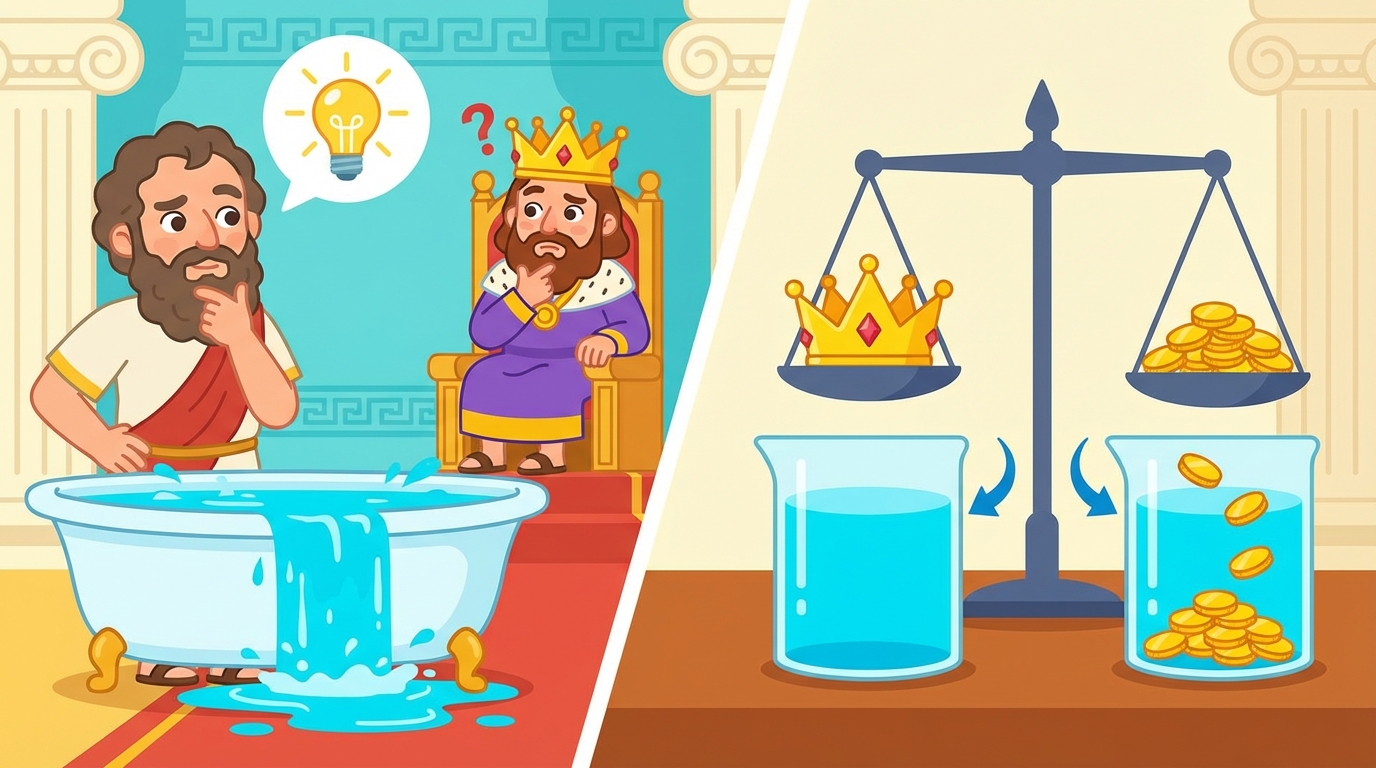
Imagine being given a puzzle by a King where the punishment for failing might be... very bad! 😱 This is exactly what happened to a famous thinker named Archimedes.
King Hiero II of Syracuse had a shiny new crown. However, he was suspicious! He thought the goldsmith had cheated him by mixing in cheaper, lighter silver instead of using only pure gold.
The King asked Archimedes to prove if the crown was fake without scratching or melting it. Archimedes was stumped... until he decided to take a bath.
🛁 The Bathtub Moment
As Archimedes lowered himself into a full tub, he watched water spill over the sides. Splash! suddenly, it clicked.
He realized that the amount of water that spilled out (displaced) was equal to the space his body took up. Legend says he was so excited he ran through the streets shouting 'Eureka!'
🧪 How did this solve the mystery?
Archimedes knew that gold is very dense (heavy for its size). Silver is less dense.
- If the crown was pure gold, it would be small and displace less water.
- If it had silver mixed in, it would be bulkier and displace more water.
Spoiler Alert: The crown displaced too much water. The goldsmith had cheated the King!
Key Facts
2 What is Buoyancy? The Upward Push
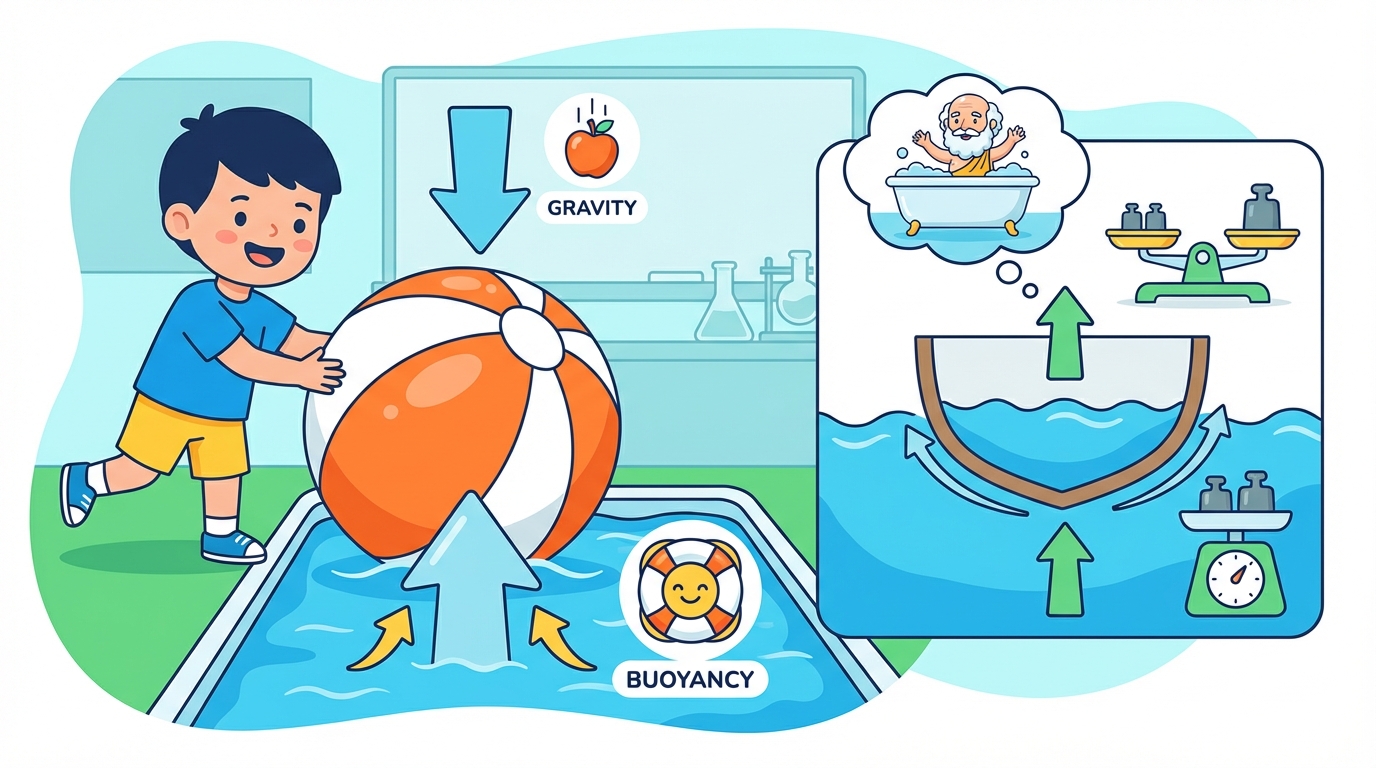
Have you ever tried to push a beach ball underwater? It takes a lot of effort, and the moment you let go, it pops right back up! 🏖️ That push you feel is buoyancy.
A long time ago, a Greek scientist named Archimedes noticed something cool while taking a bath. When he sat down, the water level rose.
He realized that the water he moved out of the way (displacement) was pushing back on him. This led to a famous rule: The upward buoyant force is equal to the weight of the fluid that the object displaces.
The Battle: Gravity vs. Buoyancy ⚔️
| If the object is... | The Result |
|---|---|
| Heavier than the water it moves | SINK ⬇️ (Gravity wins) |
| Lighter than the water it moves | FLOAT ⬆️ (Buoyancy wins) |
Key Facts
3 Making Space: Understanding Water Displacement

The Bathtub Effect 🛁
Have you ever noticed that when you jump into a full bathtub or a swimming pool, the water level rises? 🌊 If the tub is too full, the water might even spill onto the floor! This isn't just a mess; it's physics in action.
How to Measure Volume 📏
We can use displacement to measure the volume of oddly shaped objects, like a rock or a toy dinosaur. It is simple subtraction!
- 1. Measure water level before.
- 2. Drop the object in.
- 3. Measure the new water level.
- 4. The difference is the object's volume!
The Rock Experiment 🪨
| Step | Water Level |
|---|---|
| Start | 200 ml |
| Add Rock | 250 ml |
| Result | 50 ml Displaced |
The volume of the rock is exactly 50 ml.
Key Facts
4 Archimedes' Principle Explained
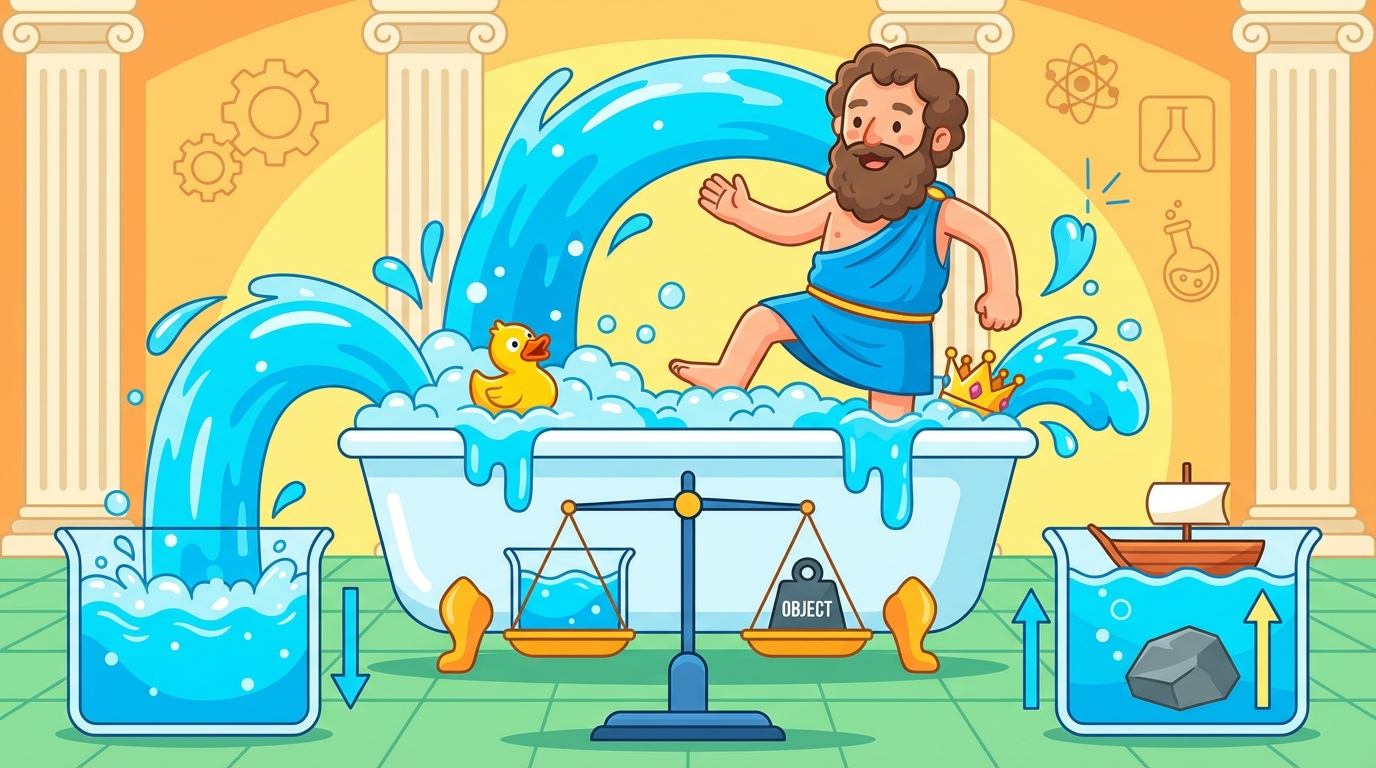
🛁 The Story of the Bathtub
Imagine you are the ancient Greek scientist Archimedes. You step into a bathtub filled to the very top. What happens? Splosh! Water spills over the sides.
Archimedes realized that the water had to move out of the way to make room for his body. This is called displacement. Legend says he was so excited he ran down the street shouting 'Eureka!' (I found it!).
⚖️ The Golden Rule
Archimedes' Principle states that the upward force (buoyancy) acting on an object is equal to the weight of the fluid the object displaces.
If you push 5 pounds of water out of the way, the water pushes back up with 5 pounds of force!
Why do things float or sink?
| Scenario | Battle of Forces | Result |
|---|---|---|
| Heavy Rock 🪨 | Gravity (Weight) > Buoyant Force | Sinks ⬇️ |
| Rubber Duck 🦆 | Gravity (Weight) < Buoyant Force | Floats ⬆️ |
| Submarine 🚤 | Gravity (Weight) = Buoyant Force | Hovers ↔️ |
Key Facts
5 Sink or Float? The Battle of Forces
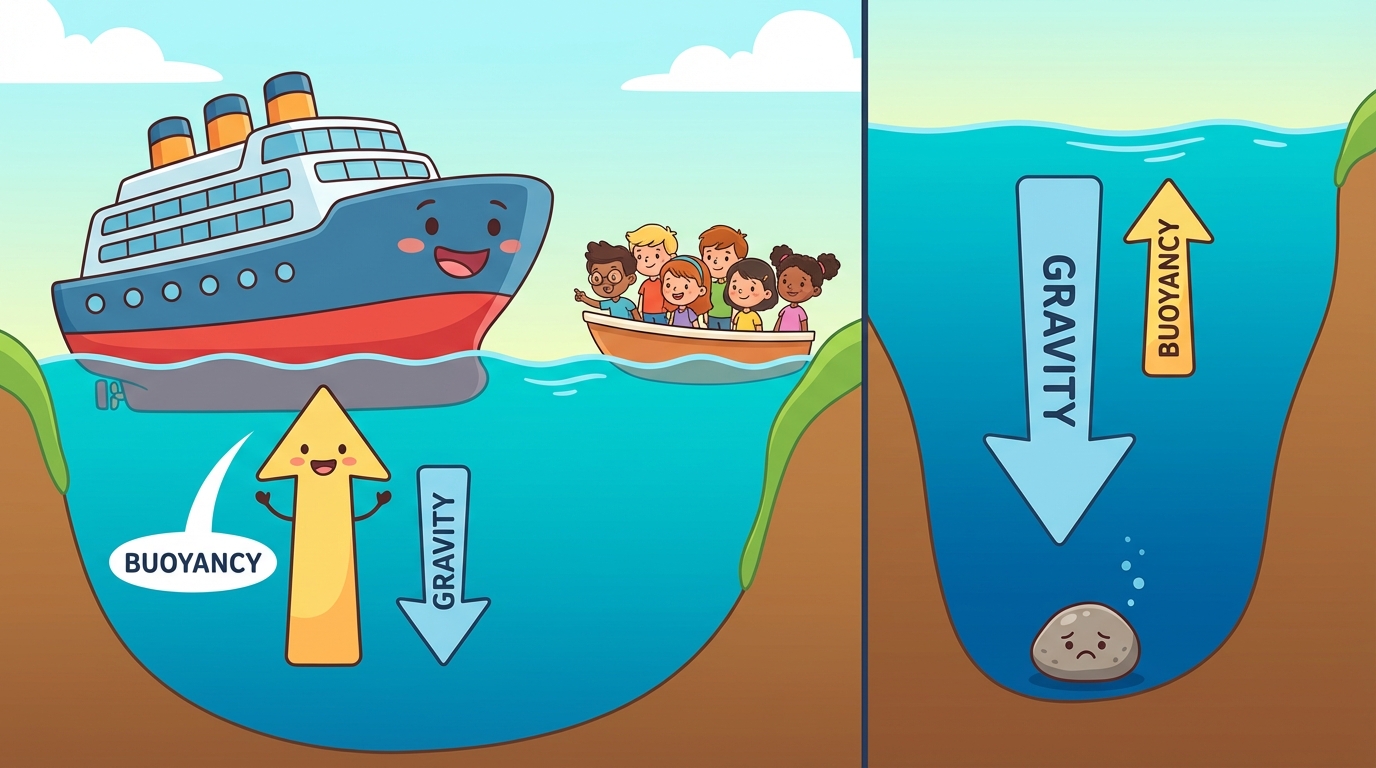
Have you ever wondered why a massive steel cruise ship floats, but a tiny pebble sinks to the bottom of a lake? It's all about a battle between two forces! 🥊
Gravity pulls everything down towards the Earth. It wants to pull the object to the bottom of the water.
Buoyancy is the magical upward force that water exerts. It pushes against gravity to keep things afloat!
🛁 The Eureka Moment!
Over 2,000 years ago, a Greek scientist named Archimedes figured this out while taking a bath. He noticed the water level rose when he sat down. He realized: The water being pushed away (displaced) creates the force that pushes back up!
Who Wins the Battle?
| The Scenario | The Result |
|---|---|
| The object is heavier than the water it pushes away. | Gravity wins! The object sinks. ⚓ |
| The object is lighter than the water it pushes away. | Buoyancy wins! The object floats. 🦆 |
Pro Tip: This is why ships are shaped like big bowls. This shape pushes away lots of water, creating a super strong upward force!
Key Facts
6 Engineering Marvels: How Heavy Steel Ships Float
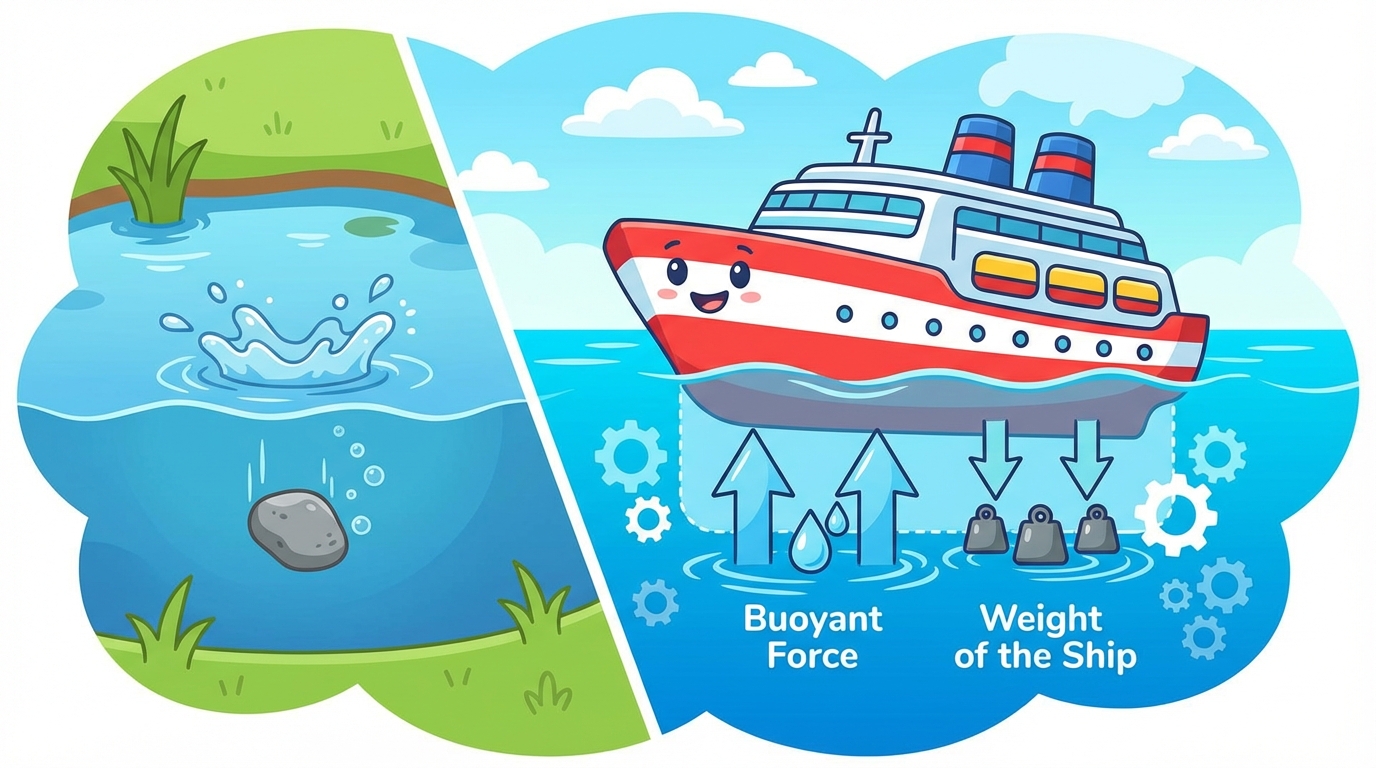
Have you ever thrown a pebble into a pond? Splash! It sinks immediately. But huge cruise ships weigh thousands of tons and are made of heavy steel. So, why don't they sink like a stone? 🚢⚓
It is all about density and displacement. If you drop a solid block of steel into the ocean, it sinks because it is denser than water. However, ships are not solid blocks!
Engineers design ships with a hollow hull full of air. This makes the average density of the ship (steel + air) lighter than the water. 🎈
Solid Steel vs. Steel Ship
| Object | What happens? | Why? |
|---|---|---|
| Solid Steel Cube 🔲 | Sinks Fast ⬇️ | It is compact and pushes away very little water. |
| Steel Ship Hull 🚢 | Floats Well 🌊 | It is wide and hollow. It pushes away (displaces) a huge amount of water! |
💡 Archimedes' Principle in Action
The water pushes back! When a ship sits in the water, it pushes water out of the way. The water pushes back with an upward force (buoyancy) equal to the weight of the displaced water. Since the ship is wide and hollow, it displaces enough water to hold up its massive weight!
Key Facts
7 Not Just Water: Buoyancy in the Air

Did you know we live at the bottom of an ocean of air? 🌍💨 Just like water, air is a fluid, which means Archimedes' Principle applies to the sky too!
How do giant balloons lift people? When the pilot lights the burner, the air inside gets hot. Hot air molecules move fast and spread out, making the air inside less dense than the cool air outside. The surrounding heavy air pushes the lighter balloon up!
Helium is a special gas that is naturally lighter than the oxygen and nitrogen we breathe. A helium balloon rises because the buoyant force of the air around it is stronger than the balloon's weight.
🤔 Why do balloons stop rising?
As you go higher into space, the air gets thinner (less dense). Eventually, a balloon reaches a height where the air outside is just as thin as the air inside. At that point, the buoyant force equals gravity, and it stops rising!
Key Facts
8 Key Vocabulary
Master these important terms for your exam:
| Term | Definition |
|---|---|
|
Archimedes' Principle
Principio de Arquímedes |
The scientific law stating that the buoyant force on an object is equal to the weight of the fluid the object displaces.
La ley científica que establece que la fuerza de empuje sobre un objeto es igual al peso del fluido que el objeto desplaza. |
|
Buoyancy
Flotabilidad |
The ability of an object to float in a fluid.
La capacidad de un objeto para flotar en un fluido. |
|
Buoyant Force
Fuerza de empuje |
The upward force exerted by a fluid that opposes the weight of an immersed object.
La fuerza ascendente ejercida por un fluido que se opone al peso de un objeto sumergido. |
|
Fluid
Fluido |
A substance that flows and has no fixed shape, such as a liquid or a gas.
Una sustancia que fluye y no tiene forma fija, como un líquido o un gas. |
|
Displacement
Desplazamiento |
The act of pushing a fluid out of the way to make room for an object.
La acción de apartar un fluido para hacer espacio para un objeto. |
|
Density
Densidad |
A measure of how much matter is packed into a certain amount of space (mass divided by volume).
Una medida de cuánta materia hay en una cierta cantidad de espacio (masa dividida por volumen). |
|
Volume
Volumen |
The amount of space an object takes up.
La cantidad de espacio que ocupa un objeto. |
|
Mass
Masa |
The amount of matter in an object.
La cantidad de materia que tiene un objeto. |
|
Weight
Peso |
The force of gravity pulling down on an object.
La fuerza de gravedad que tira de un objeto hacia abajo. |
|
Gravity
Gravedad |
The force that pulls objects toward the center of the Earth.
La fuerza que atrae a los objetos hacia el centro de la Tierra. |
|
Submerged
Sumergido |
Completely covered by a fluid; underwater.
Completamente cubierto por un fluido; bajo el agua. |
|
Float
Flotar |
To rest on the surface of a fluid without sinking.
Mantenerse en la superficie de un fluido sin hundirse. |
|
Sink
Hundirse |
To drop to the bottom of a fluid because the object is denser than the fluid.
Caer al fondo de un fluido porque el objeto es más denso que el fluido. |
|
Upward Force
Fuerza ascendente |
A push that moves something towards a higher position.
Un empuje que mueve algo hacia una posición más alta. |
|
Matter
Materia |
Anything that has mass and takes up space.
Cualquier cosa que tiene masa y ocupa espacio. |
Time to Practice!
There are 7 questions waiting for you. Questions are shuffled each attempt.
Take the Quiz