Food & Calories
Learn how food acts as fuel for the body, understand the different types of nutrients, and discover how we measure energy using calories.
1 Fuel for the Body: Why We Eat
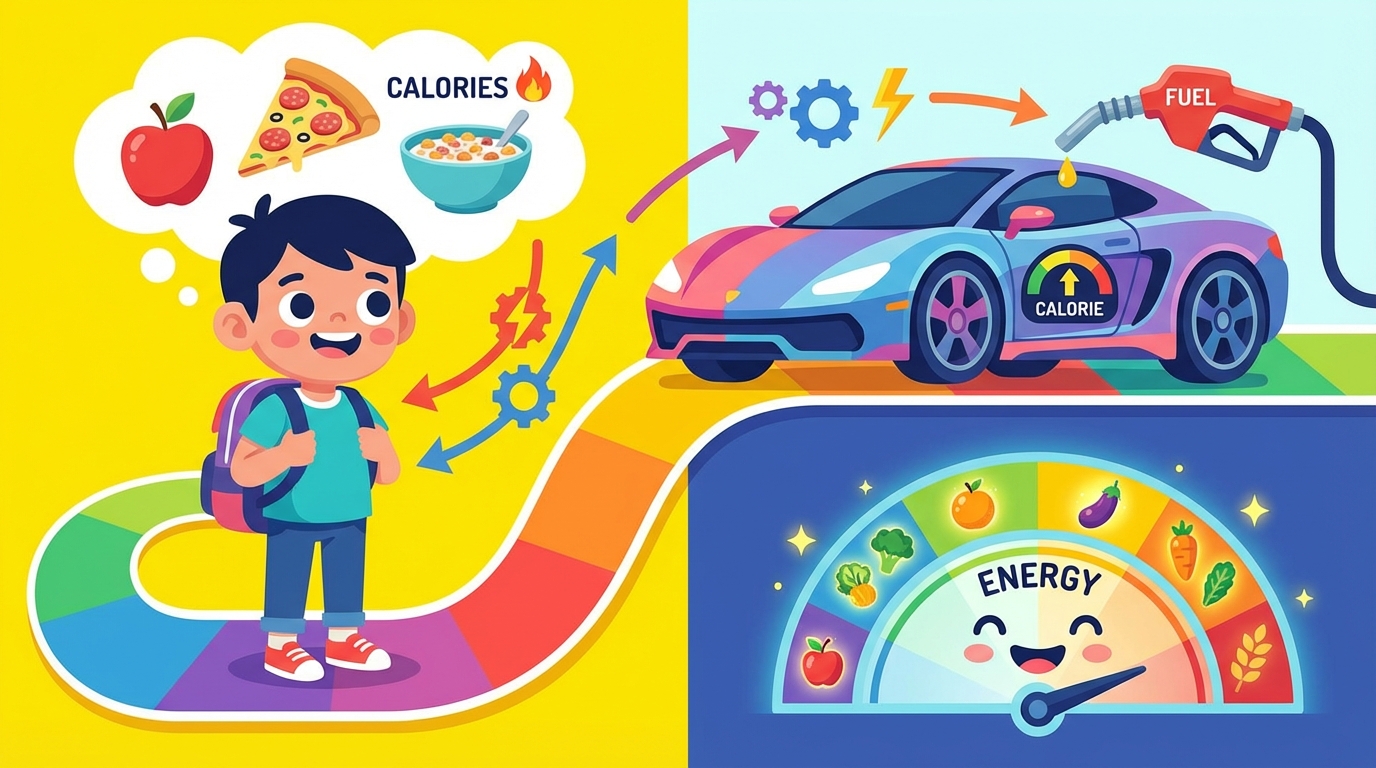
Imagine your body is a high-tech sports car 🏎️. Just like a car needs gasoline to drive, your body needs food to function. That fuel is measured in Calories.
🔥 What is a Calorie?
A calorie isn't a physical thing you can touch! It is a unit of energy. When you eat an apple 🍎 or a sandwich 🥪, you are actually consuming stored energy that your body unlocks to keep you moving, thinking, and growing.
Your body is always burning fuel, even right now!
- 🧠 Thinking: Your brain uses 20% of your energy!
- ❤️ Surviving: Breathing and heartbeats burn calories (Basal Metabolism).
- 🏃 Moving: Sports and walking require extra fuel.
How much fuel do activities use?
| Activity (30 mins) | Approx. Calories Burned |
|---|---|
| Sleeping 🛌 | ~20-30 |
| Doing Homework 📝 | ~40-50 |
| Riding a Bike 🚴 | ~150-250 |
Key Facts
2 What is a Calorie? Measuring Energy
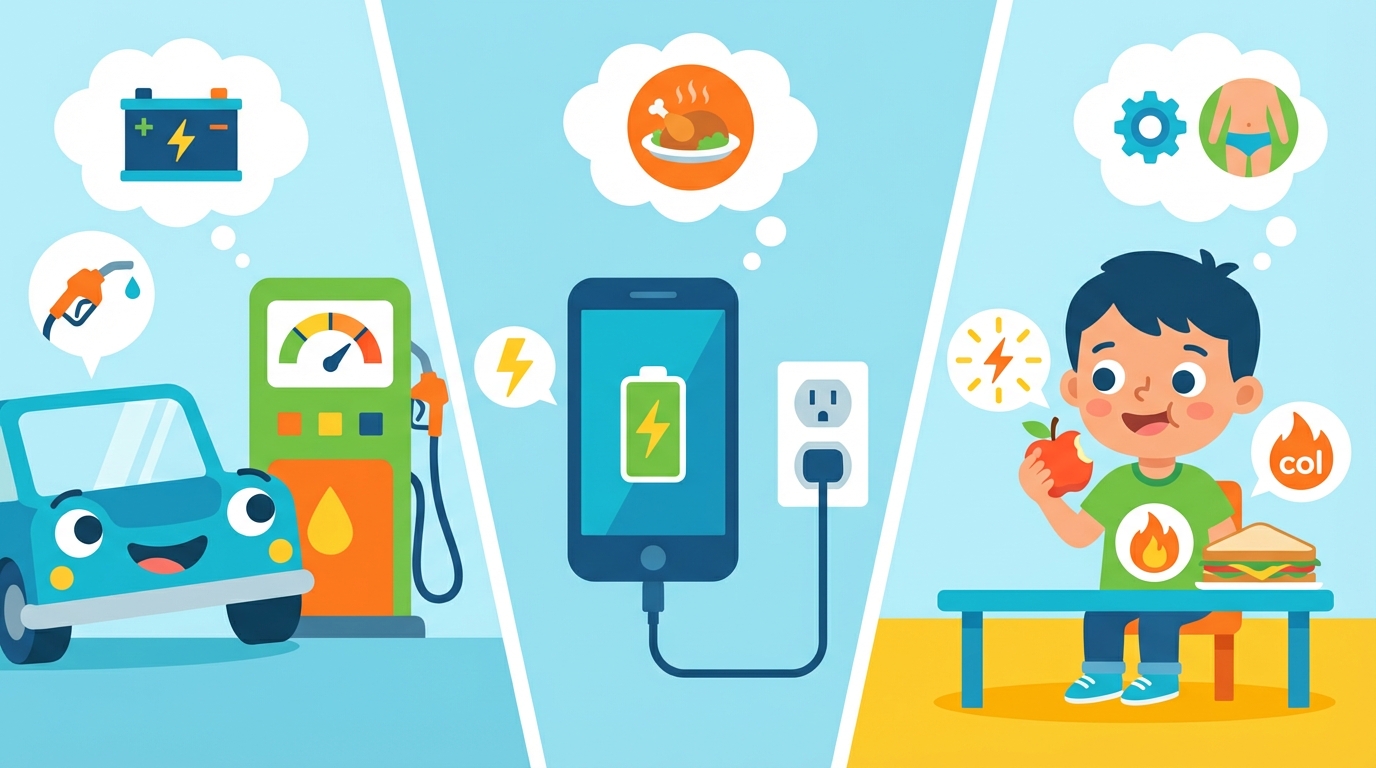
Have you ever wondered why cars need gas or why your phone needs a battery? 🚗🔋 Your body is a machine too, and it needs fuel! That fuel comes from food, and we measure that energy in Calories.
A calorie is not a physical thing you can touch. You can't see a calorie under a microscope! It is simply a unit of measurement for energy.
Just like we use inches to measure length or pounds to measure weight, we use calories to measure how much energy a food provides to your body.
How do scientists measure calories? They actually burn dried food in a special container surrounded by water!
If the burning food heats up 1 kilogram of water by 1 degree Celsius, that equals 1 Calorie (technically a kilocalorie). The more energy the food has, the hotter the water gets! 🌡️
Energy Math: Fueling Your Day
| Food Item 🍎 | Approximate Energy ⚡ | Activity to Burn It 🏃 |
|---|---|---|
| Large Apple | 95 Calories | Walking for 20 mins |
| Slice of Pizza | 285 Calories | Biking for 45 mins |
| Chocolate Bar | 250 Calories | Dancing for 40 mins |
Key Facts
3 The Big Three: Introduction to Macronutrients

Just like a video game character needs different items to level up, your body needs three main types of nutrients to survive and thrive. We call these Macronutrients (or 'Macros' for short)!
The Energy Givers
These are your body's favorite fuel source. They give you the quick energy to run during recess and think during math class.
- 🍞 Examples: Bread, pasta, rice, fruits, potatoes.
The Body Builders
Proteins act like bricks. They build your muscles, repair cuts and scrapes, and help you grow taller.
- 🍗 Examples: Chicken, beans, eggs, fish, tofu.
The Protectors
Don't be scared of fats! Healthy fats protect your organs, keep your body warm, and help your brain work smartly.
- 🥜 Examples: Nuts, avocado, olive oil, cheese.
Key Facts
4 Carbohydrates: Fast Fuel and Fiber
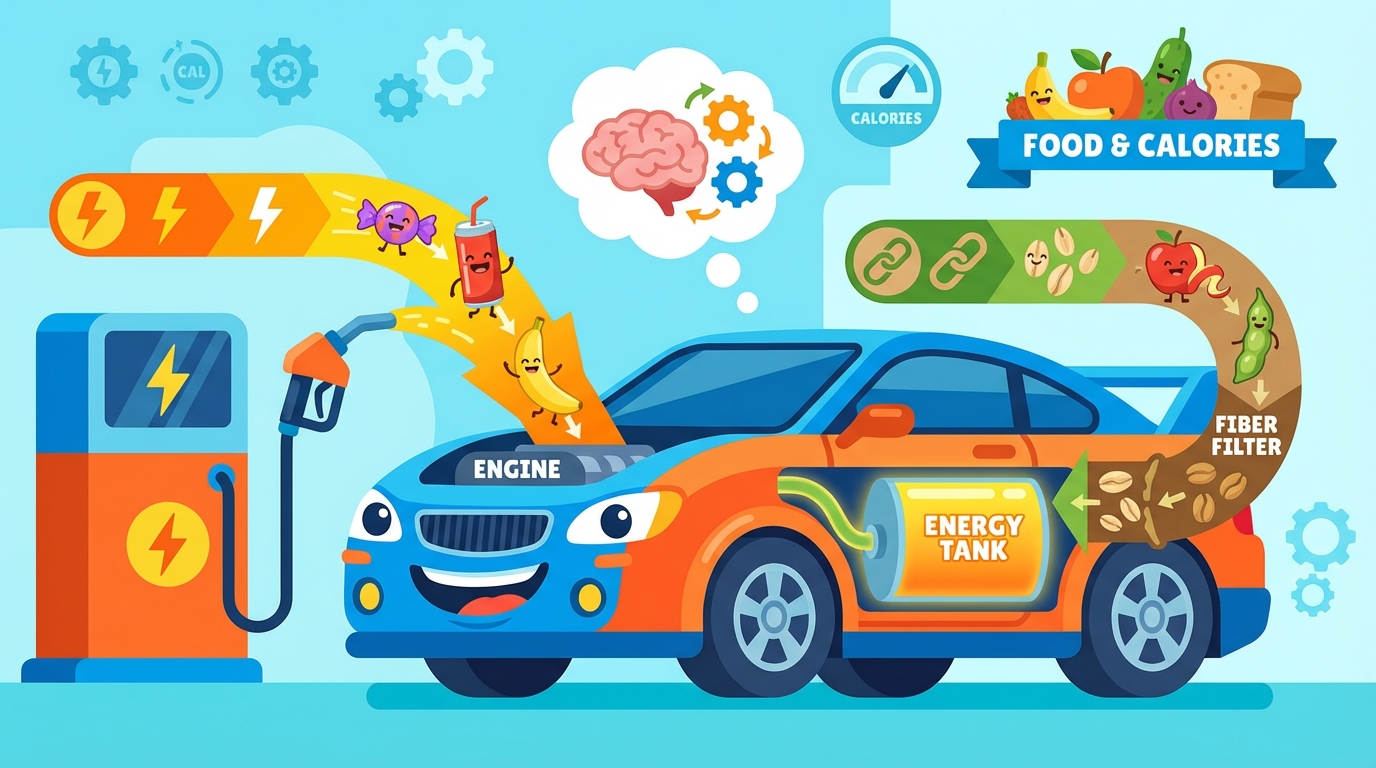
Think of your body as a high-performance sports car 🏎️. Carbohydrates (or 'carbs') are the premium gasoline that keeps your engine running!
These are like a flash of lightning. They give you a quick burst of energy, but it fades fast! If you don't use this energy, your body stores it for later.
- 🍭 Candy & Soda
- 🍇 Fruits (Natural sugar)
- 🥛 Milk
These are like a slow-burning log on a campfire. They release energy steadily over a long time, helping you focus in class and play sports longer.
- 🍞 Whole grain bread
- 🍝 Pasta & Rice
- 🥔 Potatoes & Corn
The Super Broom: Fiber 🧹
Fiber is a special type of carbohydrate found in plants that your body cannot digest. Instead of being used for energy, it acts like a broom, sweeping through your digestive system to keep everything moving smoothly. It also helps you feel full!
| Instead of this (Low Fiber) 🚫 | Try this (High Fiber) ✅ |
|---|---|
| White Bread | Whole Wheat Bread 🥪 |
| Potato Chips | Popcorn (Air-popped) 🍿 |
| Apple Juice | Whole Apple with Skin 🍎 |
Key Facts
5 Proteins: The Body's Building Blocks
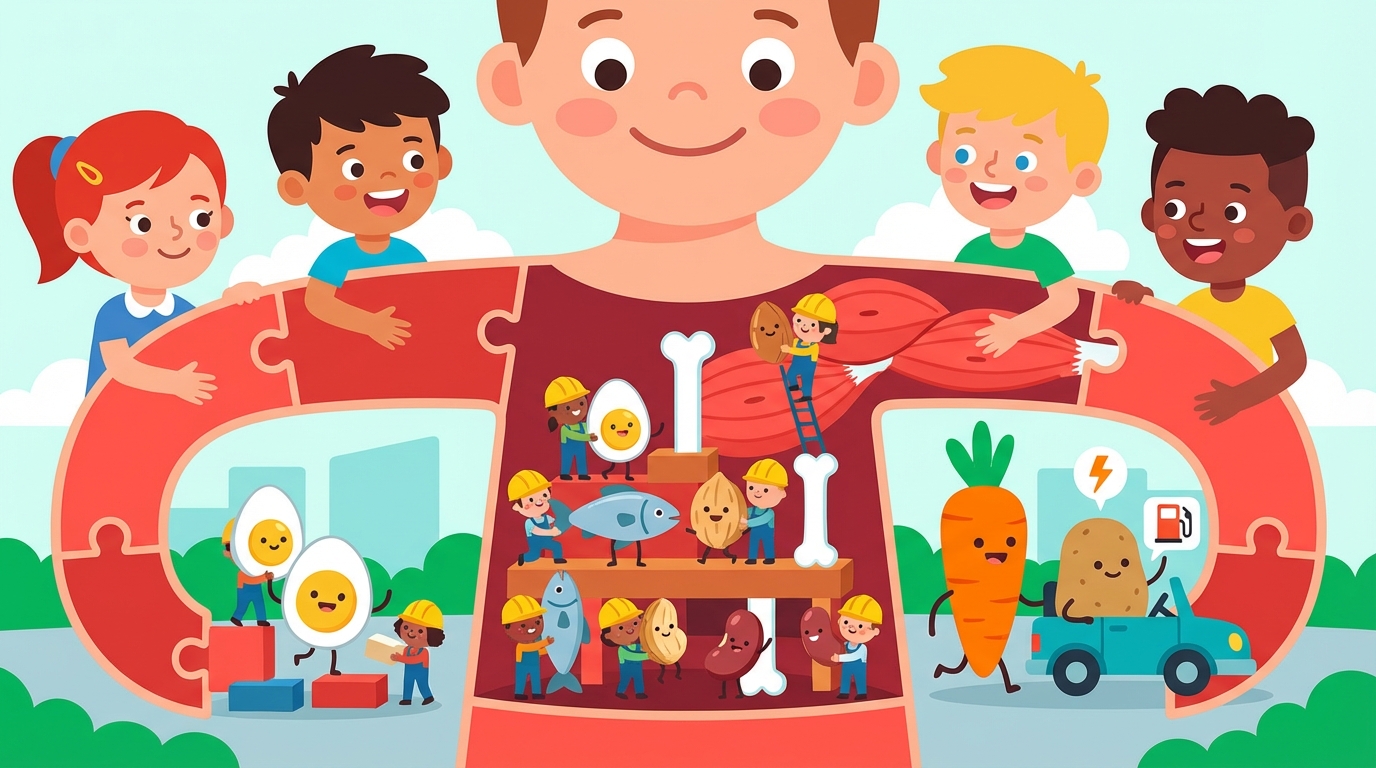
If carbohydrates are the fuel, proteins are the construction workers! 👷♂️🏗️ Just like a house needs bricks and wood to stand tall, your body needs protein to grow and stay strong.
Why do we need Protein? 🤔
Every single cell in your body contains protein. It has three main jobs:
- Growth: It builds your muscles, bones, and organs. 💪
- Repair: It heals cuts, scrapes, and helps muscles recover after sports. 🩹
- Maintenance: It keeps your hair shiny, nails strong, and skin healthy! 💅
Where can we find it? 🍽️
🥩 Animal Sources
Meat, chicken, fish, eggs, milk, and cheese.
Complete Proteins🥜 Plant Sources
Beans, lentils, tofu, nuts, seeds, and quinoa.
Plant Power!Key Facts
6 Fats: Long-Term Energy and Protection
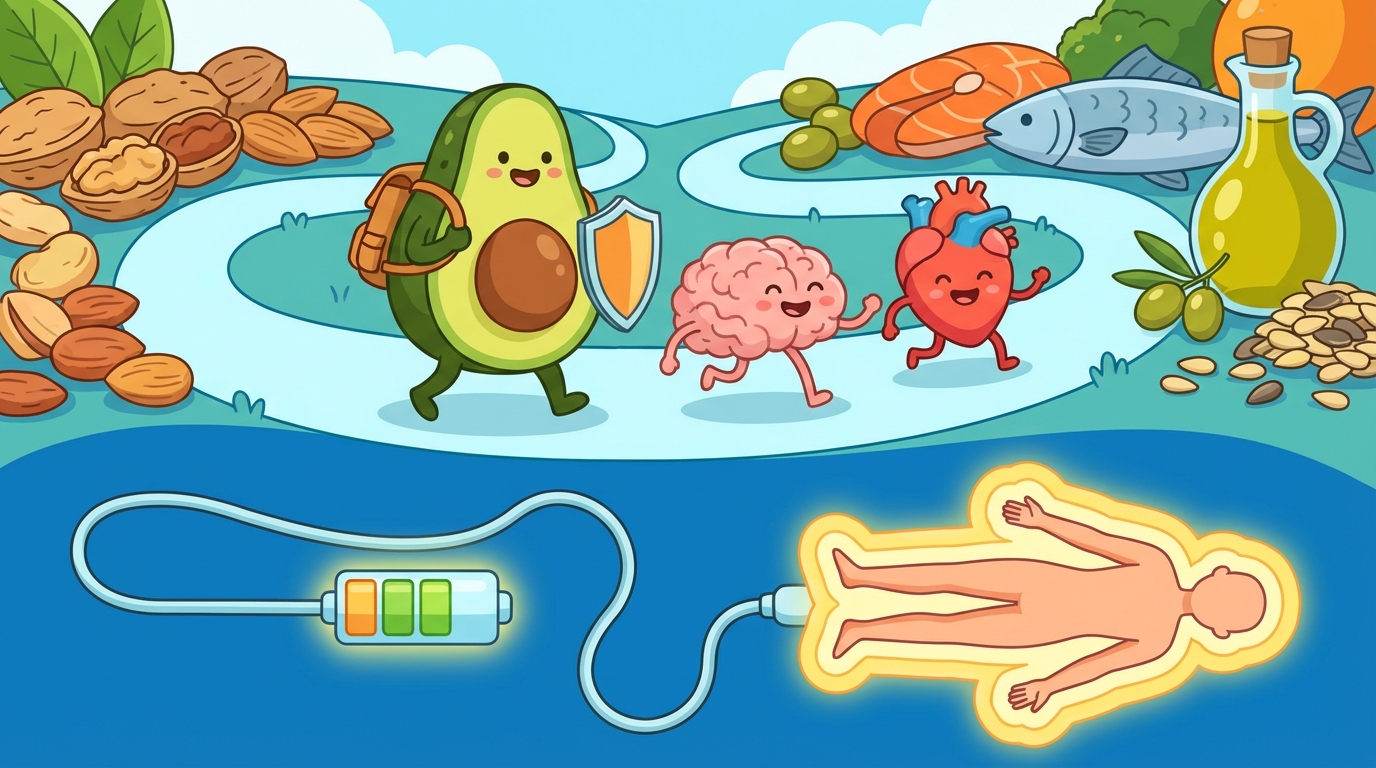
🥑 Don't Fear the Fat!
Many people think fats are bad, but your body needs them to survive! While carbohydrates give you quick energy, fats are like your body's reserve battery pack. They store energy for later use and keep your engines running smoothly.
- 🧠 Brain Power: Did you know your brain is about 60% fat? It needs healthy fats to think clearly and solve problems.
- 🔥 Insulation: Fats form a layer under your skin that acts like a coat, keeping you warm.
- 🛡️ Protection: They act as a cushion to protect your vital organs (like your heart and kidneys) from bumps and bruises.
Some vitamins (A, D, E, and K) are fat-soluble. This means they cannot do their job unless fat is present to move them around your body. Without fat, eating healthy veggies wouldn't give you all their benefits!
🤔 Choose Your Fats Wisely
Not all fats are created equal. Try to eat more of the 'Good Guys'!
| ✅ The Good Guys (Unsaturated) | 🛑 The Limit Guys (Saturated/Trans) |
|---|---|
| 🥑 Avocados & Olive Oil | 🍔 Greasy Fast Food |
| 🥜 Nuts & Seeds (Almonds, Walnuts) | 🧈 Excessive Butter |
| 🐟 Fatty Fish (Salmon, Tuna) | 🍰 Processed Cakes & Cookies |
Key Facts
7 Micronutrients: Vitamins and Minerals
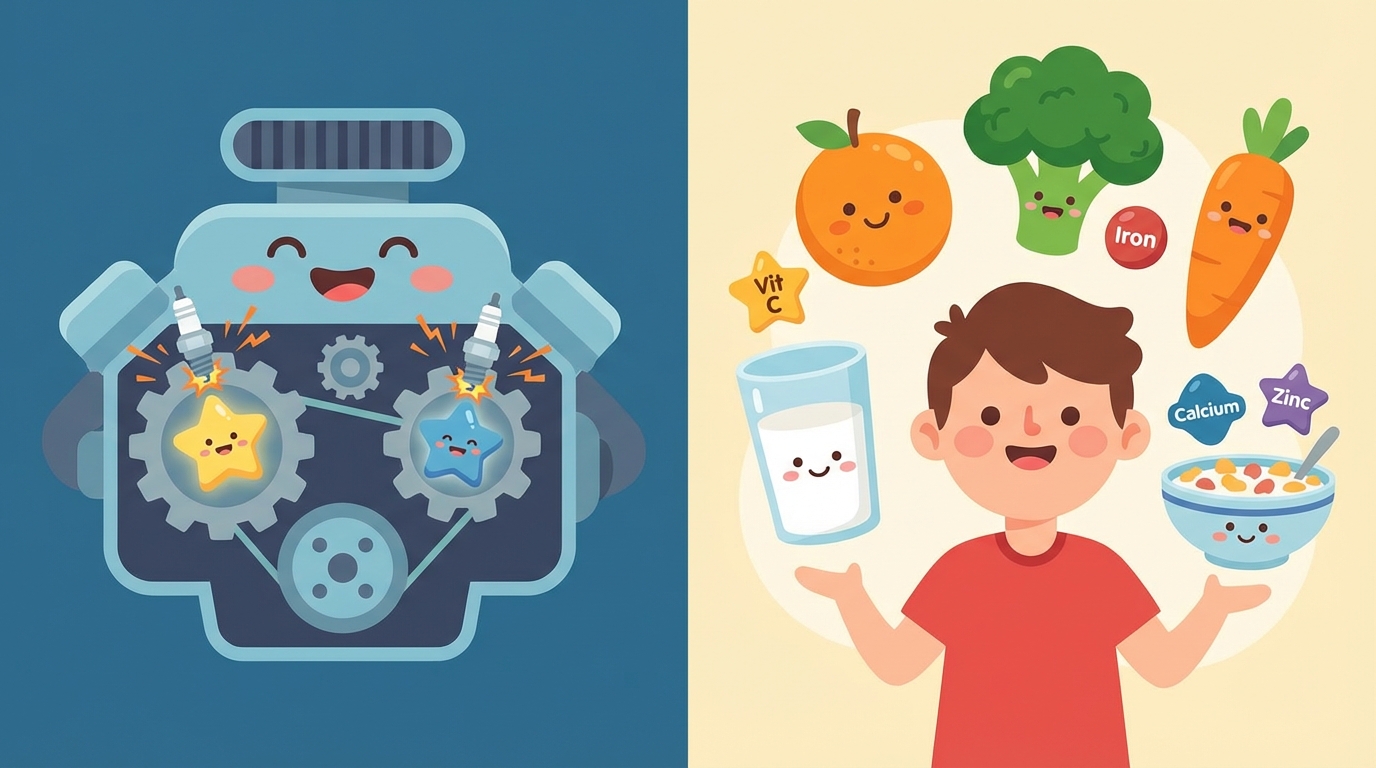
🌟 Small but Mighty!
Unlike macronutrients (carbs, proteins, fats), our bodies only need micronutrients in tiny amounts. However, they are like the spark plugs of a car engine—without them, your body cannot function properly!
Vitamins are organic compounds made by plants and animals. They help your body grow and work the way it should.
- Vitamin A: Good for eyesight 🥕
- Vitamin C: Boosts immune system 🍊
- Vitamin D: Strengthens bones ☀️
Minerals are inorganic elements that come from the earth (soil and water) and are absorbed by plants.
- Calcium: Builds strong teeth/bones 🥛
- Iron: Helps blood carry oxygen 🥩
- Potassium: Helps muscles work 🍌
🌈 Eat the Rainbow!
The best way to get all your vitamins and minerals is to eat a colorful variety of fruits and vegetables. Don't just eat beige food!
Key Facts
8 Water: The Essential Solvent for Life
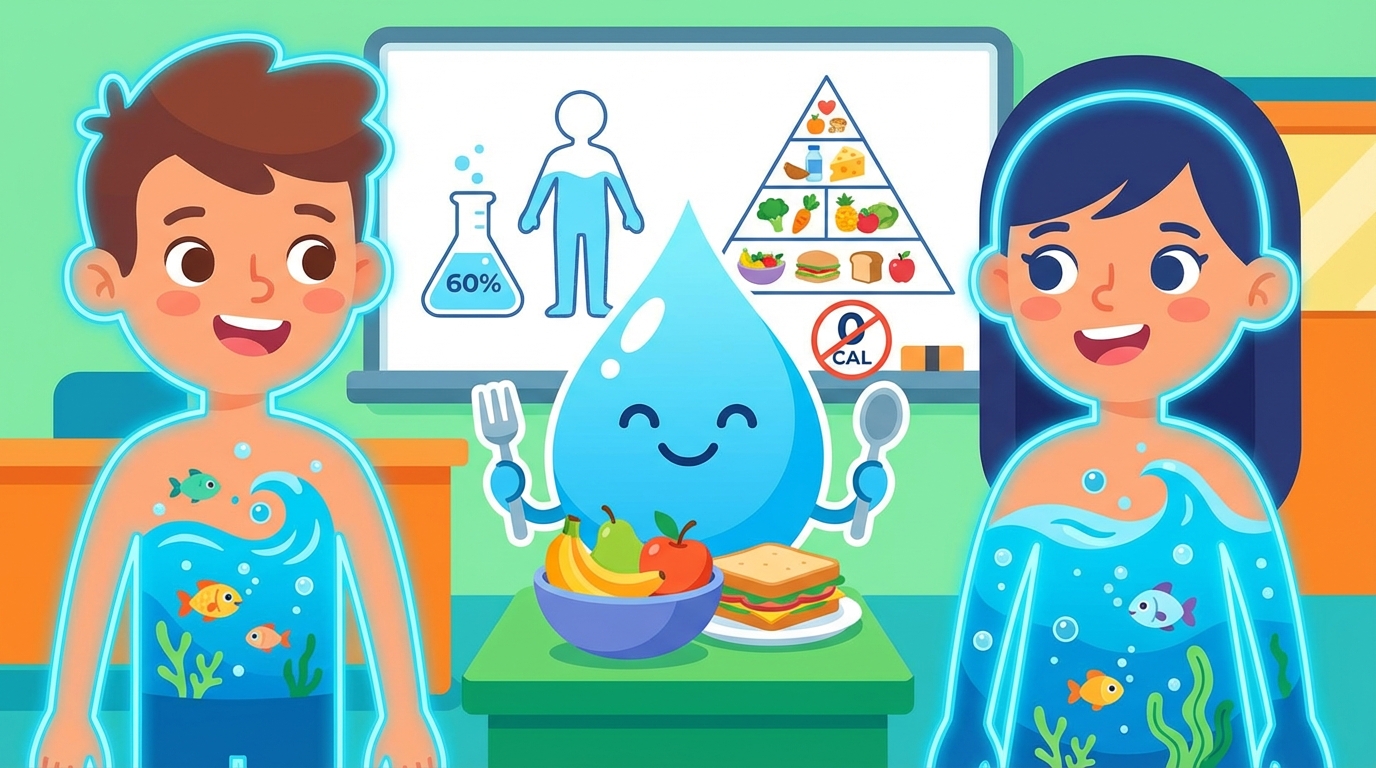
Did you know that you are basically a walking, talking aquarium? 🐟 Approximately 60% of your body weight is just water! While water contains 0 calories (zero energy), it is absolutely essential for processing the energy we get from food.
🧪 Why is it called a 'Solvent'?
Think about mixing chocolate powder into milk. The powder disappears into the liquid. That is dissolving! Water is known as the 'Universal Solvent' because it dissolves more substances than any other liquid. This allows your blood (which is mostly water) to carry vitamins, minerals, and glucose to every cell in your body.
- Transportation: It acts like a highway system, moving nutrients into cells and waste out of them. 🚛
- Temperature Control: Sweating helps cool you down when you burn calories during exercise. 🌡️
- Digestion: Saliva and stomach juices are water-based; they break down food so your body can use it. 🍎
How do you know if you are drinking enough? Check these signs:
| Sign | Status |
|---|---|
| Clear or Pale Yellow Pee | Hydrated! ✅ |
| Dark Yellow Pee | Drink Water! ⚠️ |
| Thirsty & Tired | Dehydrated! 🛑 |
*Tip: Don't wait until you are thirsty to drink!
Key Facts
9 Decoding Food Labels: Nutrition Facts

🕵️ Be a Food Detective!
Have you ever looked at the back of a snack package? That black and white box is called the Nutrition Facts label. It contains secret codes that tell you exactly what you are putting into your body.
This is the most important part! The label tells you the nutrition for one serving, not necessarily the whole package.
Example: If a bag of chips has 2 servings and you eat the whole bag, you have to multiply everything by 2 (calories, sugar, and fat)!
Look at the % Daily Value (DV) column on the right side. It helps you judge if a nutrient is high or low:
- ⬇️ 5% or less is LOW (Good for fat, sodium, sugar).
- ⬆️ 20% or more is HIGH (Good for vitamins, calcium, fiber).
🔍 The Ingredients List
Ingredients are listed in order of quantity. The ingredient used the most is listed first. If Sugar or Corn Syrup is the first or second ingredient, that food is basically candy disguised as a snack! 🍭
Key Facts
10 Energy Balance: Metabolism and Activity
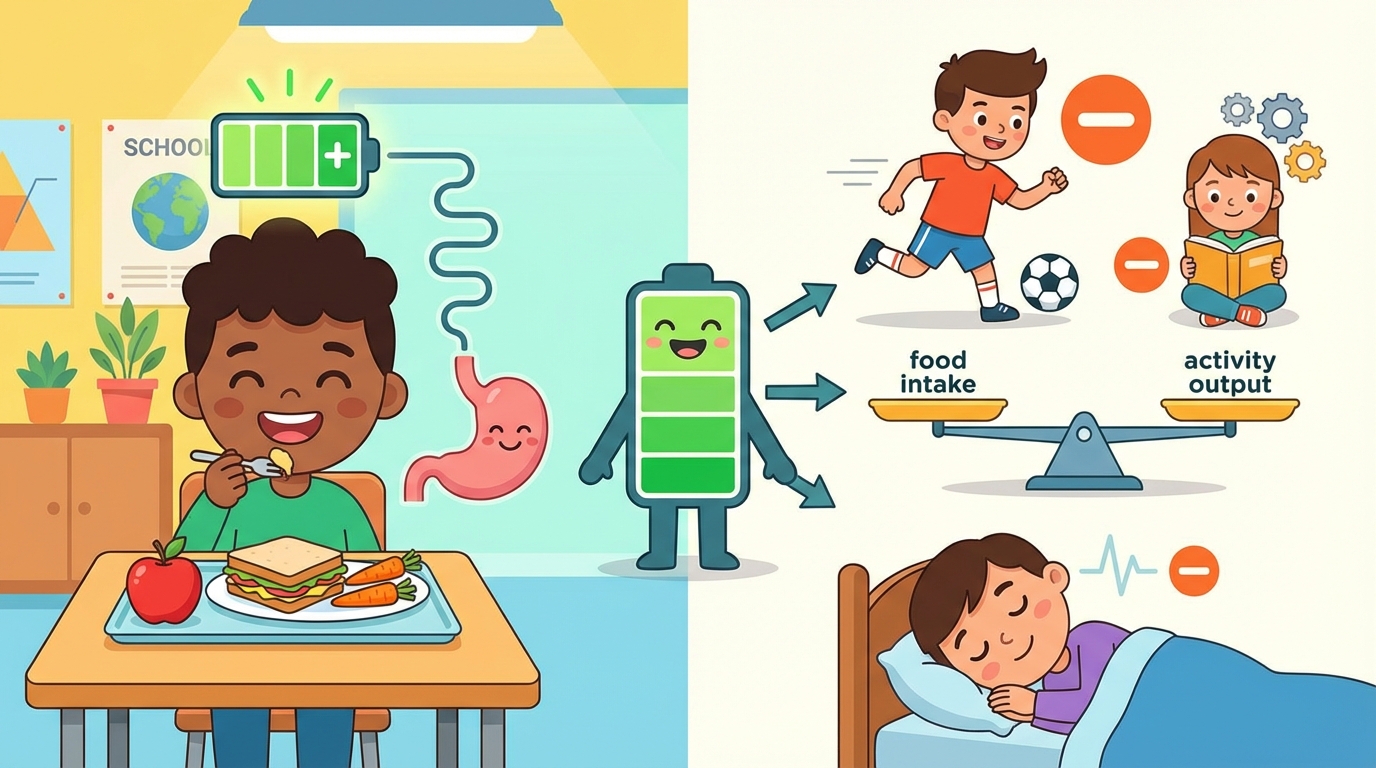
🔋 The Human Battery
Think of your body like a smartphone. You need to charge it (eat food) to keep it running. But unlike a phone, you use energy even when you are in 'sleep mode'!
Even if you stayed in bed all day, your body burns calories. This is called your Basal Metabolic Rate (BMR).
- 🫀 Beating your heart
- 🫁 Breathing air
- 🧠 Thinking and dreaming
- 🦴 Growing taller!
Did you know? About 60-70% of the calories you eat are used just to keep you alive!
This is the energy you choose to use. The more you move, the more fuel you need.
| Activity | Intensity | Energy Used |
|---|---|---|
| 🎮 Video Games | Sedentary | Low ⬇️ |
| 🚶 Walking | Moderate | Medium ➡️ |
| ⚽ Soccer/Dance | Vigorous | High ⬆️ |
⚖️ The Balancing Act
Energy In (Food) = Energy Out (Metabolism + Activity)
If you eat more energy than you use, your body stores it. If you use more than you eat, your body uses its reserves. For 6th graders, you need a little extra energy just to grow!
Key Facts
11 Key Vocabulary
Master these important terms for your exam:
| Term | Definition |
|---|---|
|
Calorie
Caloría |
A unit used to measure the amount of energy contained in food.
Una unidad usada para medir la cantidad de energía contenida en los alimentos. |
|
Nutrient
Nutriente |
A substance that provides nourishment essential for growth and the maintenance of life.
Una sustancia que proporciona el alimento esencial para el crecimiento y el mantenimiento de la vida. |
|
Metabolism
Metabolismo |
The chemical process by which your body breaks down food to release energy.
El proceso químico mediante el cual tu cuerpo descompone los alimentos para liberar energía. |
|
Carbohydrate
Carbohidrato |
A nutrient that provides the body with its main source of energy; found in bread, pasta, and fruits.
Un nutriente que proporciona al cuerpo su principal fuente de energía; se encuentra en el pan, la pasta y las frutas. |
|
Protein
Proteína |
A nutrient needed for building and repairing body tissues, such as muscle.
Un nutriente necesario para construir y reparar tejidos corporales, como los músculos. |
|
Fat (Lipid)
Grasa (Lípido) |
A nutrient that stores energy, insulates the body, and protects organs.
Un nutriente que almacena energía, aísla el cuerpo y protege los órganos. |
|
Glucose
Glucosa |
A simple sugar that circulates in the blood and provides the major source of energy for body tissues.
Un azúcar simple que circula en la sangre y proporciona la principal fuente de energía para los tejidos corporales. |
|
Fiber
Fibra |
A tough complex carbohydrate that the body cannot digest, which helps move food through the digestive system.
Un carbohidrato complejo y resistente que el cuerpo no puede digerir, el cual ayuda a mover los alimentos a través del sistema digestivo. |
|
Vitamin
Vitamina |
An organic compound found in food that helps regulate body processes and immune function.
Un compuesto orgánico que se encuentra en los alimentos y ayuda a regular los procesos corporales y la función inmunológica. |
|
Mineral
Mineral |
An inorganic element, such as calcium or iron, essential to nutrition and body structure.
Un elemento inorgánico, como el calcio o el hierro, esencial para la nutrición y la estructura corporal. |
|
Digestion
Digestión |
The process of breaking down food into smaller components that can be absorbed into the bloodstream.
El proceso de descomponer los alimentos en componentes más pequeños que pueden ser absorbidos por el torrente sanguíneo. |
|
Balanced Diet
Dieta equilibrada |
Eating a variety of foods in the right amounts to provide the necessary nutrients for good health.
Comer una variedad de alimentos en las cantidades adecuadas para proporcionar los nutrientes necesarios para una buena salud. |
|
Saturated Fat
Grasa saturada |
A type of fat found mostly in animal products that is usually solid at room temperature.
Un tipo de grasa que se encuentra principalmente en productos animales y que generalmente es sólida a temperatura ambiente. |
|
Unsaturated Fat
Grasa insaturada |
A healthy type of fat found in plants and fish that is usually liquid at room temperature.
Un tipo de grasa saludable que se encuentra en plantas y pescados, y que generalmente es líquida a temperatura ambiente. |
|
Empty Calories
Calorías vacías |
Calories from solid fats and added sugars in foods that offer few or no nutrients.
Calorías provenientes de grasas sólidas y azúcares añadidos en alimentos que ofrecen pocos o ningún nutriente. |
Time to Practice!
There are 7 questions waiting for you. Questions are shuffled each attempt.
Take the Quiz