Rules to be alive
Discover the seven essential life processes (MRS GREN) that distinguish living organisms from non-living objects, and explore the basic building blocks of all life: cells.
1 Living vs. Non-Living: The 7 Life Processes
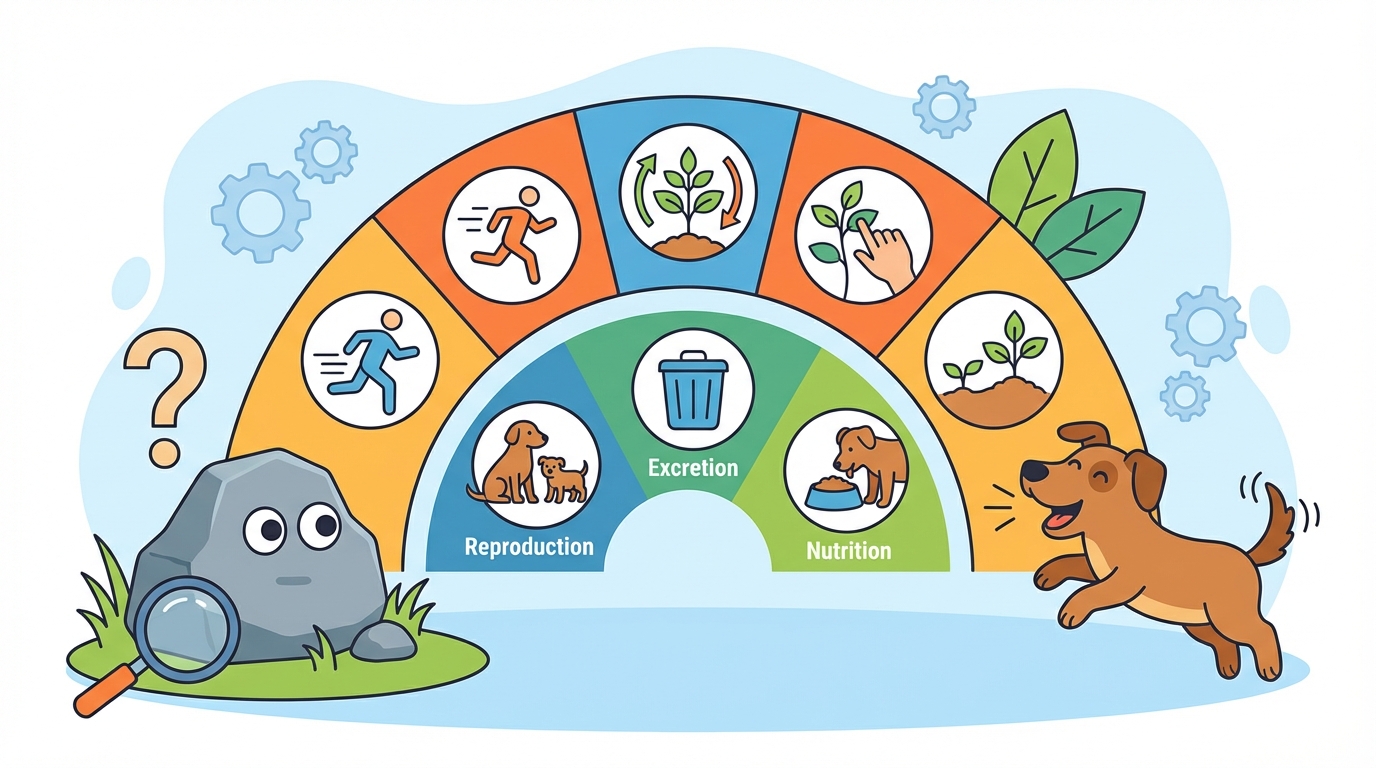
How do you know if your pet rock is actually alive? 🪨 vs 🐕. It is not just about moving! Scientists use a special checklist called MRS GREN to decide.
🌿 The 7 Rules of Life (MRS GREN)
- Movement 🏃 Changing position
- Respiration 🫁 Releasing energy from food
- Sensitivity 👀 Noticing changes around you
- Growth 🌱 Getting bigger or changing shape
- Reproduction 🐣 Making new offspring
- Excretion 🚽 Getting rid of waste
- Nutrition 🍎 Taking in food/fuel
Compare: Robot vs. Human
| Action | Human (Living) 🧍 | Robot (Non-Living) 🤖 |
|---|---|---|
| Fuel | Eats food for nutrition | Uses electricity/batteries |
| Growth | Grows from baby to adult | Stays the same size forever |
| Senses | Feels pain, heat, cold | Sensors detect data, but no 'feeling' |
No! It cannot reproduce biologically and is not made of cells.
Key Facts
2 Fueling Up: Nutrition and Respiration
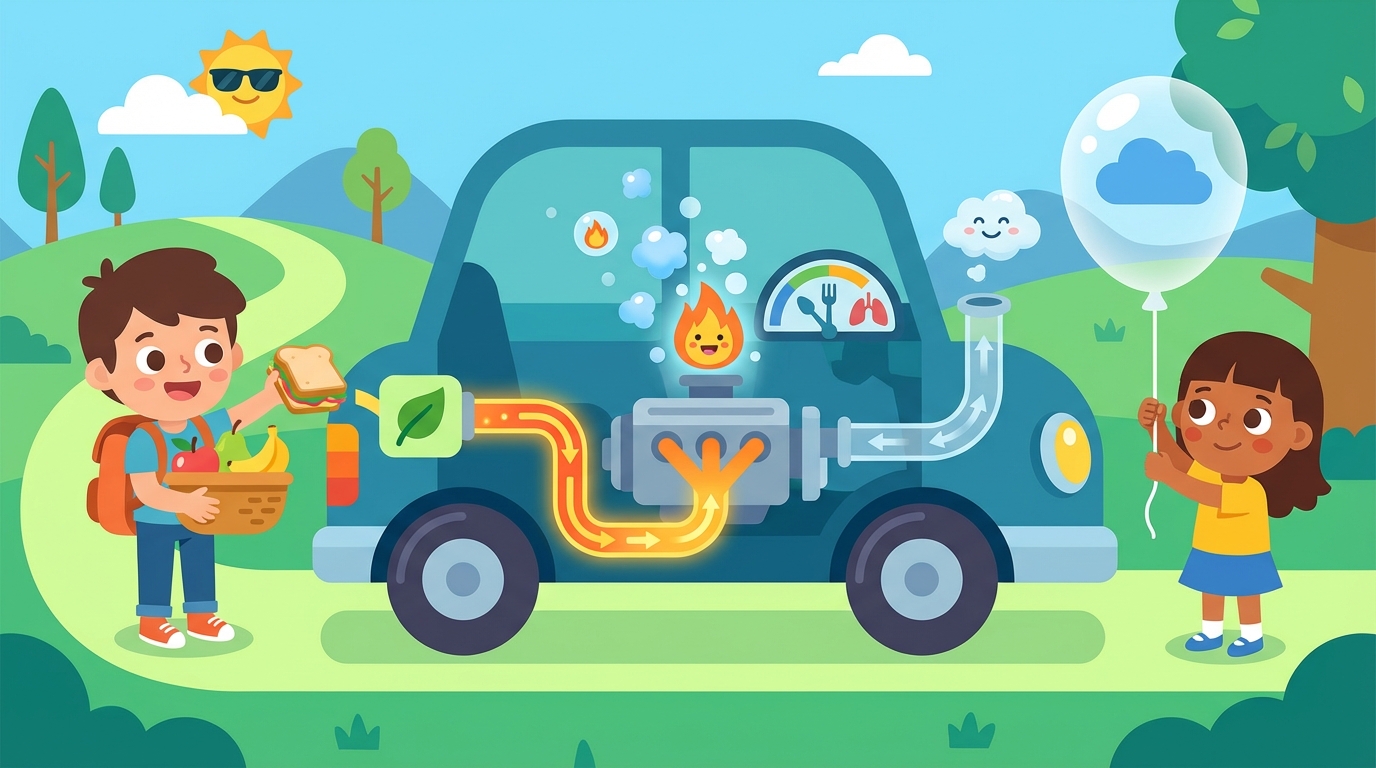
Imagine your body is a high-tech car. To keep running, it needs two things: fuel (food) and oxygen to burn that fuel. Let's look at how living things power up!
🌱 Nutrition: Getting the Fuel
Nutrition is how organisms take in materials from their environment to grow and repair themselves. There are two main strategies:
- Autotrophs (Self-feeders): Like plants! They use sunlight to cook up their own food through photosynthesis.
- Heterotrophs (Other-feeders): Like humans and dogs! We must eat plants or other animals to get energy.
💨 Respiration: Burning the Fuel
Respiration is NOT just breathing! It is a chemical process happening inside your cells right now.
When you breathe in oxygen, it travels to your cells to unlock the energy stored in your food. The waste product is Carbon Dioxide (CO2), which you breathe out!
Comparison: Plants vs. Animals
| Action | Plants 🌻 | Animals 🐯 |
|---|---|---|
| How they get food | Make it using sunlight (Photosynthesis) | Hunt, gather, or buy it (Ingestion) |
| Gas needed | Mostly Carbon Dioxide (CO2) | Oxygen (O2) |
| Energy Goal | To grow leaves, roots, and flowers | To move, think, and keep warm |
Key Facts
3 Action and Reaction: Movement and Sensitivity
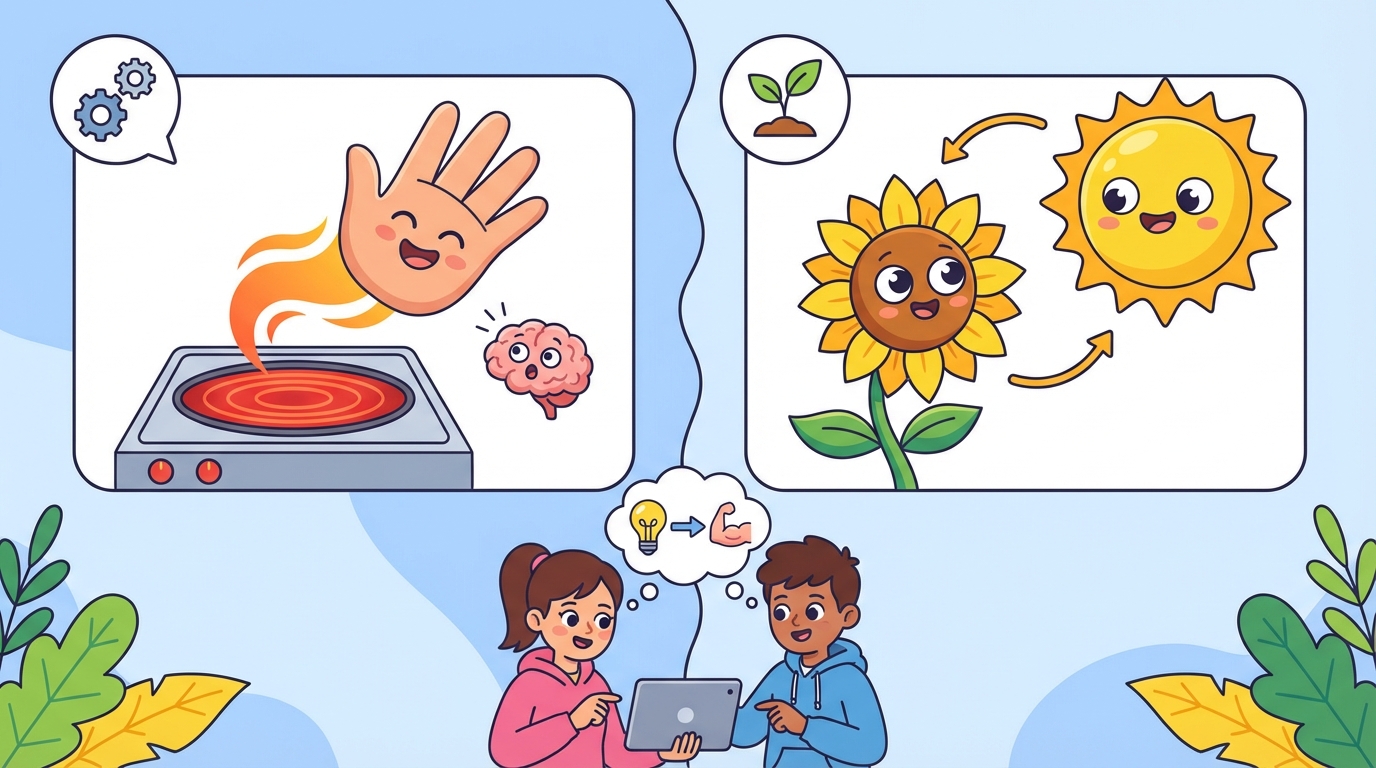
Have you ever pulled your hand away from something hot without thinking? 🖐️🔥 Or watched a sunflower turn its head to follow the sun? 🌻 That is Sensitivity and Movement in action!
👀 Sensitivity: The Super Sense
All living things are like detectives. They detect changes in their environment called Stimuli and react to them with a Response.
- Stimulus: A loud noise 📢
- Response: Covering your ears 🙉
We use our five senses to detect these changes. Even tiny bacteria can sense food nearby!
🏃 Movement: Not Just Running
When we think of movement, we usually think of locomotion (moving from place to place). But did you know plants move too?
- Animals: Can walk, fly, or swim to find food or escape danger. 🐆
- Plants: Move by growing. Roots grow down towards water, and stems grow up towards light. 🌱
🆚 Comparison: How do they react?
| Feature | Animals 🐶 | Plants 🌿 |
|---|---|---|
| Reaction Speed | Usually fast (running away) | Usually slow (growing towards light) |
| Movement Type | Locomotion (whole body moves) | Growth movement (parts move) |
| Purpose | Find food, shelter, mates | Absorb maximum sunlight and water |
Key Facts
4 The Cycle of Life: Growth, Reproduction, and Excretion
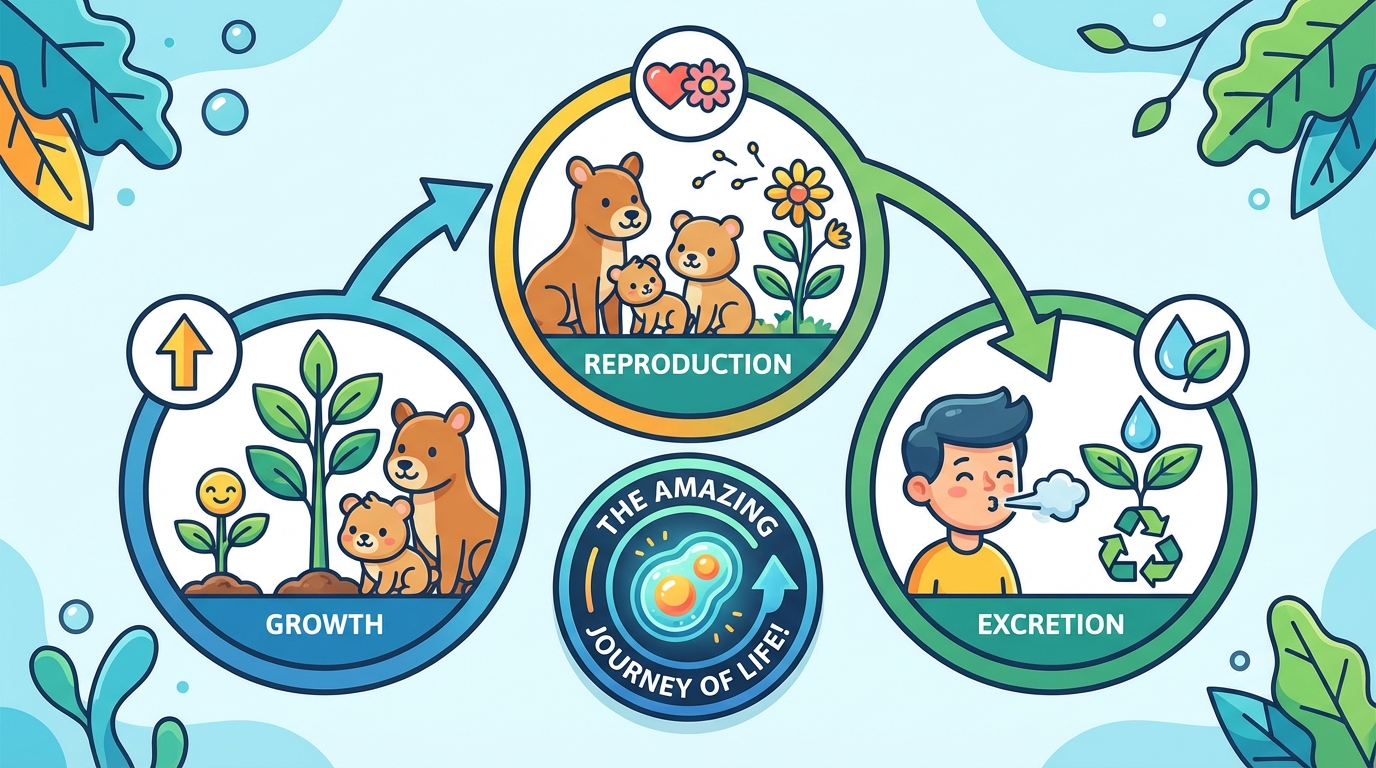
🔄 The Journey of Being Alive!
Being alive isn't just about eating and moving. It is a continuous cycle! Living things start small, get bigger, make copies of themselves, and must keep their bodies clean on the inside.
Have you noticed your pants getting shorter? That's growth! It doesn't just mean getting bigger like a balloon; it means your body is making more cells.
- 🐣 Start: A single cell.
- 💪 Process: Cells divide and specialize.
- 🌳 Result: A complex organism (like you!).
Living things don't live forever, so they must produce offspring (babies or seeds) to keep their species from disappearing. This is called reproduction.
Examples: A cat having kittens, an apple tree dropping seeds, or bacteria splitting in two.
Your body is like a factory. It takes in materials, but it also creates trash! Excretion is how we get rid of waste so it doesn't poison us.
🗑️ How Do We Get Rid of Waste?
| Type of Waste | Example | How it leaves the body |
|---|---|---|
| Gas 💨 | Carbon Dioxide (CO₂) | Lungs (Breathing out) |
| Liquid 💧 | Urine & Sweat | Kidneys & Skin |
| Solid 💩 | Undigested Food | Digestive System |
Key Facts
5 Cells: The Building Blocks of Life
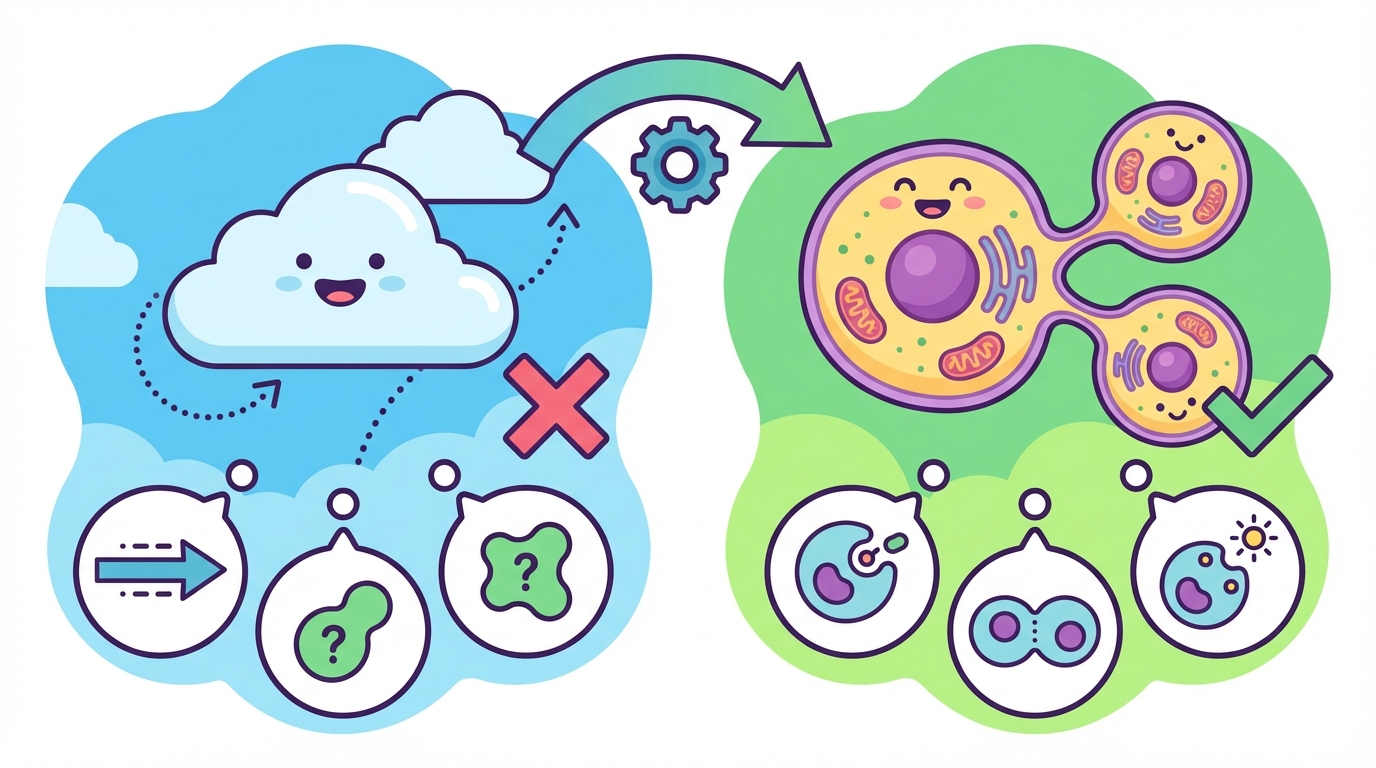
🤔 The Big Question: Is it Alive?
Imagine a cloud moving across the sky. It moves, it grows, and it changes shape. Is it alive? No! To be officially 'alive' in science, an organism must follow specific rules. Let's look at the checklist of life!
- 🧱 1. Made of Cells: Just like a LEGO® castle is made of bricks, every living thing is made of at least one cell.
- ⚡ 2. Use Energy: You eat pizza 🍕; plants use sunlight ☀️. Living things need fuel to survive.
- 📈 3. Grow and Develop: A tiny acorn becomes a giant oak tree. Living things get bigger and change over time.
- 🐣 4. Reproduce: Living things make copies of themselves (babies, seeds, or dividing cells).
- 👀 5. Respond to Change: If you step on a sharp rock, you jump! Living things react to their surroundings.
Robot vs. Hamster 🐹
Why isn't a smart robot alive?
| Feature | 🤖 Robot | 🐹 Hamster |
|---|---|---|
| Moves? | ✅ Yes | ✅ Yes |
| Uses Energy? | ✅ Yes (Battery) | ✅ Yes (Food) |
| Made of Cells? | ❌ No (Metal) | ✅ Yes! |
| Grows? | ❌ No | ✅ Yes! |
Even though robots are smart, they don't grow or have cells!
Key Facts
6 Key Vocabulary
Master these important terms for your exam:
| Term | Definition |
|---|---|
|
Organism
Organismo |
Any individual living thing that demonstrates all the characteristics of life.
Cualquier ser vivo individual que demuestra todas las características de la vida. |
|
Cell
Célula |
The smallest basic unit of structure and function in living things.
La unidad básica más pequeña de estructura y función en los seres vivos. |
|
Unicellular
Unicelular |
An organism made of only one single cell (like bacteria).
Un organismo formado por una sola célula (como las bacterias). |
|
Multicellular
Pluricelular |
An organism composed of many cells specialized to perform different functions.
Un organismo compuesto por muchas células especializadas para realizar diferentes funciones. |
|
Homeostasis
Homeostasis |
The ability to maintain a stable internal environment despite changes outside.
La capacidad de mantener un ambiente interno estable a pesar de los cambios externos. |
|
Metabolism
Metabolismo |
The total of all chemical reactions an organism uses to build up or break down materials for energy.
El total de todas las reacciones químicas que un organismo utiliza para construir o descomponer materiales para obtener energía. |
|
Stimulus
Estímulo |
A change in an organism's surroundings that causes the organism to react.
Un cambio en el entorno de un organismo que hace que este reaccione. |
|
Response
Respuesta |
An action or change in behavior that occurs as a result of a stimulus.
Una acción o cambio de comportamiento que ocurre como resultado de un estímulo. |
|
Reproduction
Reproducción |
The process by which living things produce new individuals of the same type.
El proceso mediante el cual los seres vivos producen nuevos individuos del mismo tipo. |
|
Asexual Reproduction
Reproducción asexual |
Reproduction involving only one parent, producing offspring identical to the parent.
Reproducción que involucra a un solo progenitor, produciendo descendencia idéntica al progenitor. |
|
Sexual Reproduction
Reproducción sexual |
Reproduction involving two parents combining genetic material to create unique offspring.
Reproducción que involucra a dos progenitores que combinan material genético para crear descendencia única. |
|
DNA
ADN |
The genetic material that carries information about an organism and is passed from parent to offspring.
El material genético que transporta información sobre un organismo y se transmite de padres a hijos. |
|
Growth
Crecimiento |
The process of becoming larger in size.
El proceso de aumentar de tamaño. |
|
Development
Desarrollo |
The process of change that occurs during an organism's life to produce a more complex organism.
El proceso de cambio que ocurre durante la vida de un organismo para producir un organismo más complejo. |
|
Autotroph
Autótrofo |
An organism that makes its own food, usually through photosynthesis (also called a producer).
Un organismo que fabrica su propio alimento, generalmente a través de la fotosíntesis (también llamado productor). |
|
Heterotroph
Heterótrofo |
An organism that cannot make its own food and must feed on other organisms (also called a consumer).
Un organismo que no puede fabricar su propio alimento y debe alimentarse de otros organismos (también llamado consumidor). |
Time to Practice!
There are 7 questions waiting for you. Questions are shuffled each attempt.
Take the Quiz