Simple Machines
Explore how six basic devices change the way we apply force to make work easier.
1 Work and Force: The Physics of Moving Things
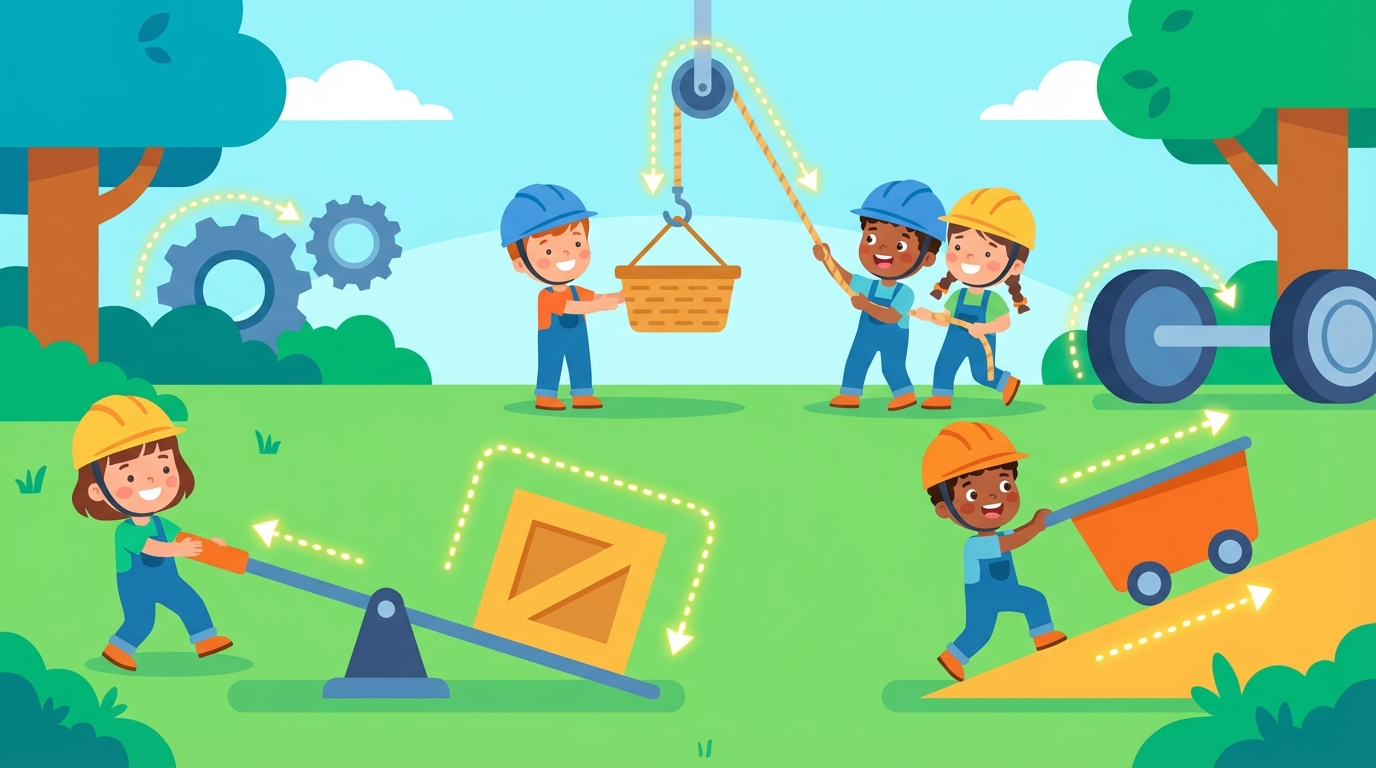
🚀 What is Physics?
Physics is the science of how things move and interact! Today, we are looking at two very important words: Force and Work.
A force is simply a push or a pull. When you kick a soccer ball, you are applying force. Without force, nothing would ever move!
In science, work has a special meaning. Work is only done when you use force to move an object over a distance.
Formula: Work = Force × Distance
🤖 Simple Machines: Making Life Easier
Simple machines are tools that make work easier by changing the strength or direction of a force. They don't reduce the amount of work, but they make it feel easier!
| Machine | What it does | Real Life Example |
|---|---|---|
| Lever ⚖️ | Lifts heavy loads with less effort. | A seesaw or a crowbar. |
| Inclined Plane 📐 | A ramp that helps move things up. | Wheelchair ramp or a slide. |
| Pulley 🏗️ | Uses a rope and wheel to lift things. | A flagpole or window blinds. |
Key Facts
2 What is a Simple Machine? Working Smarter, Not Harder
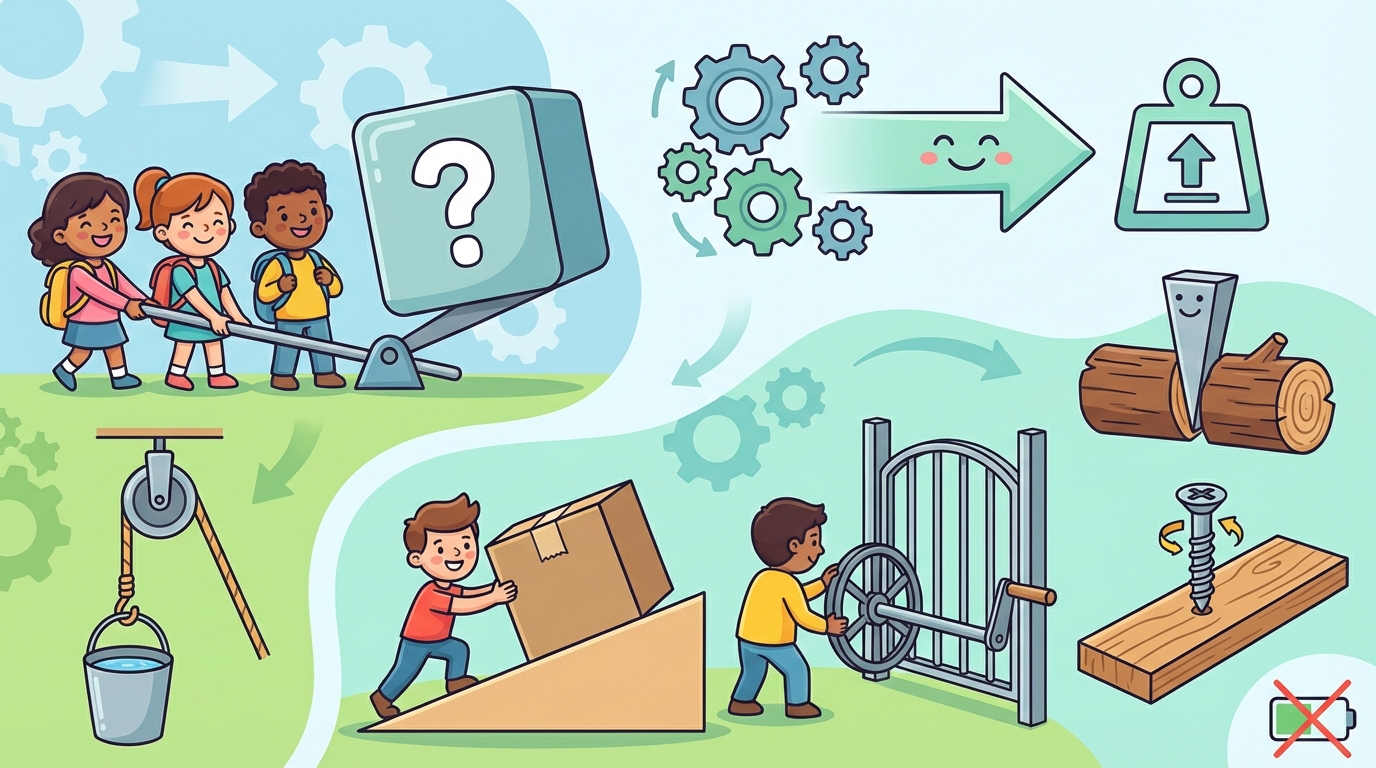
No Batteries Required! 🔋🚫
When you hear the word 'machine', you probably think of robots, cars, or computers. But in science, a simple machine is a tool with few or no moving parts that makes work easier. They don't have engines, and they don't use electricity!
Simple machines can't create energy (that's magic, not science!). Instead, they do one of two things:
- 🔄 Change the direction of a force (like raising a flag on a pole).
- 📈 Multiply the force you use (making heavy things feel lighter).
Here is the secret rule of physics: You can't get something for nothing.
If a machine lets you use less force to lift a heavy box, you usually have to move that box a longer distance.
🌍 Real World Example: The Moving Truck
Imagine trying to lift a heavy piano straight up into a truck. Impossible, right? 😫 Now, imagine pushing it up a long ramp. It takes much less strength to push it, but you have to walk a longer distance up the ramp to get to the same height. That is a simple machine in action!
Key Facts
3 The Trade-Off: Mechanical Advantage and Distance
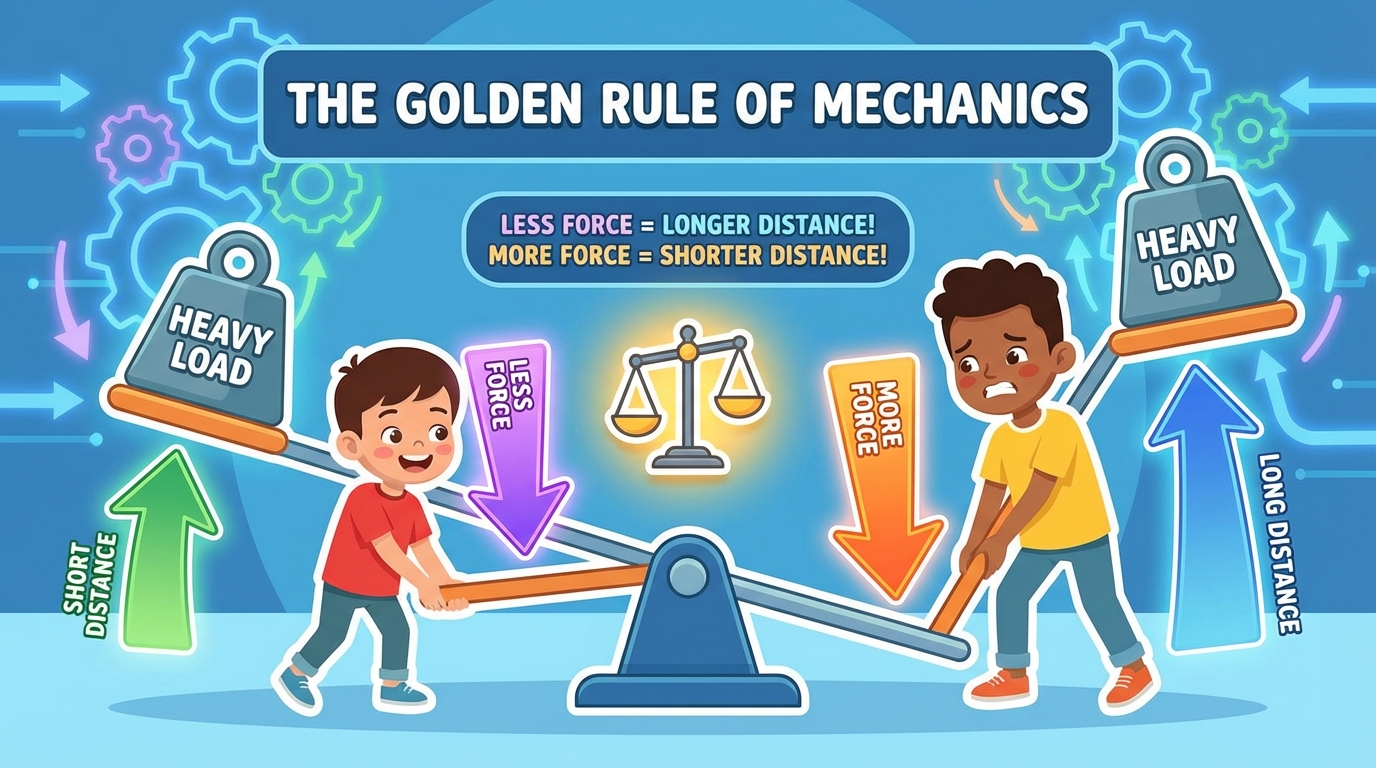
⚖️ The Golden Rule of Mechanics
Here is the big secret of physics: You never get something for nothing! Simple machines make work feel easier by reducing the force you need to push or pull, but there is a price to pay.
Think of it like a see-saw. If you want to use less force (effort), you must move that force over a longer distance.
- 🔽 Less Force Needed = Easier to lift
- 🔼 More Distance Required = You have to walk further
It is a trade! You trade distance to save your muscles.
Imagine climbing a steep mountain:
Path A (Straight Up): Very short distance, but extremely hard (requires huge force). 🧗
Path B (Winding Road): A much longer distance zigzagging up, but much easier to walk (requires less force). 🚶
Result: You reach the same height (same work done), but the effort feels different!
🧪 The Math Behind the Magic
Work = Force × Distance
| Method | Force (Effort) | Distance | Total Work |
|---|---|---|---|
| 💪 Lifting Straight Up | 100 Newtons | 1 Meter | 100 Joules |
| 🎢 Using a Long Ramp | 50 Newtons | 2 Meters | 100 Joules |
*Notice that the Total Work stays the same. Energy is conserved!
Key Facts
4 The Lever: Parts of the Bar
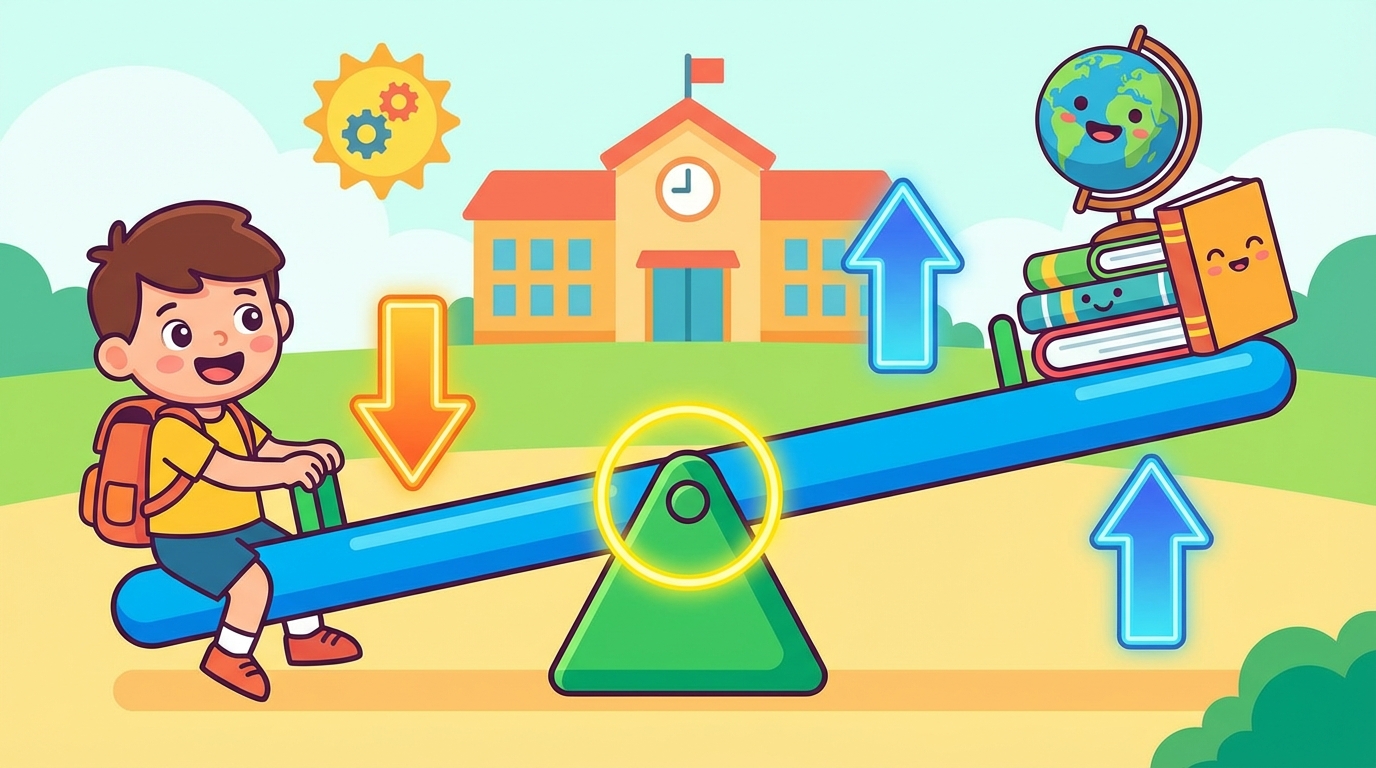
A lever isn't just a stick! To work properly, a lever needs three specific parts arranged on a rigid bar (beam). Imagine a playground seesaw to understand how these parts work together.
This is the fixed point where the bar rests or turns. It does not move! Think of the middle part of a seesaw that touches the ground.
This is the push or pull that YOU apply to the machine. On a seesaw, this is you pushing off the ground with your legs.
This is the weight or object you are trying to move or lift. On a seesaw, this is your friend sitting on the other side!
🌟 The Golden Rule
The Bar (Beam) must be strong and rigid. If the bar bends or breaks, the energy from your Effort won't reach the Load!
| Tool | Where is the Fulcrum? | Where is the Load? |
|---|---|---|
| Seesaw | In the middle | At the end (friend) |
| Wheelbarrow | At the wheel (front) | In the bucket (middle) |
| Tweezers | At the joined end | At the tips (object) |
Key Facts
5 The Three Classes of Levers
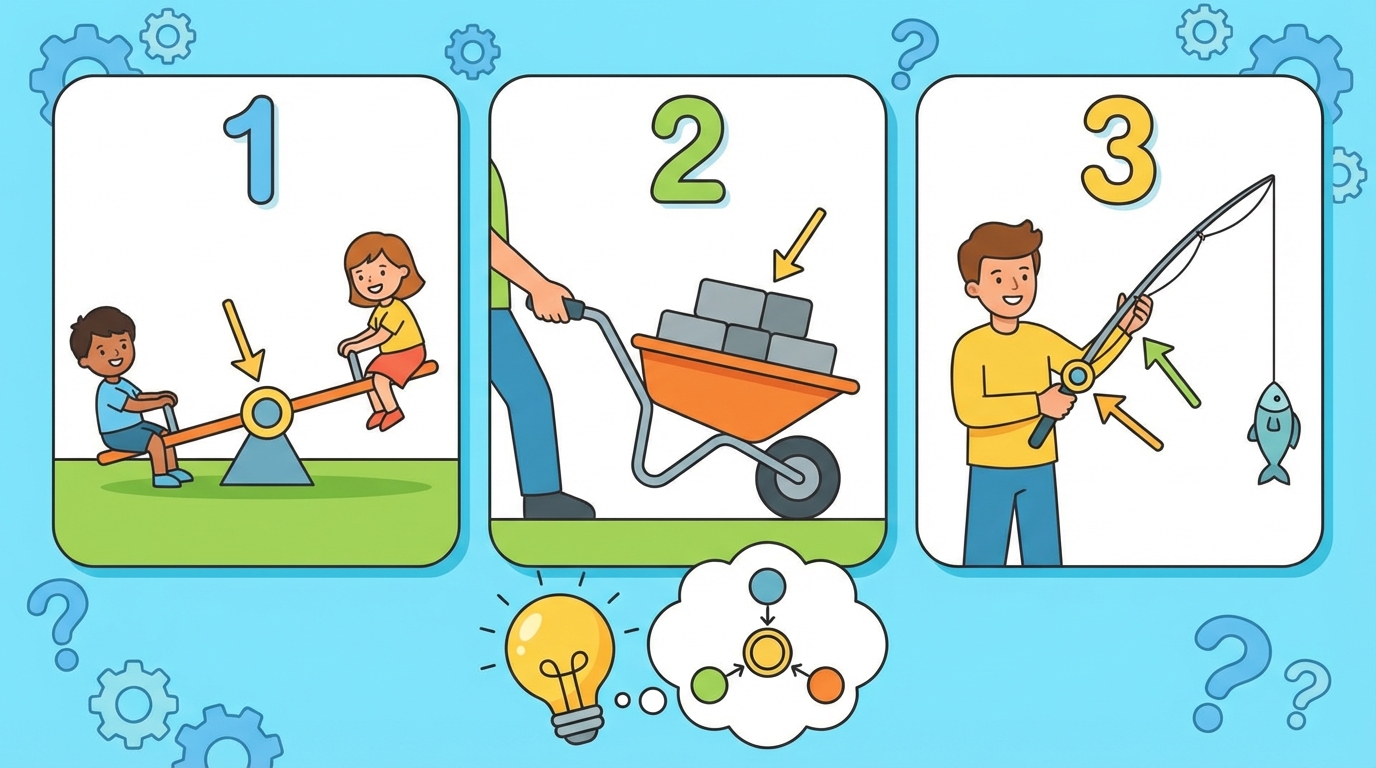
Not all levers look like a seesaw! Scientists group levers into three classes depending on where the parts are located. To figure out the class, just look at what is in the middle.
Fulcrum in middle = Class 1 | Load in middle = Class 2 | Effort in middle = Class 3
Fulcrum in the Middle
The Fulcrum is between the Effort and the Load. These can change the direction of force.
- 🎡 Seesaw
- ✂️ Scissors
- 🔨 Crowbar
Load in the Middle
The Load is between the Fulcrum and the Effort. These are great for lifting heavy things!
- 🛒 Wheelbarrow
- 🥜 Nutcracker
- 🍾 Bottle Opener
Effort in the Middle
The Effort is between the Fulcrum and the Load. These give you more speed or distance.
- 🧹 Broom
- 🎣 Fishing Rod
- 🥢 Tweezers
In a Class 3 lever, you actually use more force than the weight of the object, but it helps you move the object much further and faster (like swinging a bat!).
Key Facts
6 The Wheel and Axle: Rolling to Success
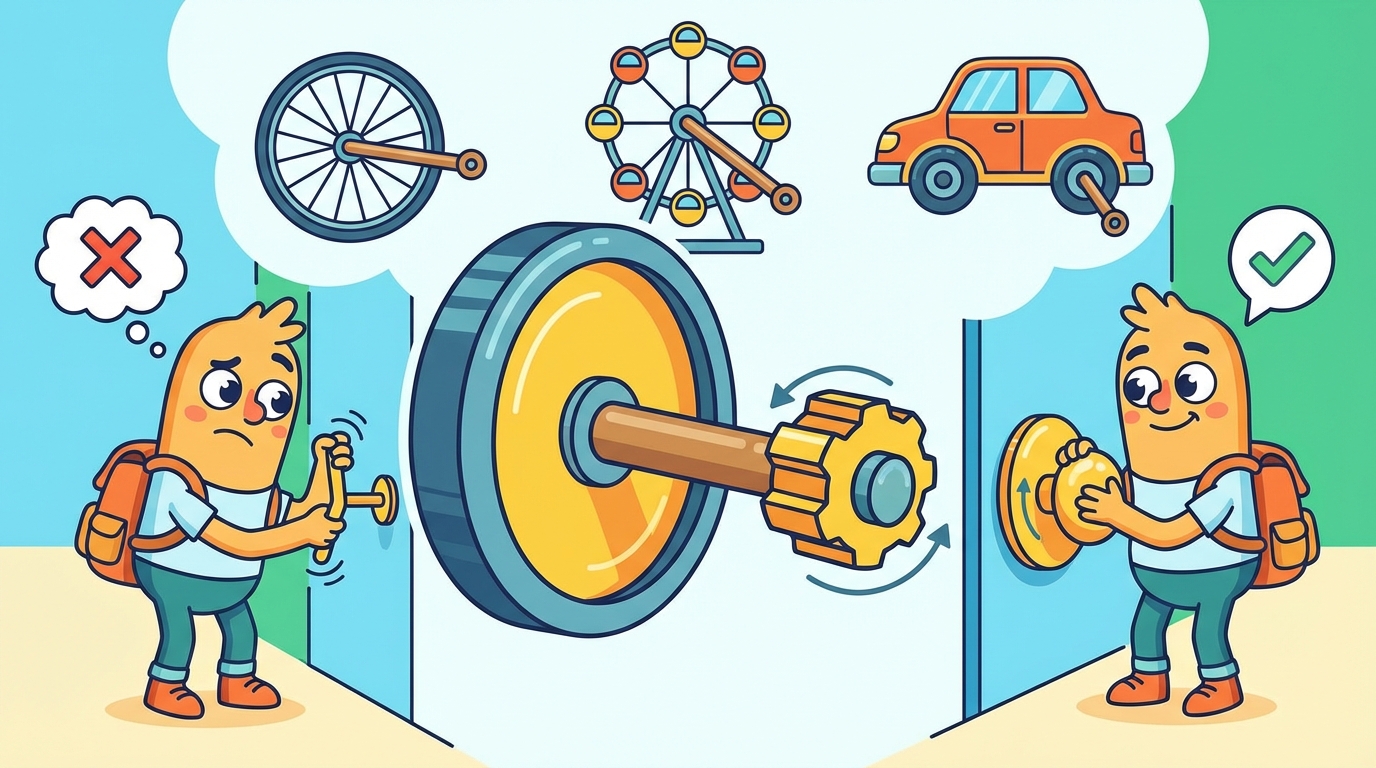
What is a Wheel and Axle? 🎡
Imagine trying to turn a doorknob that is just a tiny stick. It would be really hard to open! The wheel and axle makes this easy. It is a simple machine consisting of a large disk (the wheel) attached to a smaller rod (the axle). They turn together to make work easier.
Think of it as a lever that spins in a circle. When you turn the large wheel, you trade distance for force:
- 💪 Input Force: You apply a small force over a long distance (the big wheel).
- 💥 Output Force: The axle turns a short distance but with huge force.
| Object | The Wheel | The Axle |
|---|---|---|
| 🚪 Doorknob | The Knob | Internal Rod |
| 🔧 Screwdriver | The Handle | The Metal Shaft |
| 🚲 Bicycle | Pedals | Gears/Chain |
| 🚰 Faucet | The Handle | Valve Stem |
Key Facts
7 Pulleys: Hoisting Up Heavy Loads
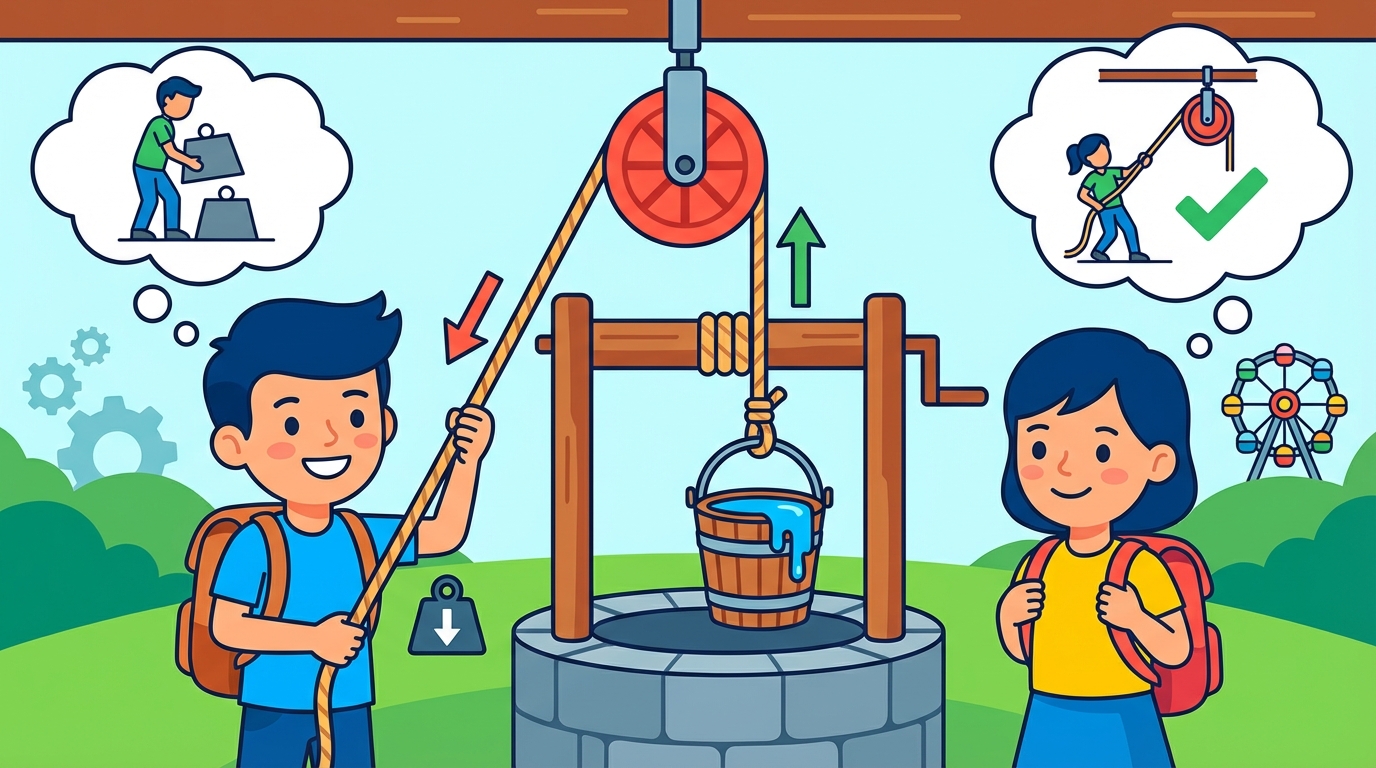
🎡 What is a Pulley?
Imagine trying to lift a heavy bucket of water from a deep well. Pulling it straight up is hard work! But if you throw a rope over a wheel, you can pull down to make the bucket go up. That's a pulley!
A pulley is a simple machine made of a wheel with a groove in its rim. A rope, cable, or belt fits into that groove so it doesn't slip off.
Two Main Types of Pulleys
1. The Fixed Pulley 🚩
This pulley stays in one place (it's fixed to a ceiling or pole). It changes the direction of the force. You pull down, the object goes up.
2. The Movable Pulley 🏗️
This pulley moves with the load. It doesn't change direction, but it multiplies your force.
Simple machines never give us energy for free! With a movable pulley, you use less force to lift a heavy box, but you have to pull more rope to lift it the same height. It's a fair trade!
Real-Life Examples
- 🏁 Flagpoles: Use a fixed pulley to raise the flag from the ground.
- 🧗 Rock Climbing: Climbers use pulley systems to stay safe and lift gear.
- 🏙️ Cranes: Construction cranes use many pulleys to lift steel beams.
- 🏠 Window Blinds: Little pulleys at the top let you pull a cord to raise the blinds.
Key Facts
8 The Inclined Plane: The Power of the Ramp
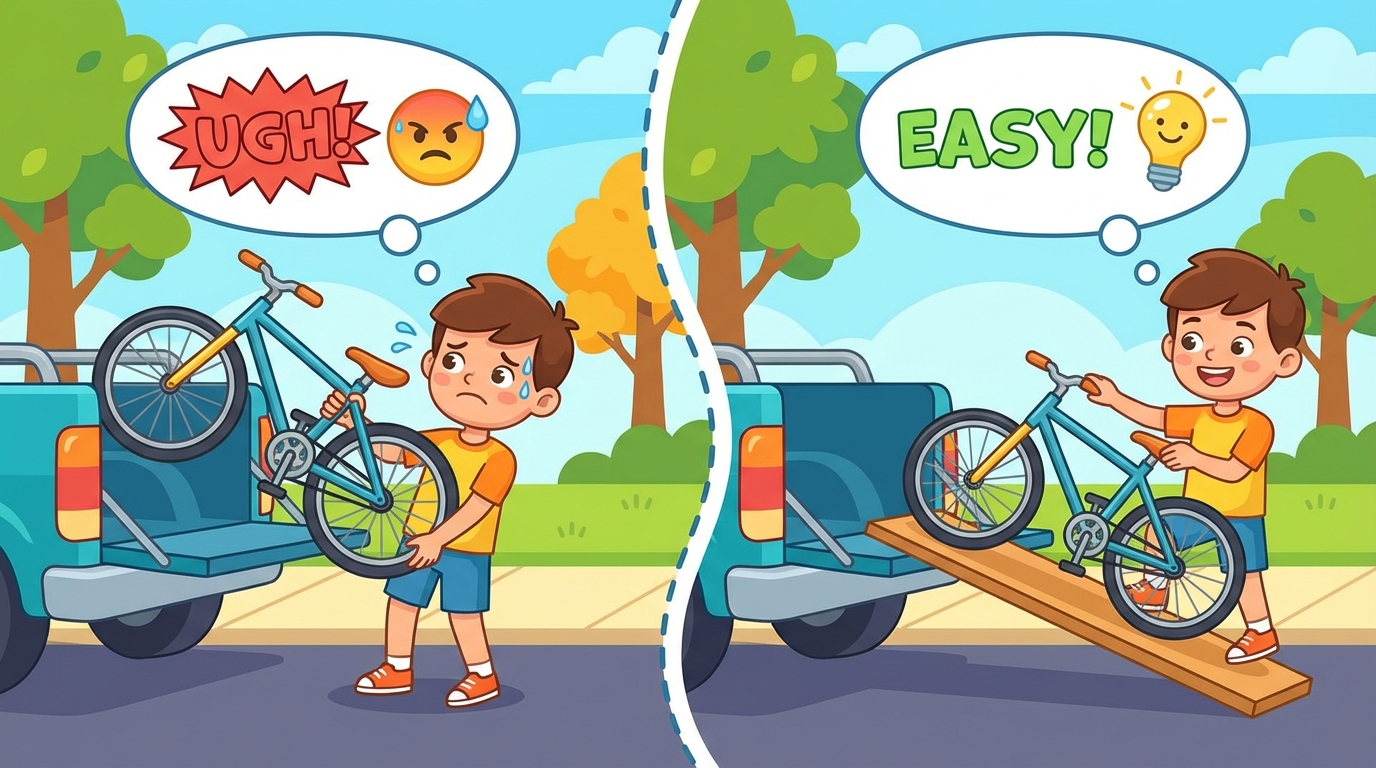
Have you ever tried to lift a heavy bicycle into the back of a truck? 🚲 It's really hard! But if you use a wooden plank to make a ramp, you can roll it up easily. That ramp is a simple machine called an Inclined Plane.
What is it? 📐
An inclined plane is a flat supporting surface tilted at an angle, with one end higher than the other. It connects a lower level to a higher level.
Simple machines don't make work disappear; they just change how we do it. Here is the secret rule of the ramp:
- Less Force: You don't have to push as hard as you would to lift it straight up. 💪
- More Distance: You have to walk further to get to the top. 📏
The angle of the slope changes everything!
| Ramp Type | Force Needed | Distance |
|---|---|---|
| Steep Ramp | High 🔴 | Short |
| Gentle Ramp | Low 🟢 | Long |
Everyday Examples
You use inclined planes all the time without realizing it!
Playground Slides
Wheelchair Ramps
Stairs
*Wait, stairs? Yes! Stairs are just an inclined plane with steps built into it so you don't slide down!
Key Facts
9 The Wedge: Splitting and Cutting
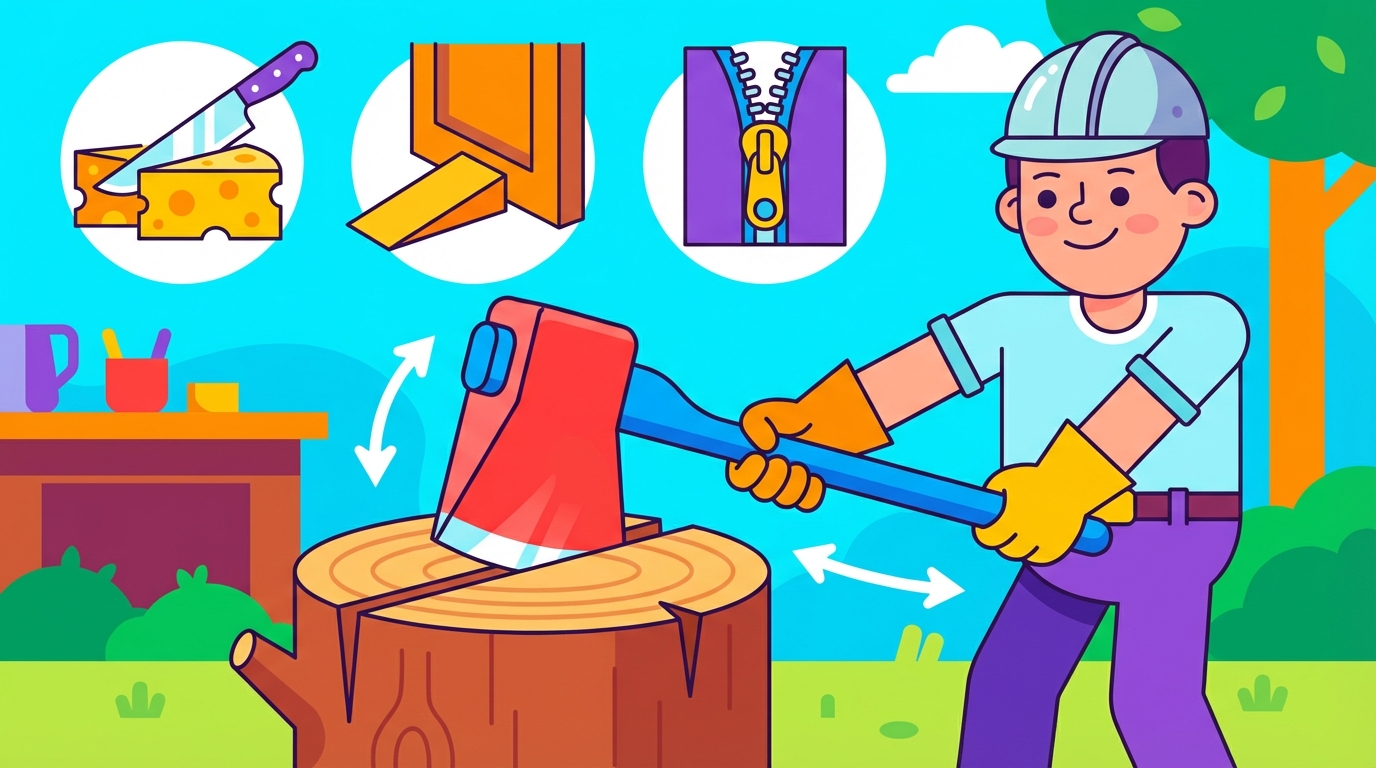
What is a Wedge? 🪓
Imagine taking two inclined planes and sticking them back-to-back. That is exactly what a wedge is! Unlike a ramp, which stays still while you move objects over it, a wedge moves to do its work.
The wedge is a simple machine used to push two objects apart or cut through an object. It is thick at one end and tapers to a thin, sharp edge at the other.
When you apply force to the wide end (downward), the wedge redirects that force outward (sideways). This powerful outward force splits things apart!
Nature's Wedges 🦷
Look in the mirror! Your front teeth (incisors) are wedges. They are sharp at the bottom to cut through your apple or sandwich when you bite down.
Common Wedges in Action
| Tool | Function | Result |
|---|---|---|
| Axe | Splitting | Separates wood logs |
| Knife | Cutting | Slices through food |
| Zipper | Separating | Locks or unlocks teeth |
| Doorstop | Holding | Uses friction to hold a door |
Key Facts
10 The Screw: An Inclined Plane Wrapped Around
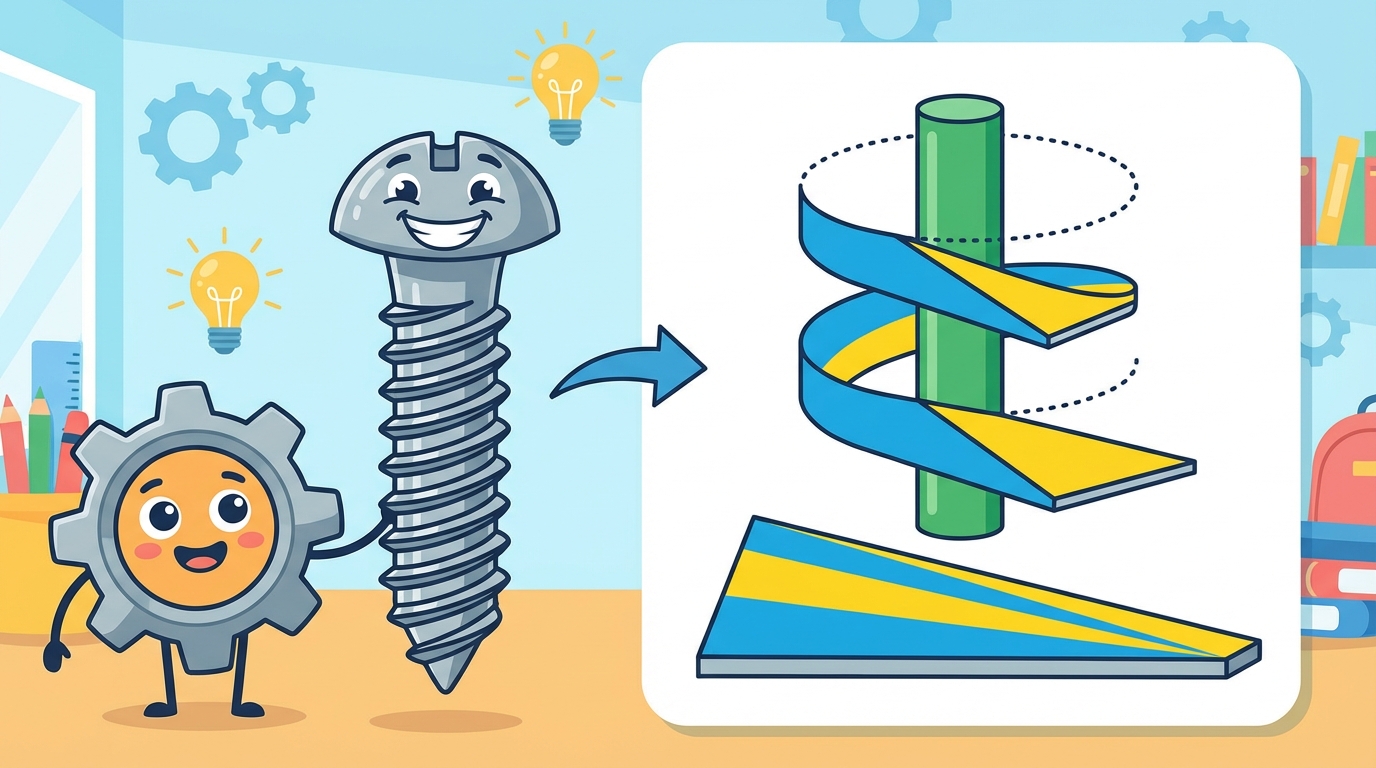
🔩 What is a Screw?
It might look like a twisted nail, but a screw is actually an inclined plane wrapped around a cylinder!
🔄 How It Works
Screws convert rotational motion (turning) into linear motion (moving straight down or up).
- 🔹 The Thread: The ridges winding around the cylinder.
- 🔹 The Pitch: The distance between the threads.
The Trade-off: You have to turn the screw many times (large distance) to move it a small amount forward, but this creates a massive amount of holding force.
💡 Everyday Examples
Screws aren't just for wood! You use them every day without noticing:
| Object | Action |
|---|---|
| Jar Lid 🥫 | The lid screws onto the glass jar threads. |
| Light Bulb 💡 | The metal base is a screw. |
| Faucet 🚰 | Turning the handle screws a stopper down to block water. |
| Spiral Staircase 🌀 | A giant screw you can walk on! |
Key Facts
11 Compound Machines: Putting It All Together
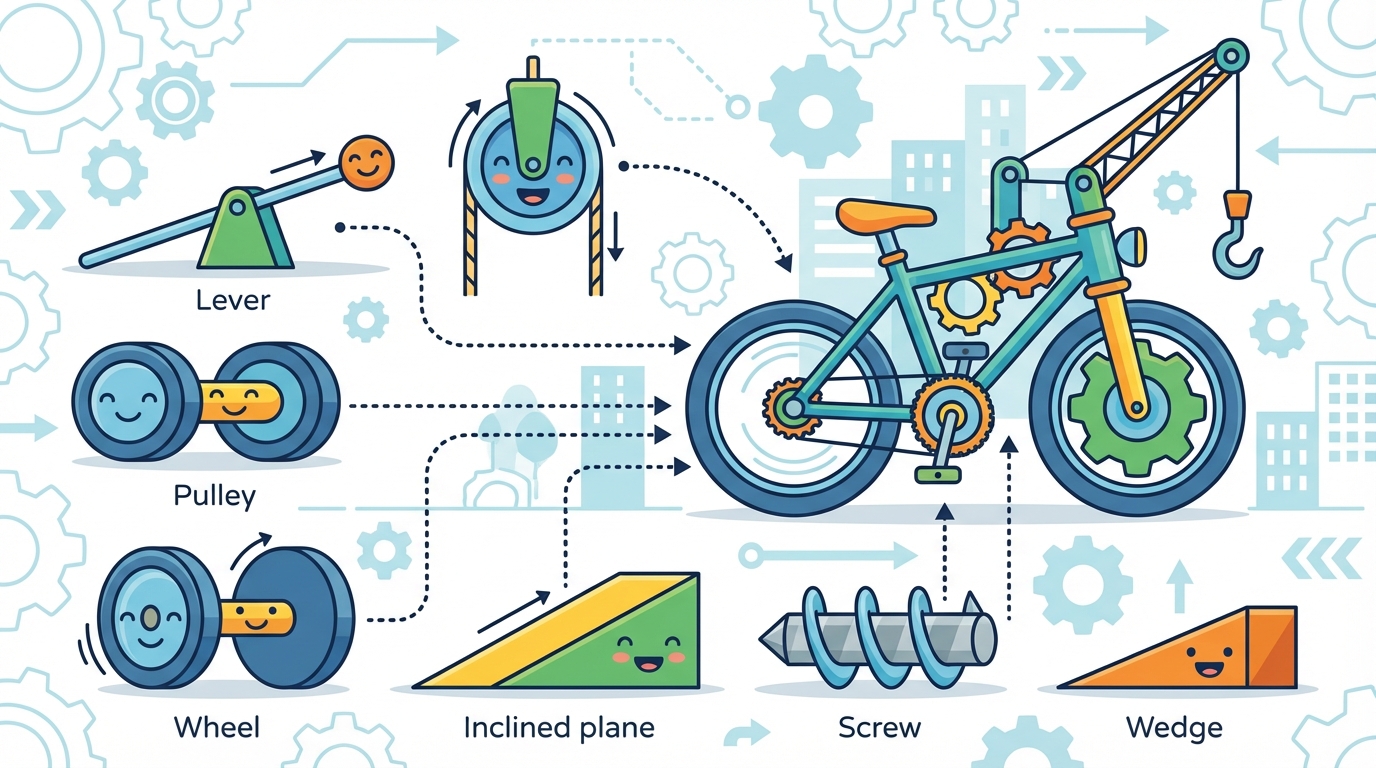
What happens when simple machines team up? 🤝 You get a Compound Machine! Most of the devices we use every day are actually combinations of the simple machines we just learned about.
🧩 The Definition
A compound machine (also called a complex machine) is a system made up of two or more simple machines working together. The output force of one simple machine becomes the input force for the next one!
✂️ Common Examples
- Scissors: Two levers connected with two wedges (blades).
- Wheelbarrow: A lever combined with a wheel and axle.
- Can Opener: A wedge, a lever, and a wheel and axle (gear).
🚲 Let's Deconstruct a Bicycle!
| Bike Part | Simple Machine | What it Does |
|---|---|---|
| Pedals | Lever | You push down (input force) to turn the crank. |
| Wheels | Wheel & Axle | The axle turns the large wheel to cover distance. |
| Gears/Chain | Pulley System | Transfers energy from the pedals to the back wheel. |
| Brakes | Lever | You squeeze the handle to apply friction. |
| Bolts | Screws | Hold the bike frame together tightly. |
Key Facts
12 Key Vocabulary
Master these important terms for your exam:
| Term | Definition |
|---|---|
|
Simple Machine
Máquina simple |
A device that changes the direction or magnitude of a force to make work easier.
Un dispositivo que cambia la dirección o magnitud de una fuerza para facilitar el trabajo. |
|
Work
Trabajo |
Using a force to move an object a certain distance.
El uso de una fuerza para mover un objeto una cierta distancia. |
|
Force
Fuerza |
A push or a pull acting on an object.
Un empuje o tracción que actúa sobre un objeto. |
|
Lever
Palanca |
A stiff bar that rests on a support called a fulcrum used to lift or move loads.
Una barra rígida que descansa sobre un soporte llamado punto de apoyo para levantar o mover cargas. |
|
Fulcrum
Punto de apoyo |
The fixed point around which a lever pivots.
El punto fijo alrededor del cual gira una palanca. |
|
Inclined Plane
Plano inclinado |
A flat, sloped surface used to move heavy loads up or down with less effort.
Una superficie plana e inclinada utilizada para mover cargas pesadas hacia arriba o hacia abajo con menos esfuerzo. |
|
Wedge
Cuña |
A simple machine with a thick end that tapers to a thin edge, used to split or lift objects.
Una máquina simple con un extremo grueso que se estrecha hasta un borde delgado, usada para dividir o levantar objetos. |
|
Screw
Tornillo |
An inclined plane wrapped around a cylinder used to hold things together or lift materials.
Un plano inclinado envuelto alrededor de un cilindro, utilizado para unir cosas o levantar materiales. |
|
Wheel and Axle
Rueda y eje |
A wheel attached to a smaller rod (axle) so that these two parts rotate together.
Una rueda unida a una varilla más pequeña (eje) de modo que ambas partes giran juntas. |
|
Pulley
Polea |
A wheel with a grooved rim around which a cord passes, used to change the direction of a force.
Una rueda con un borde acanalado por donde pasa una cuerda, utilizada para cambiar la dirección de una fuerza. |
|
Mechanical Advantage
Ventaja mecánica |
The number of times a machine increases the force exerted on it.
El número de veces que una máquina aumenta la fuerza ejercida sobre ella. |
|
Compound Machine
Máquina compuesta |
A machine made of two or more simple machines working together.
Una máquina hecha de dos o más máquinas simples que trabajan juntas. |
|
Effort Force
Fuerza de esfuerzo |
The force applied to a machine to do work.
La fuerza aplicada a una máquina para realizar un trabajo. |
|
Load
Carga |
The object being moved or lifted by a machine.
El objeto que es movido o levantado por una máquina. |
|
Friction
Fricción |
A force that opposes motion between two surfaces that are in contact.
Una fuerza que se opone al movimiento entre dos superficies que están en contacto. |
|
Efficiency
Eficiencia |
A measure of how much of the work put into a machine is converted into useful output work.
Una medida de cuánto del trabajo invertido en una máquina se convierte en trabajo útil. |
Time to Practice!
There are 7 questions waiting for you. Questions are shuffled each attempt.
Take the Quiz