Understanding Speed
Learn how to describe motion, calculate speed using formulas, and interpret distance-time graphs.
1 Motion and Reference Points: Are We Moving?

🤔 Wait, are we moving?
Right now, you are probably sitting in a chair reading this. Are you moving? Well, the answer is yes and no! It all depends on your point of view.
An object is in motion if it changes position relative to a reference point. A reference point is a place or object used for comparison to determine if something is in motion. Usually, we use stationary objects like trees, signs, or buildings.
🚌 The School Bus Example
Imagine you are sitting on a moving school bus next to your best friend.
- 👀 To you: Your friend is not moving because they are sitting right next to you.
- 👀 To a person on the sidewalk: Your friend is moving fast because the bus is driving away!
| Observer | Are you moving? |
|---|---|
| Your friend on the bus | No (Stationary) |
| A dog on the sidewalk | Yes (Moving) |
| An astronaut in space | Yes (Spinning with Earth!) |
Conclusion: Motion is relative. You need a reference point to know if motion is happening!
Key Facts
2 What is Speed? Defining Fast and Slow
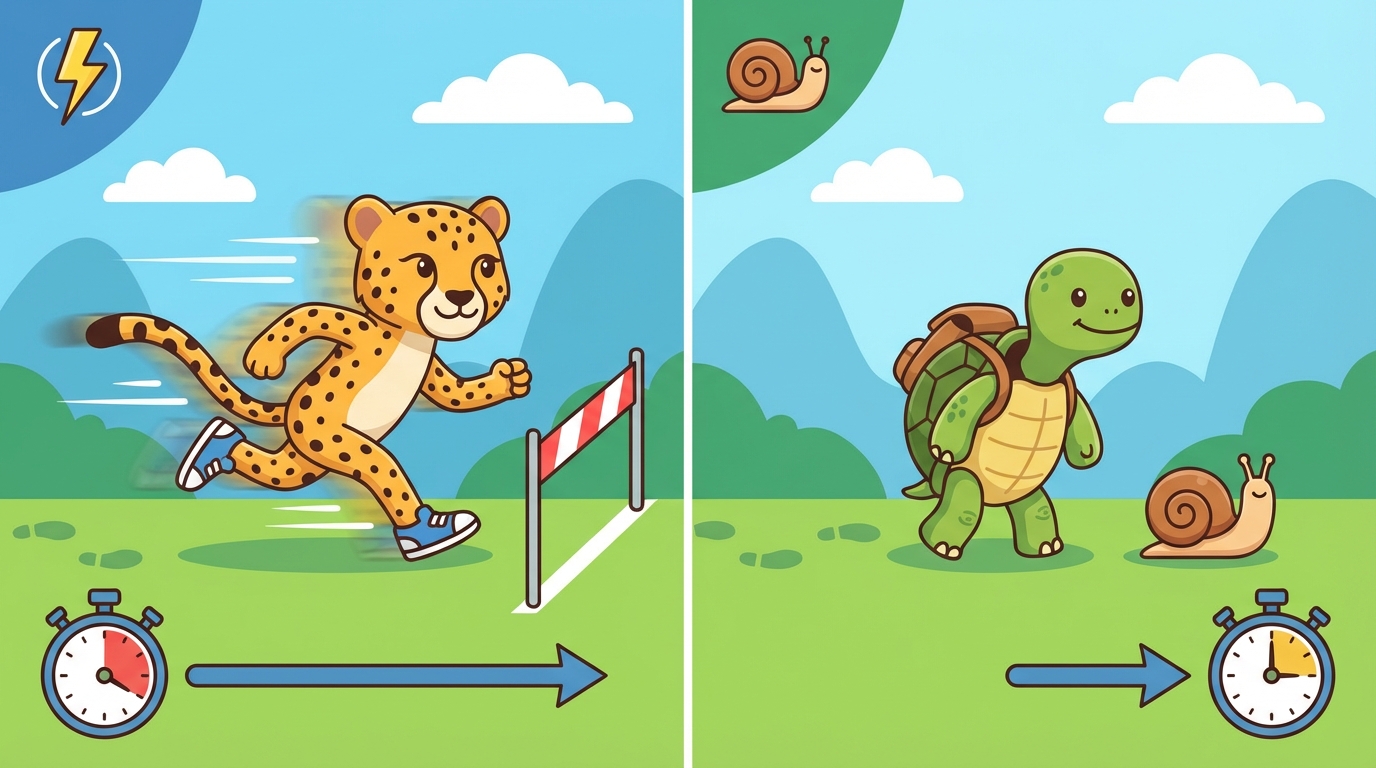
Have you ever wondered why a cheetah wins a race against a turtle? It all comes down to Speed! 🏃💨
⚡ What is Speed?
Speed is a measure of how fast something moves. It tells us the distance traveled in a specific amount of time.
An object is fast if it covers a long distance in a short amount of time.
- A race car zooming around a track 🏎️
- A jet plane flying across the sky ✈️
- Light traveling from the sun ☀️
An object is slow if it covers a short distance in a long amount of time.
- A snail moving across a leaf 🐌
- A glacier sliding down a mountain 🏔️
- Traffic during rush hour 🚗🚙🚛
Let's Compare!
Imagine a race to the candy store (100 meters away). Who gets there first?
| Racer | Time Taken | Speed Description |
|---|---|---|
| Bicycle 🚲 | 10 Seconds | Very Fast! |
| Runner 🏃 | 20 Seconds | Fast |
| Walking 🚶 | 60 Seconds | Slow |
Key Facts
3 The Magic Formula: Calculating Speed

Have you ever wondered how referees know exactly how fast a sprinter is running? They use a simple mathematical tool! To find out how fast something is moving, we need to know two things: how far it traveled and how long it took.
⚡ The Formula
Speed = Distance ÷ Time
Or simply:
S = D / T
Distance is the pizza, and Time is the number of people sharing it.
🏃 Let's Try It!
Imagine a student runs 50 meters in 10 seconds.
Step 1: Find Distance (50m)
Step 2: Find Time (10s)
Step 3: Divide!
50 ÷ 10 = 5 m/s
The student's speed is 5 meters per second!
Key Facts
4 Units of Measurement: Meters, Seconds, and Hours

⏱️ The Ingredients of Speed
To calculate speed, we need to measure two things: how far something moves (Distance) and how long it takes (Time). It's like a recipe!
Distance is the amount of space between two points. In science, we usually use:
- Meters (m): For short distances, like the length of a hallway or a soccer field.
- Kilometers (km): For long trips, like driving to another city.
Remember: 1 km = 1,000 meters!
Time measures how long an event lasts. The most common units for speed are:
- Seconds (s): For quick events, like a sprint or a ball falling.
- Hours (h): For long durations, like a road trip or a flight.
Remember: 1 h = 3,600 seconds!
🚀 Putting it Together: The Speed Units
When we combine distance and time, we get speed! Here are the two main 'teams':
| Unit Symbol | Read as... | Best Used For... |
|---|---|---|
| m/s | Meters per second | Science & Sports: Running, throwing a ball, sound waves. |
| km/h | Kilometers per hour | Travel: Cars, trains, airplanes, highway limits. |
Key Facts
5 Speed vs. Velocity: Why Direction Matters

Imagine a pilot flying a plane at 500 miles per hour. ✈️ That sounds fast, right? But if the pilot doesn't know where they are going, the passengers are in trouble! This is the main difference between speed and velocity.
🏃 Speed (Rapidez)
Speed tells you how fast something is moving. It is just a number with units.
- Formula: Distance ÷ Time
- Example: 25 m/s
- Does direction matter? No! ❌
🧭 Velocity (Velocidad)
Velocity tells you how fast AND which way something is moving.
- Formula: Speed + Direction
- Example: 25 m/s North
- Does direction matter? Yes! ✅
Let's Compare! 🆚
| Scenario | Is it Speed? | Is it Velocity? |
|---|---|---|
| A car driving 60 mph | ✅ Yes | ❌ No (No direction) |
| A storm moving 20 mph East | ✅ Yes | ✅ Yes (Has direction!) |
| A runner running in a circle | ✅ Constant Speed | 🔄 Changing Velocity |
🌪️ Real-Life Science: Weather Forecasting
Meteorologists (weather scientists) care more about velocity than speed. Knowing a hurricane has wind speeds of 100 mph is scary, but knowing it is moving North-West towards the coast is what helps people prepare and stay safe!
Key Facts
6 Average Speed vs. Instantaneous Speed
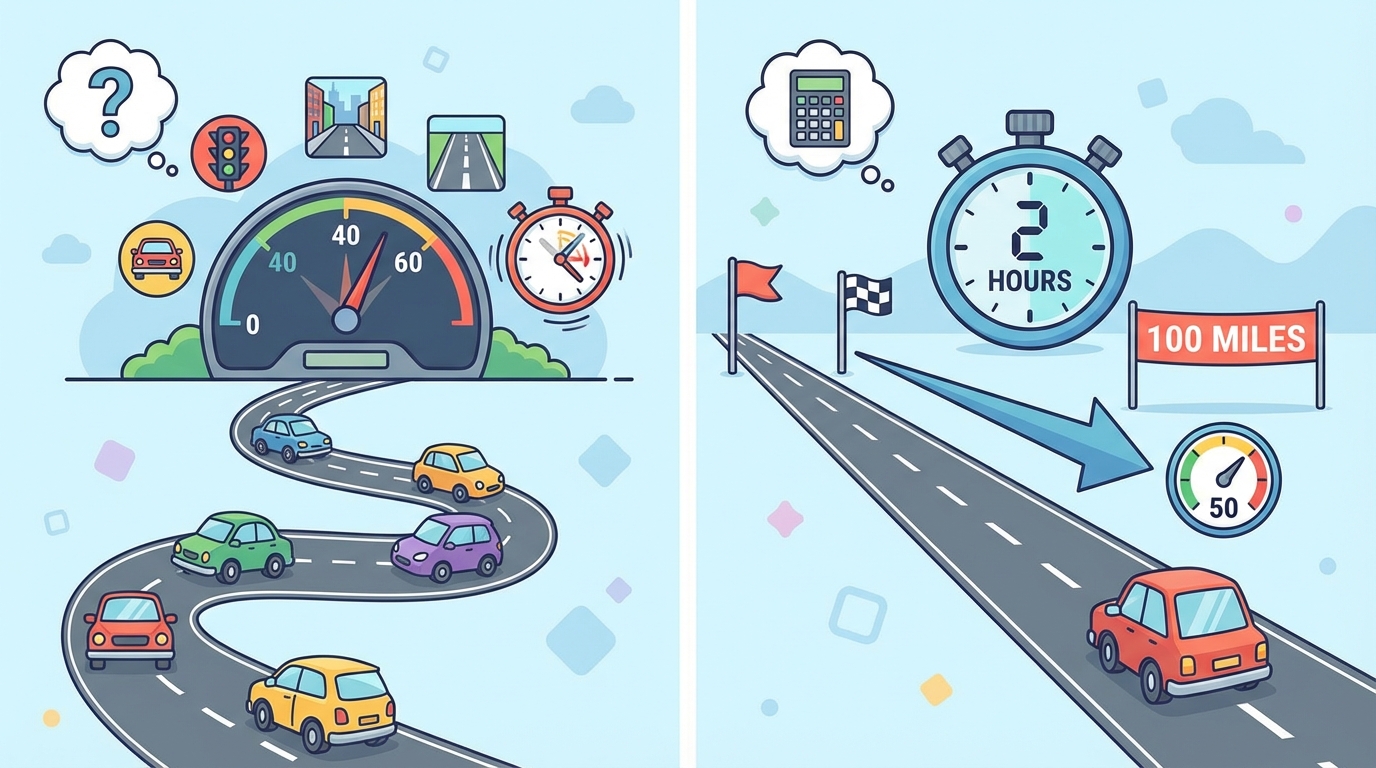
Have you ever looked at a car's speedometer? 🚗 Sometimes it says 40 mph, then 60 mph, then 0 mph at a red light. But if you drive 100 miles in 2 hours, we say your speed was 50 mph. How can both be true? Let's find out!
This is your speed at a specific moment in time.
Think of it like taking a photo 📸 or a freeze-frame. It tells you exactly how fast you are moving right now.
This is the speed calculated over the entire trip.
It doesn't care about stoplights or traffic jams. It only cares about the total distance and total time.
The Great Comparison Table 📊
| Feature | Instantaneous Speed | Average Speed |
|---|---|---|
| What is it? | Speed at this exact second. | Speed over the whole journey. |
| Tool used | Speedometer / Radar Gun 🔫 | Calculator / Math 🧮 |
| Does it change? | Yes, constantly (speed up/slow down). | No, it's one number for the whole trip. |
Key Facts
7 Visualizing Motion: Introduction to Distance-Time Graphs

📈 Motion tells a story! Just like a map shows you where places are, a Distance-Time Graph shows you how an object moves over time.
To read the story, you need to know the characters:
- The X-Axis (Bottom): This is Time ⏱️. It always moves forward to the right.
- The Y-Axis (Side): This is Distance 📏. It shows how far away the object is from the starting point.
The shape of the line tells us the speed:
- Steep Line: Fast speed! 🚀
- Gentle Line: Slow speed. 🐢
- Flat (Horizontal) Line: Stopped! No motion. 🛑
🔍 Graph Reader Cheat Sheet
| Line Shape | What it means | Real Life Example |
|---|---|---|
| Steep / Up | High Speed | Sprinting to catch the bus 🚌 |
| Gentle / Up | Low Speed | Walking your dog 🐕 |
| Flat / Straight | Zero Speed (Rest) | Stopping to tie your shoe 👟 |
Key Facts
8 Reading the Lines: Slopes and Stops on a Graph

Graphs tell a story! 📖 Just by looking at the shape of the line on a Distance-Time graph, you can tell exactly what an object is doing without doing any math yet.
The slope is how steep the line is. Think of it like a hill:
- Steep Line: The object is moving FAST! 🚀 It covers a lot of distance in a short time.
- Gentle Slope: The object is moving SLOW. 🐢 It takes a long time to go a short distance.
What happens if the line goes completely horizontal (flat)?
This means time is passing, but distance is not changing. The object has STOPPED. It is taking a rest break! 😴
Graph Detective Guide 🕵️♀️
| Line Shape | Speed | Real Life Example |
|---|---|---|
| / Steep | Fast Speed | Running to catch the bus! 🚌💨 |
| — Flat | Zero Speed | Waiting at a red light. 🚦 |
| _ / Gentle | Slow Speed | Walking your dog in the park. 🐕 |
Key Facts
9 Key Vocabulary
Master these important terms for your exam:
| Term | Definition |
|---|---|
|
Speed
Rapidez |
A measure of how fast an object is moving; distance divided by time.
Una medida de qué tan rápido se mueve un objeto; es la distancia dividida por el tiempo. |
|
Velocity
Velocidad |
Speed in a specific direction.
La rapidez en una dirección específica. |
|
Motion
Movimiento |
A change in position over time relative to a reference point.
Un cambio de posición a lo largo del tiempo en relación con un punto de referencia. |
|
Reference Point
Punto de referencia |
A stationary object used to determine if something is in motion.
Un objeto fijo que se usa para determinar si algo está en movimiento. |
|
Distance
Distancia |
The total length of the path traveled between two points.
La longitud total del camino recorrido entre dos puntos. |
|
Time
Tiempo |
How long it takes for an event to occur.
Cuánto tarda en ocurrir un evento. |
|
Position
Posición |
The location of an object.
La ubicación de un objeto. |
|
Average Speed
Rapidez media |
The total distance traveled divided by the total time taken.
La distancia total recorrida dividida por el tiempo total empleado. |
|
Constant Speed
Rapidez constante |
Speed that does not change over a period of time.
Rapidez que no cambia durante un período de tiempo. |
|
Acceleration
Aceleración |
The rate at which velocity changes (speeding up, slowing down, or changing direction).
La tasa a la que cambia la velocidad (acelerar, frenar o cambiar de dirección). |
|
Deceleration
Desaceleración |
A decrease in speed; slowing down.
Una disminución en la rapidez; frenar. |
|
Distance-Time Graph
Gráfica de distancia-tiempo |
A graph that shows how distance changes as time passes.
Una gráfica que muestra cómo cambia la distancia a medida que pasa el tiempo. |
|
Slope
Pendiente |
The steepness of a line on a graph; on a distance-time graph, a steeper slope means faster speed.
La inclinación de una línea en una gráfica; en una gráfica de distancia-tiempo, una pendiente más pronunciada significa mayor rapidez. |
|
Stationary
Estacionario |
Not moving; at rest.
Que no se mueve; en reposo. |
|
Unit
Unidad |
A standard amount used to measure something, like meters per second (m/s).
Una cantidad estándar usada para medir algo, como metros por segundo (m/s). |
Time to Practice!
There are 7 questions waiting for you. Questions are shuffled each attempt.
Take the Quiz