Informational Text
Learn to identify and analyze texts that report facts and events, focusing on news reports and interviews.
1 What is an Informational Text?
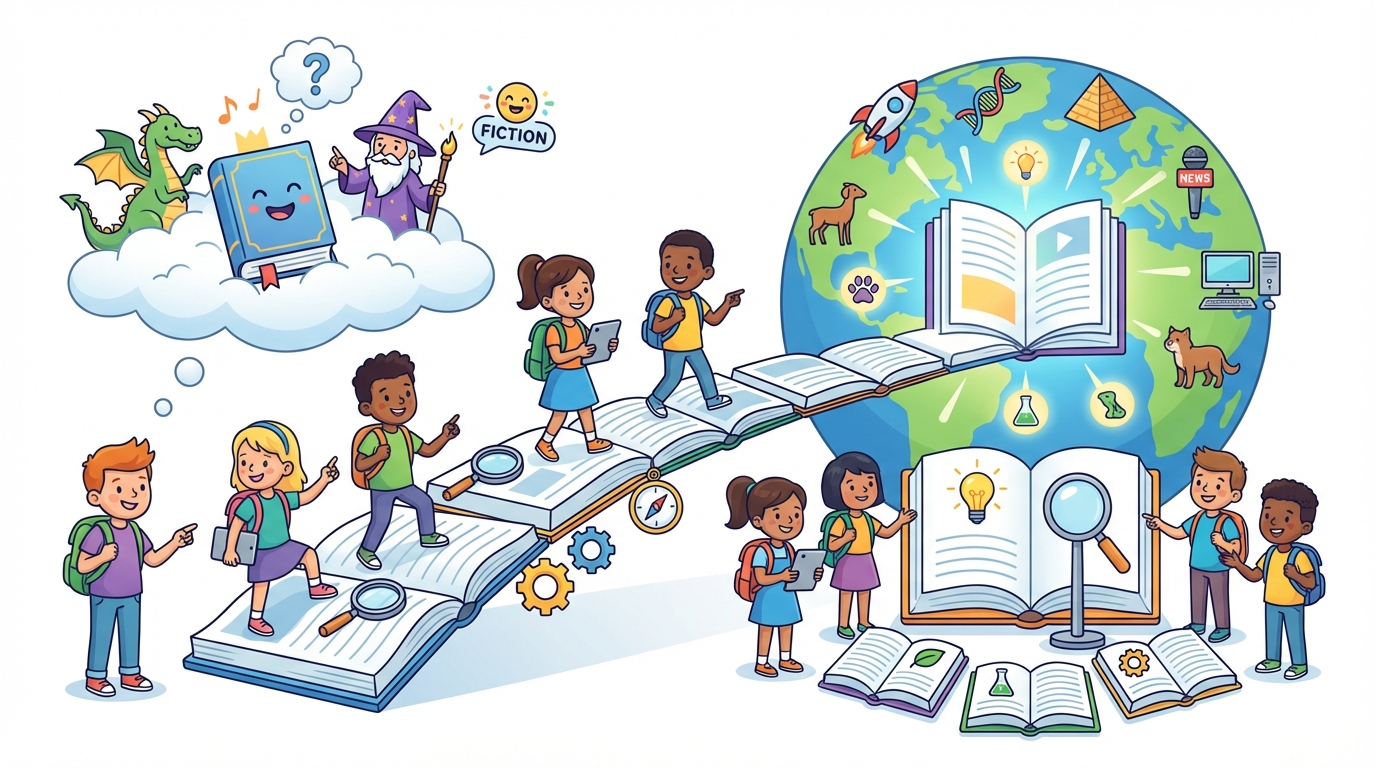
Welcome to the world of facts! 🌍 Unlike stories that are invented to entertain us, informational text is written to provide truth and knowledge about the real world.
📖 Definition
An informational text is a subset of non-fiction. Its primary purpose is to inform the reader about the natural or social world. It does not utilize characters or a plot.
- 📚 Textbooks: Science, History, or Social Studies books.
- 📰 News Articles: Newspapers and magazines reporting current events.
- 🍳 Instruction Manuals & Recipes: Step-by-step guides on how to do something.
- 🦁 Biographies: True stories about a person's life.
| Literature (Fiction) | Informational (Non-Fiction) |
|---|---|
| Has characters & plot | Has facts & topics |
| Read for entertainment | Read to learn something |
| Beginning, Middle, End | Headers, Glossary, Index |
When you read informational text, you become an investigator! 🕵️♀️ You are looking for main ideas, supporting details, and evidence to learn something new.
Key Facts
2 The News Report: Reporting Reality
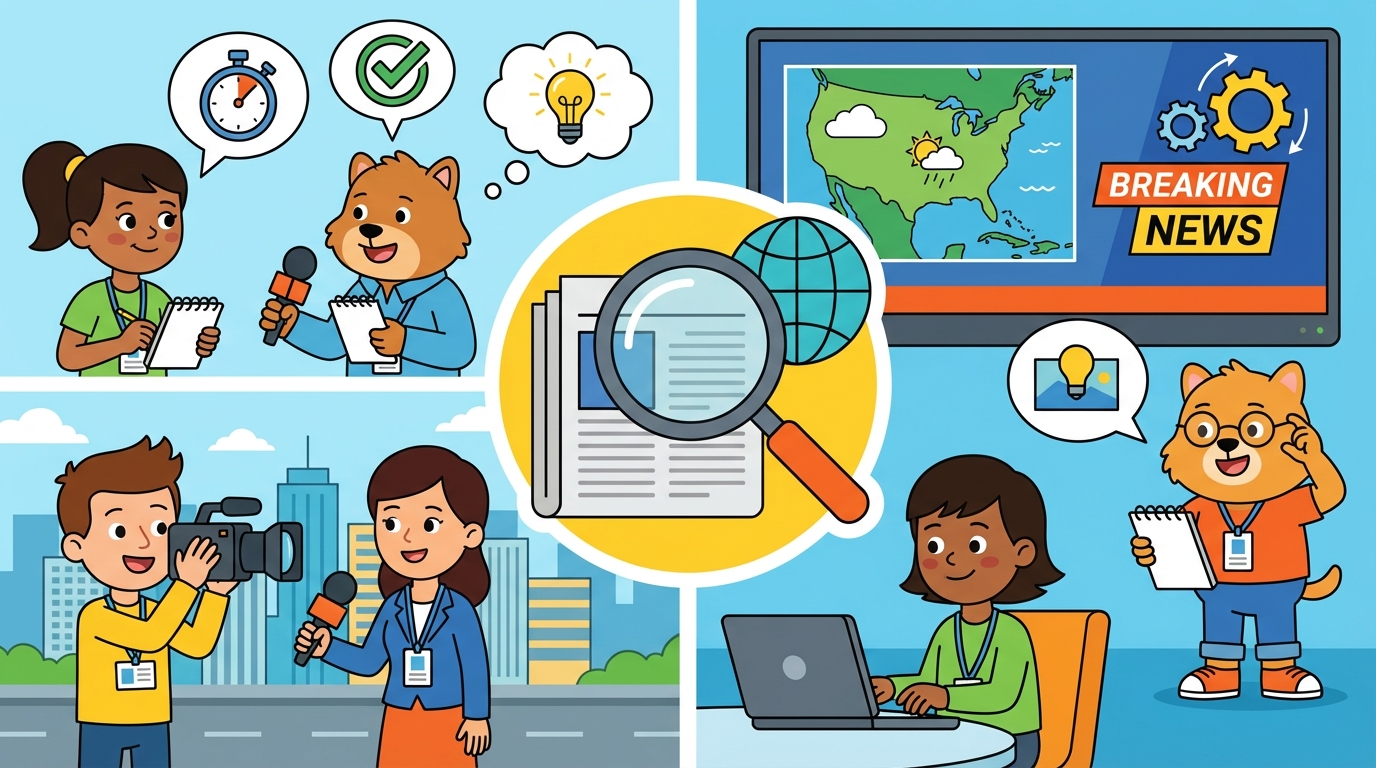
Have you ever wondered how reporters write stories? Unlike a fictional story, a news report is all about facts, truth, and speed!
The Golden Rule: The 5 Ws + H 🕵️♀️
To write a complete news story, a reporter must answer six specific questions. If one is missing, the story isn't complete!
| Question | What it tells us |
|---|---|
| Who? 👤 | The people involved in the event. |
| What? ❓ | The specific event that happened. |
| When? 📅 | The time and date it took place. |
| Where? 📍 | The location of the event. |
| Why? 💡 | The reason it happened. |
| How? ⚙️ | The details of how it occurred. |
Structure: The Inverted Pyramid 🔻
News reports are written upside down! We call this the Inverted Pyramid style. The most important information goes at the very top.
The first paragraph. It summarizes the most important facts (The 5 Ws) instantly.
Provides more details, quotes from witnesses, and background information.
Key Facts
3 The 5 Key Questions (The 5 Ws)
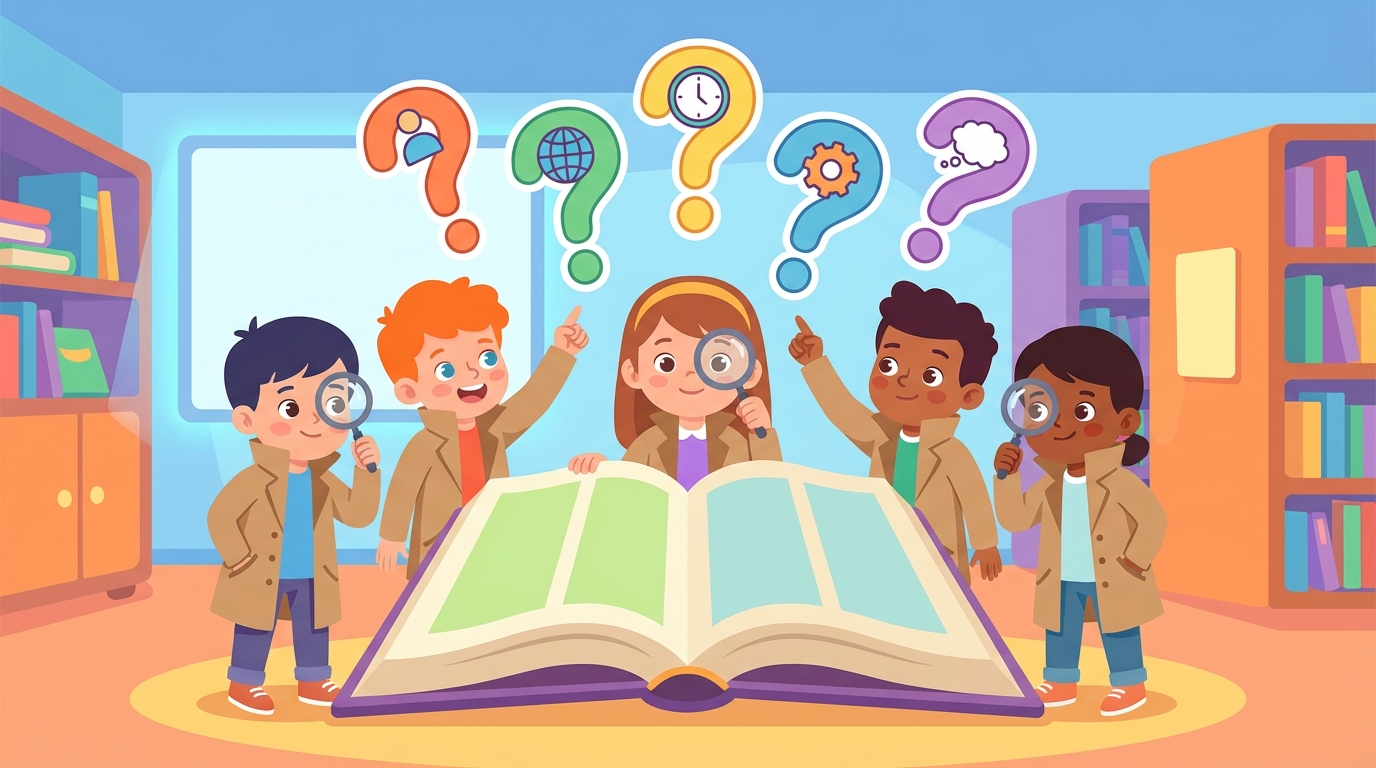
🕵️♀️ Be a Reading Detective!
When you read informational text, imagine you are a detective gathering evidence. To understand the full story, you need to uncover the facts. In English, we call these the 5 Ws. If you can answer these five questions, you have mastered the text!
Who is the text about? Who are the main people or groups involved?
What happened? What is the main event or topic being described?
Where did it happen? Look for locations, cities, or environments.
When did it take place? Look for dates, times, or historical periods.
Why did it happen? What caused the event? This is often the most important part!
Example: A News Article about Mars
| Question | Answer found in text |
|---|---|
| Who? | NASA Astronauts |
| What? | Successfully landed a new rover |
| Where? | On the surface of Mars (Jezero Crater) |
| When? | Yesterday at 3:00 PM |
| Why? | To search for signs of ancient life |
Key Facts
4 News Structure: The Inverted Pyramid
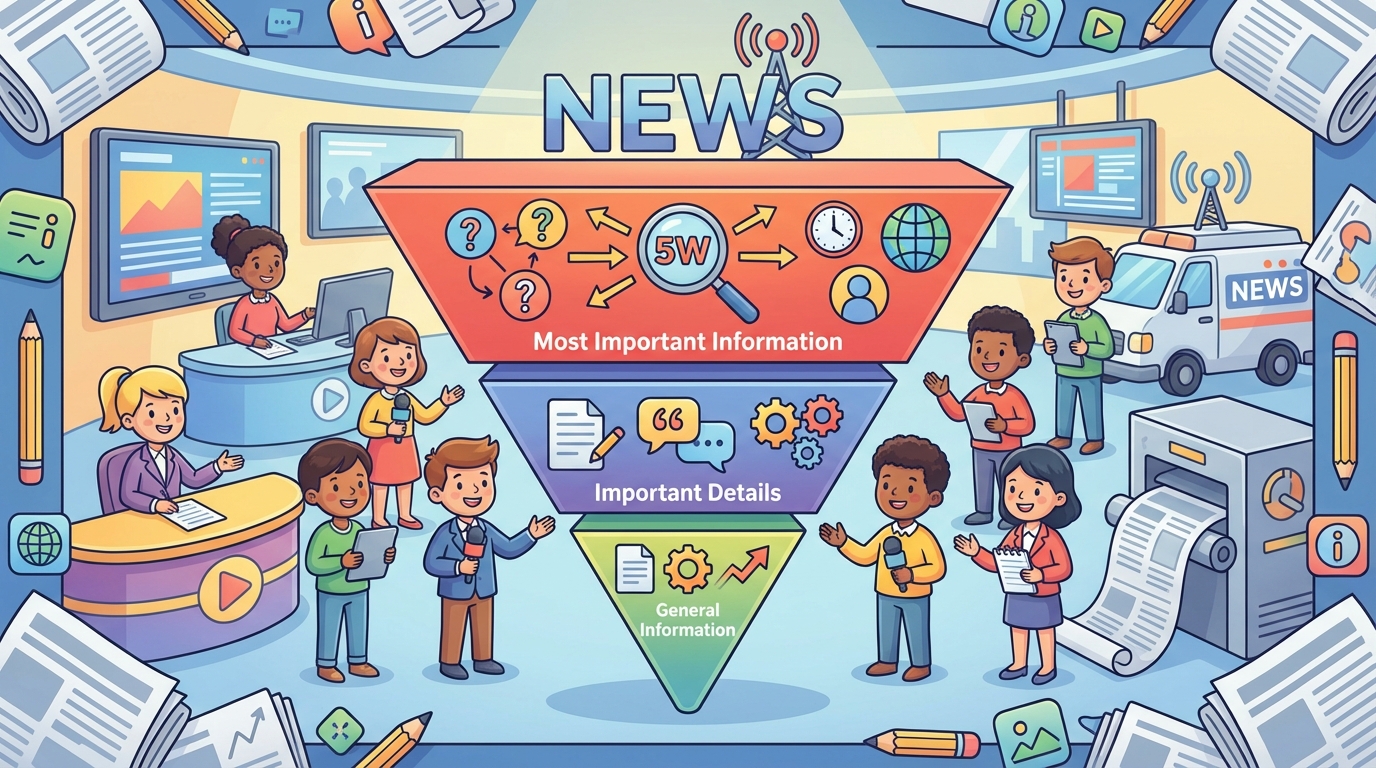
Imagine turning a pyramid upside down! 🔻 That is exactly how journalists write news stories.
The Three Layers of News
This is the hook! It must answer the 5 Ws: Who, What, Where, When, and Why. If you stop reading here, you still know the main news.
This part gives context, evidence, and quotes from people involved. It explains 'How' it happened.
Background information or interesting facts. Editors can cut this part if the newspaper runs out of space!
📰 Real Life Example: The Robotics Win
| Section | Content |
|---|---|
| The Lead | Lincoln Middle School won 1st place at the State Robotics Fair yesterday afternoon. |
| The Body | 'We practiced coding all month,' said captain Mia. The robot successfully sorted recyclables in record time. |
| The Tail | The robotics club was founded in 2015. The next competition is in June. |
Key Facts
5 Headlines and Leads: Catching Attention
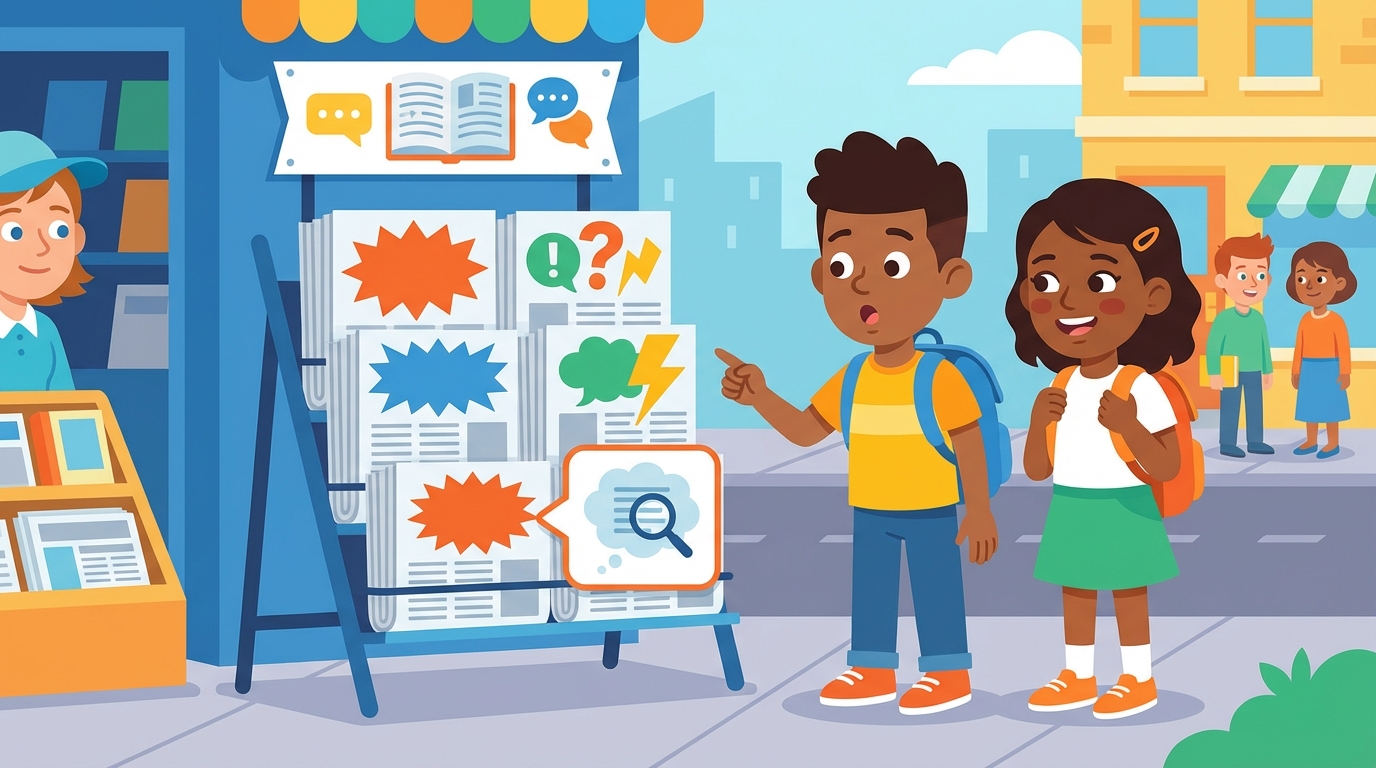
📰 The Front Page Effect!
Imagine walking past a newsstand. What makes you stop and look? It's usually a big, bold Headline! In informational text, authors use headlines and leads (the first paragraph) to hook you immediately.
This is the title of the article. It should be:
- ⚡ Short and punchy
- 👀 Written in big, bold letters
- 🧩 A clue about the main idea
This is the very first paragraph. A great lead answers the 5 Ws:
Boring vs. Catchy: A Comparison 🧐
| Boring Version 😴 | Catchy Version 🤩 | Why it works |
|---|---|---|
| School cafeteria changes menu. | Pizza Party Every Friday! Cafeteria Shake-Up | Uses exciting words and specific details. |
| A dog was found in the park yesterday. | Hero Dog Saves Picnic from Ant Invasion! | Creates a mini-story and drama. |
Key Facts
6 The Interview: A Dialogue for Information
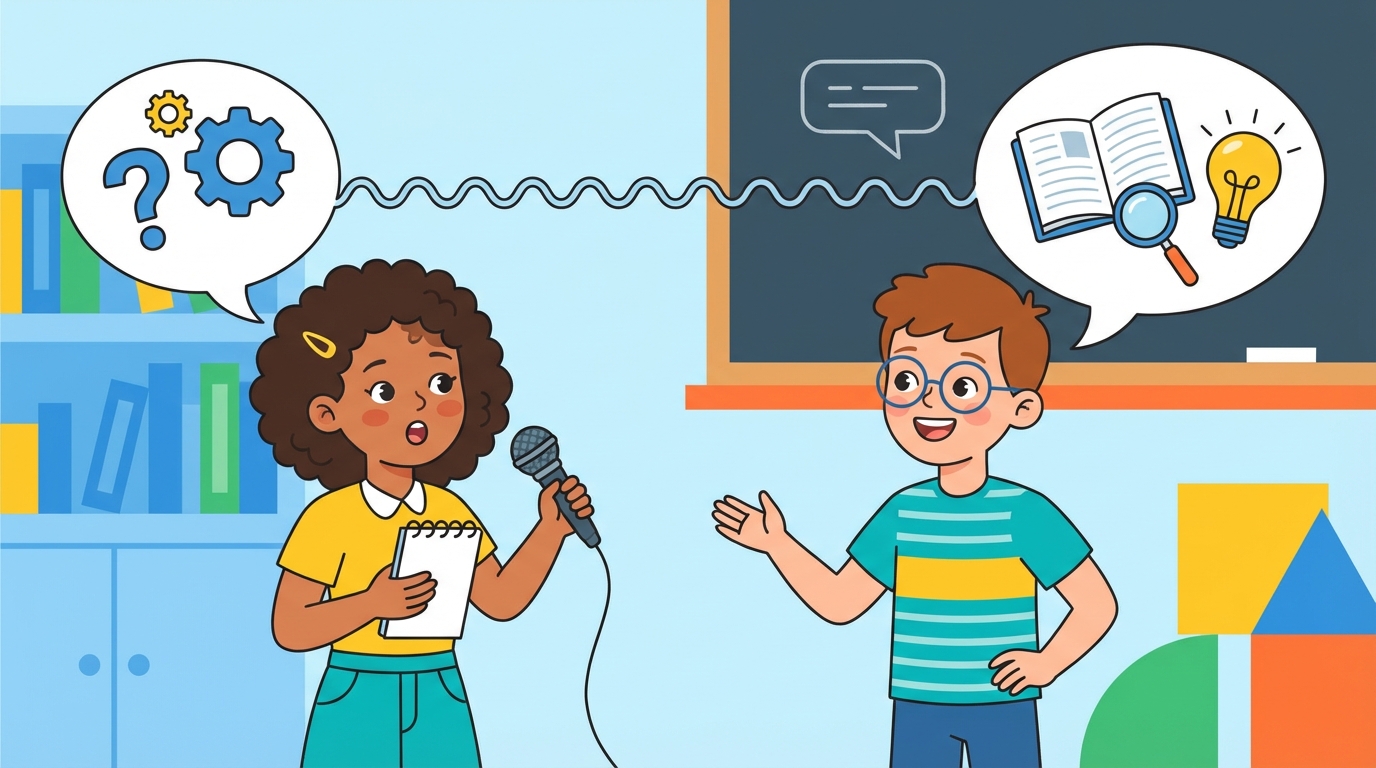
- 🕵️ The Interviewer: The person who prepares and asks the questions to guide the conversation.
- 🗣️ The Interviewee: The expert, witness, or person answering the questions to provide information.
To get the best information, use Open-Ended Questions (start with How, Why, Describe). Avoid questions that can be answered with just 'Yes' or 'No'.
🧪 The Question Lab: Make it Better!
| ❌ Closed Question (Weak) | ✅ Open-Ended Question (Strong) |
|---|---|
| Do you like being an astronaut? | What is the most exciting part of being an astronaut? |
| Was writing the book hard? | How did you overcome challenges while writing the book? |
Key Facts
7 Types of Questions: Open vs. Closed

When we read informational text, asking questions is like using a key to unlock meaning 🔑. But not all keys are the same! There are two main types of questions: Closed and Open.
These are often called 'Skinny Questions'. They usually have only one right answer or a simple 'Yes' or 'No'.
- ✅ Good for checking specific facts.
- ✅ Quick to answer.
- ✅ Start with: Who, When, Where, Did, Is.
These are often called 'Thick Questions'. They require a longer explanation, an opinion, or evidence from the text.
- 🌟 Good for deep thinking and discussion.
- 🌟 Many possible answers.
- 🌟 Start with: Why, How, Explain, Describe.
🧪 The Question Test: Which is which?
| Question | Type | Why? |
|---|---|---|
| 'What year did the Titanic sink?' | Closed | It is a specific fact (1912). |
| 'How might history have changed if the Titanic didn't sink?' | Open | You have to use imagination and logic. |
| 'Do plants need sunlight?' | Closed | Simple Yes/No answer. |
Key Facts
8 Writing the Report: Direct vs. Indirect Speech
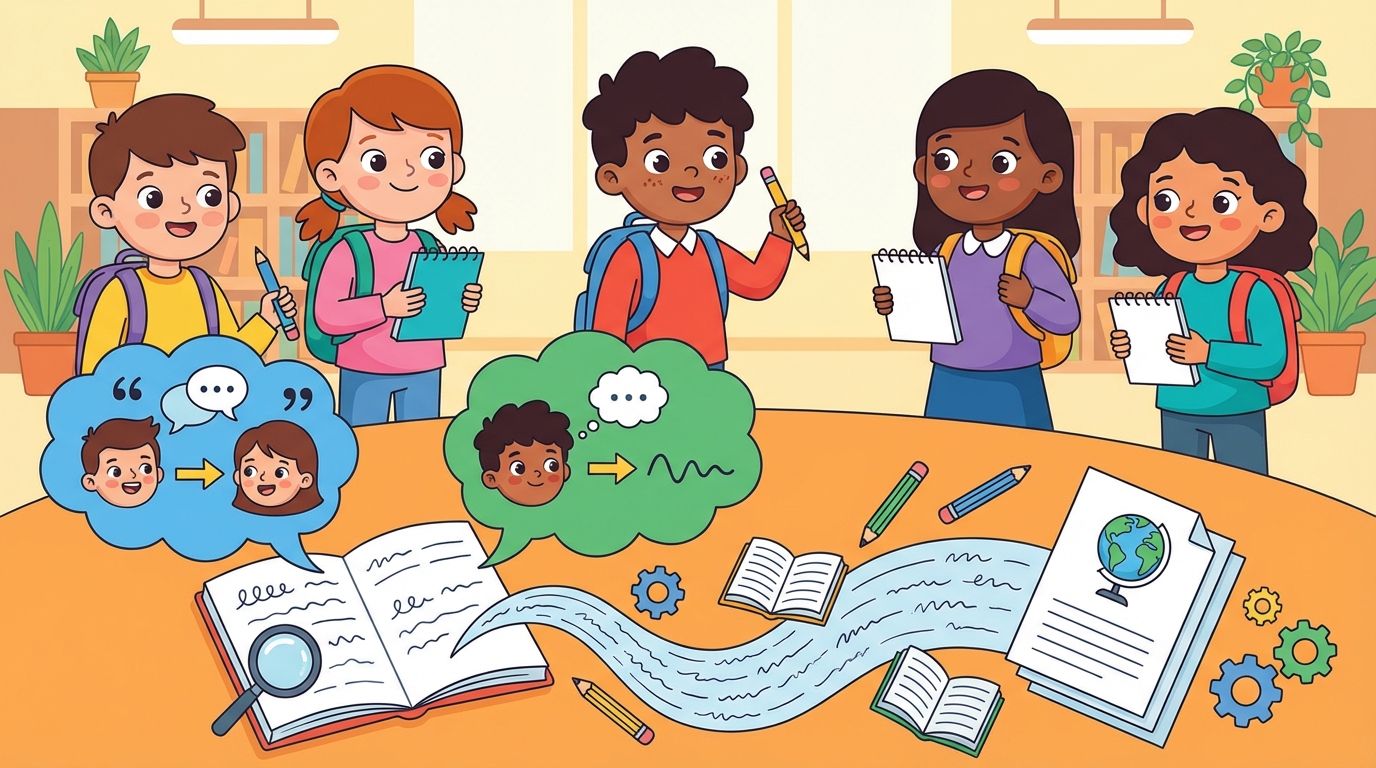
You have finished your interview and have pages full of notes. Now, how do you turn that into a report? You need to mix Direct Speech and Indirect Speech to make your writing flow! 🌊
🗣️ Direct Speech
This is when you write the exact words the person said. It puts the reader right in the room with you!
- Rule: You MUST use quotation marks (' ' or " ").
- Example: Mrs. Garcia said, "I love teaching science to 6th graders."
💭 Indirect Speech
This is when you retell or summarize what the person said using your own words.
- Rule: No quotation marks. Use words like said that or explained that.
- Example: Mrs. Garcia said that she loved teaching science to 6th graders.
Let's Compare! 🔍
| Interview Question | Direct Speech (Quote) | Indirect Speech (Report) |
|---|---|---|
| 'What is your goal?' | 'I want to win the game,' said the coach. | The coach said that he wanted to win the game. |
| 'Are you happy?' | 'I am very happy,' answered the artist. | The artist answered that she was very happy. |
Key Facts
9 Critical Reading: Fact vs. Opinion
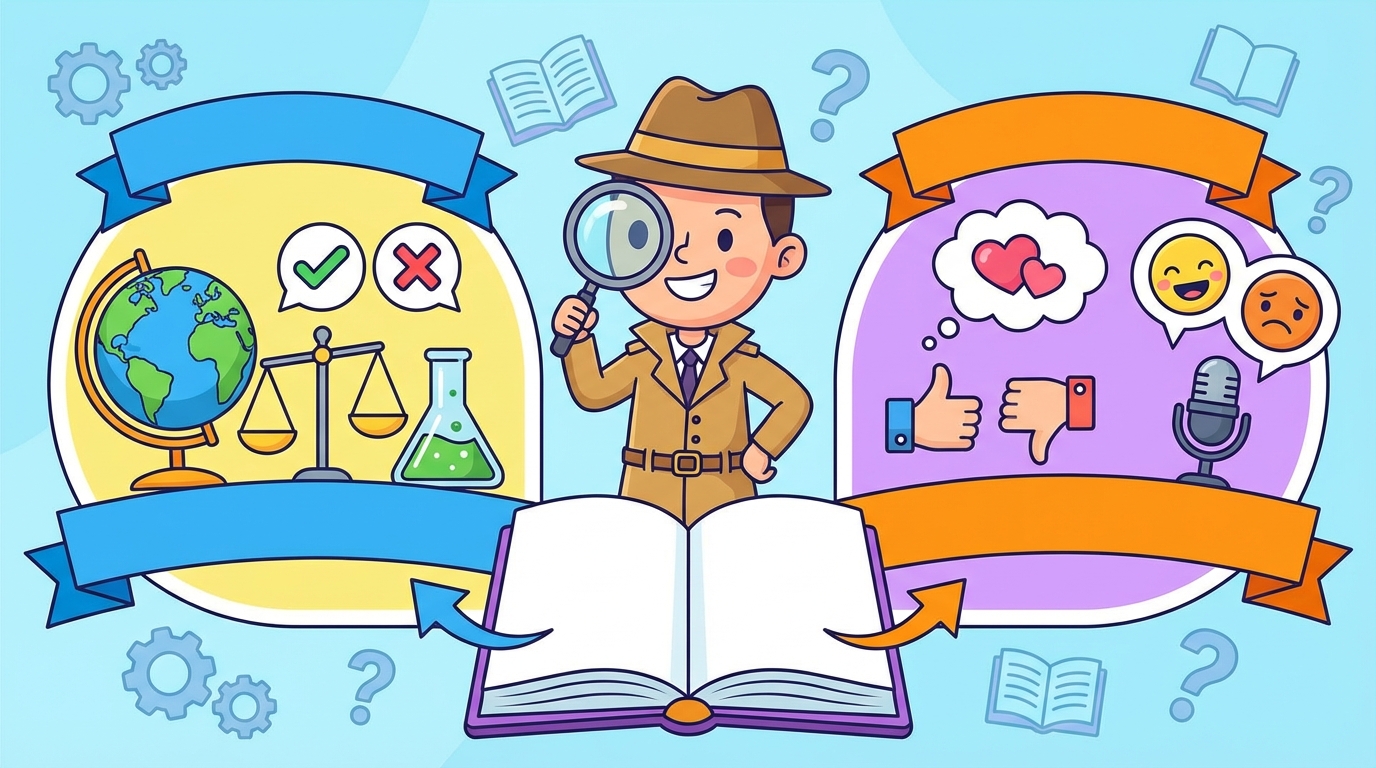
To be a great reader, you need to be a text detective 🕵️♀️. You must decide if what you are reading is true for everyone (a Fact) or just what someone believes (an Opinion).
A statement that can be proven true or false using evidence.
- ✅ Can be checked in a book or online.
- ✅ Based on data, dates, or science.
- ✅ True for everyone.
A statement that describes a feeling, belief, or judgment.
- ❤️ Cannot be proven true or false.
- ❤️ Based on emotions or personal taste.
- ❤️ Different for everyone.
Let's Compare! ⚖️
| Statement | Type | Clue |
|---|---|---|
| 'Dogs have four legs.' | Fact | You can count them. |
| 'Dogs are the best pets.' | Opinion | Some people prefer cats! 🐱 |
| 'It is 85°F outside today.' | Fact | You can use a thermometer. |
| 'It is too hot outside.' | Opinion | 'Too hot' is a feeling. |
Key Facts
10 Key Vocabulary
Master these important terms for your exam:
| Term | Definition |
|---|---|
|
Informational Text
Texto informativo |
Non-fiction writing written to inform the reader about a specific topic.
Escritura de no ficción escrita para informar al lector sobre un tema específico. |
|
Central Idea
Idea central |
The most important point the author makes about the topic; the main message.
El punto más importante que hace el autor sobre el tema; el mensaje principal. |
|
Supporting Details
Detalles de apoyo |
Facts, examples, and descriptions that explain or back up the central idea.
Hechos, ejemplos y descripciones que explican o respaldan la idea central. |
|
Text Structure
Estructura del texto |
How the information within a written text is organized (e.g., chronological, cause and effect).
Cómo está organizada la información dentro de un texto escrito (ej. cronológico, causa y efecto). |
|
Text Features
Características del texto |
Elements like headings, bold words, and pictures that help navigate and understand the text.
Elementos como encabezados, palabras en negrita e imágenes que ayudan a navegar y entender el texto. |
|
Textual Evidence
Evidencia textual |
Specific information or quotes directly from the text used to support an answer or argument.
Información específica o citas directas del texto utilizadas para apoyar una respuesta o argumento. |
|
Inference
Inferencia |
A conclusion reached on the basis of evidence and reasoning; reading between the lines.
Una conclusión alcanzada sobre la base de la evidencia y el razonamiento; leer entre líneas. |
|
Summary
Resumen |
A brief retelling of the main points of a text without personal opinions.
Un breve recuento de los puntos principales de un texto sin opiniones personales. |
|
Author's Purpose
Propósito del autor |
The reason the author wrote the text (usually to inform, persuade, or entertain).
La razón por la cual el autor escribió el texto (usualmente para informar, persuadir o entretener). |
|
Heading
Encabezado |
A title at the head of a page or section of a book that tells what that section is about.
Un título en la parte superior de una página o sección de un libro que indica de qué trata esa sección. |
|
Caption
Pie de foto |
A sentence or phrase under a picture or diagram that explains what is shown.
Una oración o frase debajo de una imagen o diagrama que explica lo que se muestra. |
|
Context Clues
Claves del contexto |
Hints that an author gives to help define a difficult or unusual word.
Pistas que da un autor para ayudar a definir una palabra difícil o inusual. |
|
Chronological Order
Orden cronológico |
Arranging events in the order in which they happened in time.
Organizar los eventos en el orden en que ocurrieron en el tiempo. |
|
Cause and Effect
Causa y efecto |
A relationship where one event makes another event happen.
Una relación donde un evento hace que ocurra otro evento. |
|
Compare and Contrast
Comparar y contrastar |
Analyzing two or more things to find similarities and differences.
Analizar dos o más cosas para encontrar similitudes y diferencias. |
Time to Practice!
There are 7 questions waiting for you. Questions are shuffled each attempt.
Take the Quiz