The comic strip
Learn how to tell stories using sequential art, exploring the visual and textual elements that make comic strips unique.
1 What is a Comic Strip?
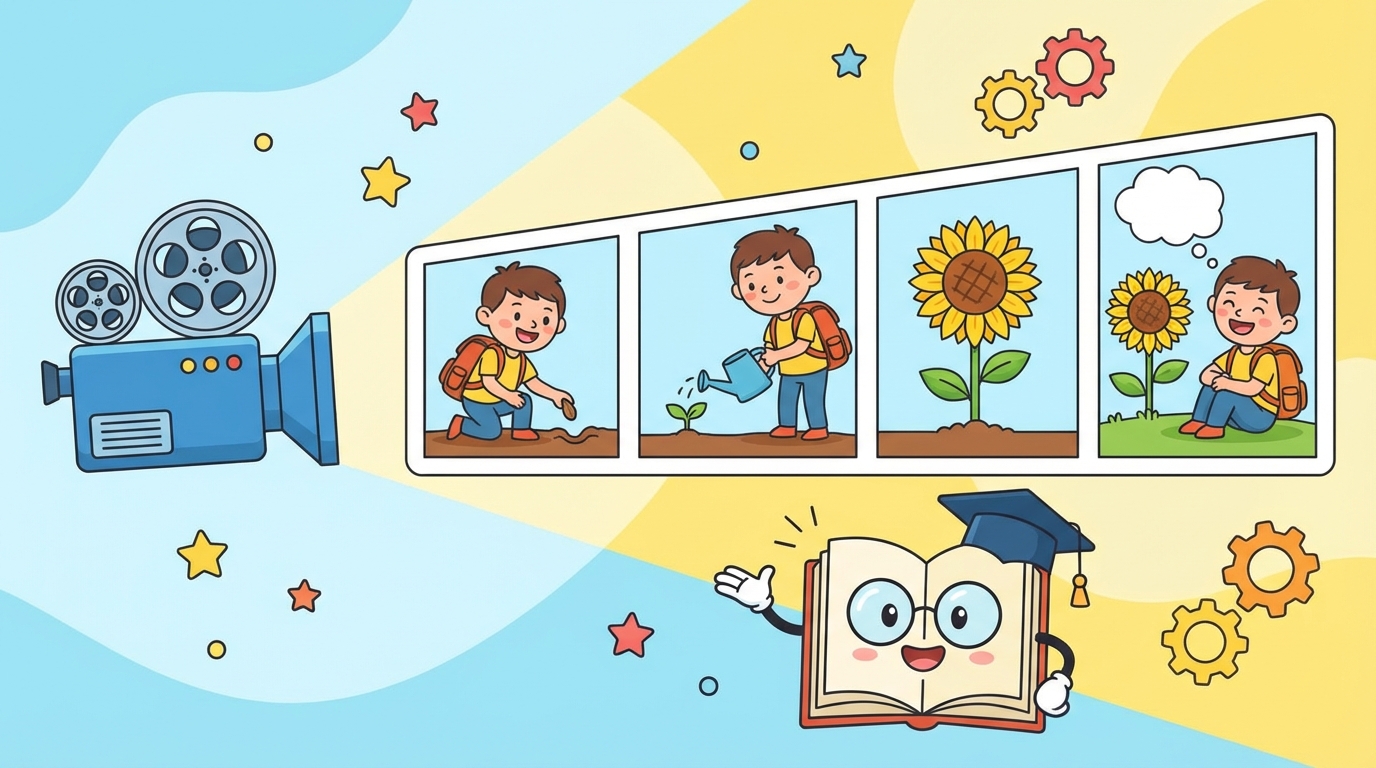
Imagine freezing a movie into separate frames and adding words to them. That is basically a comic strip! 🎬
📚 The Definition
A comic strip is a sequence of drawings, often arranged in horizontal boxes called panels, that tells a story or a joke. It combines visual art with text to communicate ideas quickly and funnily.
Key Ingredients:
Drawings show the action, setting, and characters' emotions without needing too many words.
Speech bubbles and captions explain what characters say, think, or narrate.
You probably see them in newspapers, magazines, or online as webcomics. Famous examples include Garfield, Peanuts (Snoopy), or superhero adventures like Spider-Man!
Key Facts
2 The Panel: The Frame of the Story
🖼️ What is a Panel?
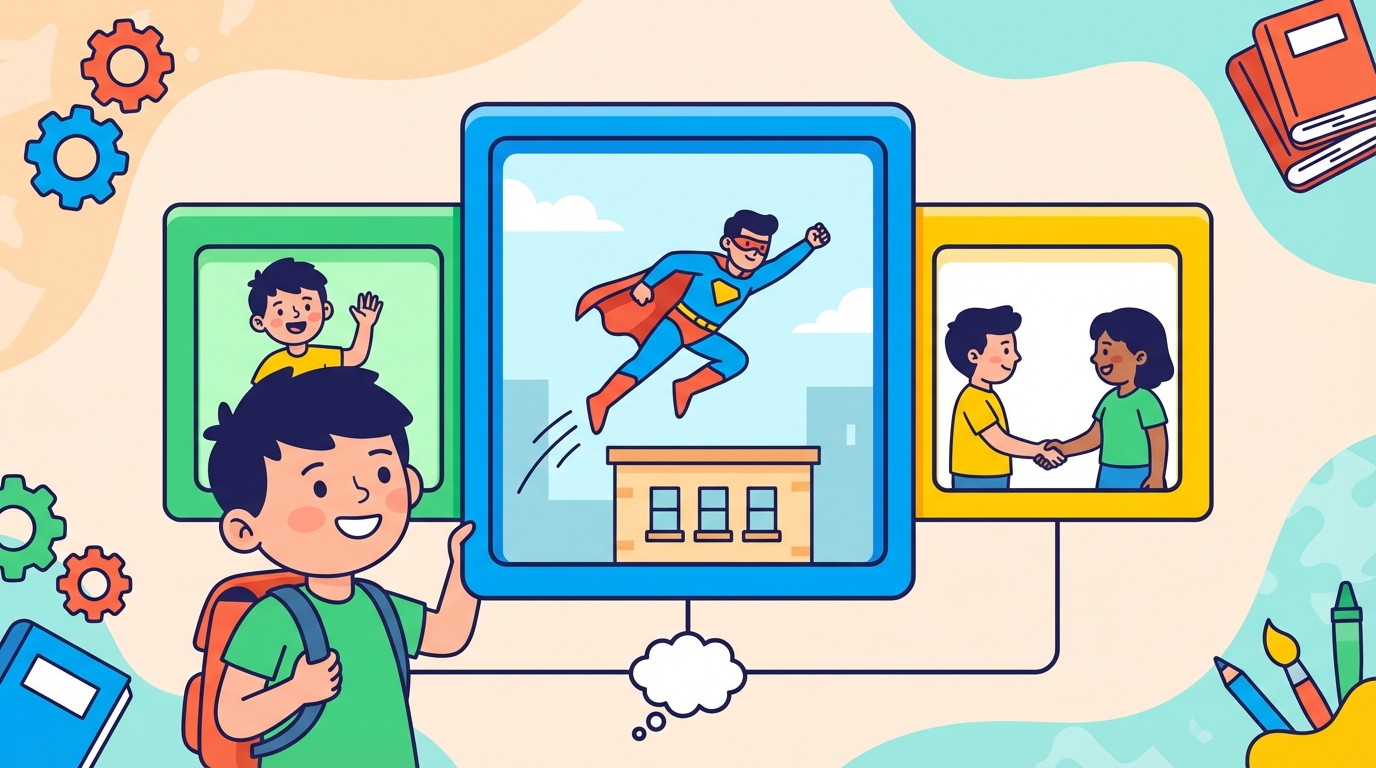
Imagine looking out a window. You only see what fits inside the frame. In a comic, a panel is that window!
It is a single drawing, usually inside a box, that freezes one specific moment in time. Panels are the building blocks of every comic strip. Without them, the story would just be a big mess of drawings!
⚡ The Magic of the 'Gutter'
Do you see the white space between the panels? That is called the gutter. Even though it is empty, it is super important! It represents the time passing between one moment and the next. Your brain magically fills in the action that happens in that empty space.
➡️ The Z-Path
In English and Spanish comics, we read panels in a specific order, just like reading a book:
- Start at the top left.
- Move to the right.
- Drop down to the next row and start on the left again.
📐 Panel Shapes Tell a Story
| Panel Shape | What it usually means |
|---|---|
| Rectangle/Square | Normal time or a standard action scene. |
| Jagged / Spiky 💥 | A loud noise, an explosion, or a sudden shock! |
| Cloud / Wavy ☁️ | A flashback (memory) or a character's dream. |
| No Border | A timeless moment or a very large, open space. |
Key Facts
3 Speech Bubbles: Shapes and Meanings
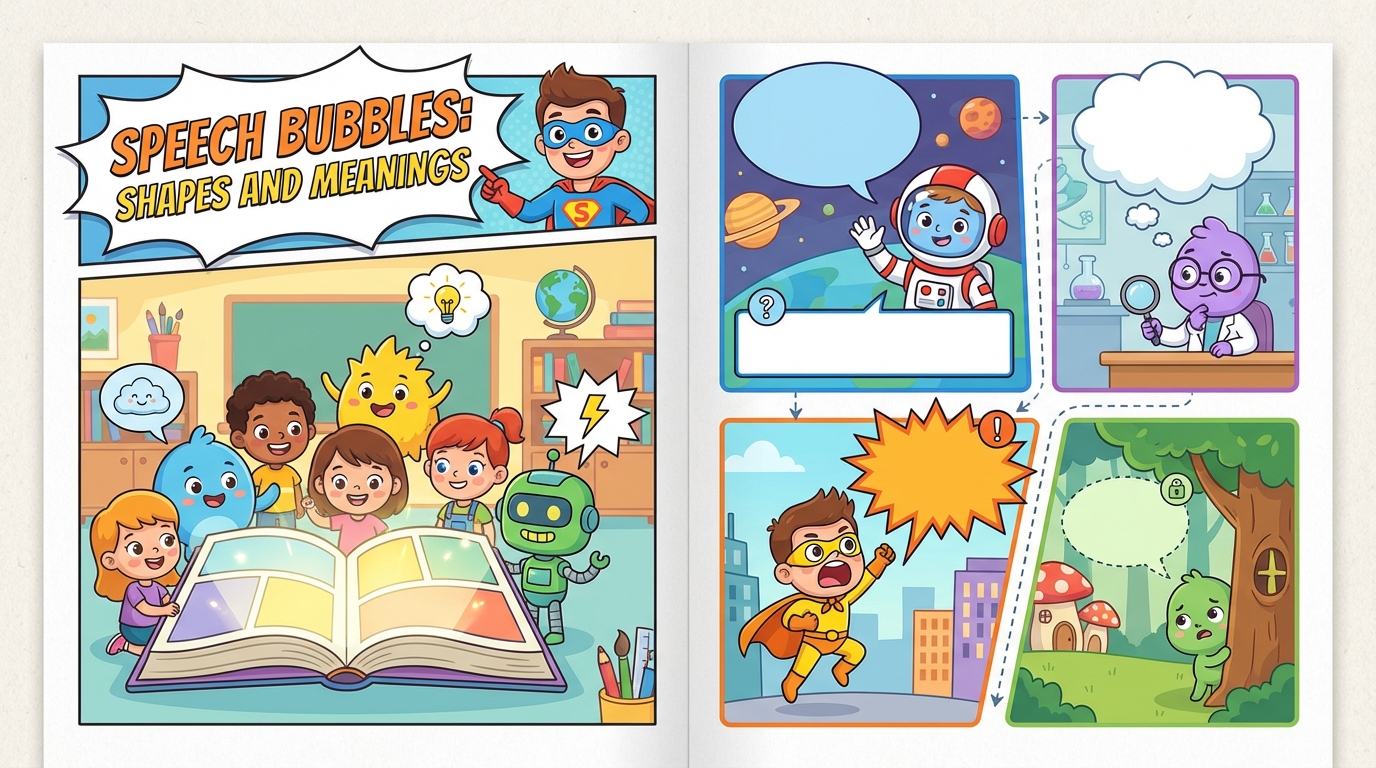
🗣️ In comics, characters don't just have words; they have a voice! The shape of the bubble tells us how they are speaking.
This is the most common shape with a smooth line. It represents normal conversation.
Example: 'Hi, do you want to play soccer?'
Jagged edges meant to look like an explosion! It represents shouting, screaming, or loud noises.
Example: 'WATCH OUT!' or 'BOOM!'
Looks like a fluffy cloud with small circles leading to the head. It represents thoughts or dreaming.
Example: (I hope I pass this test...)
Made of dashed lines. It represents whispering or speaking very quietly.
Example: 'Don't wake the baby.'
Key Facts
4 The Narrator's Voice: Captions
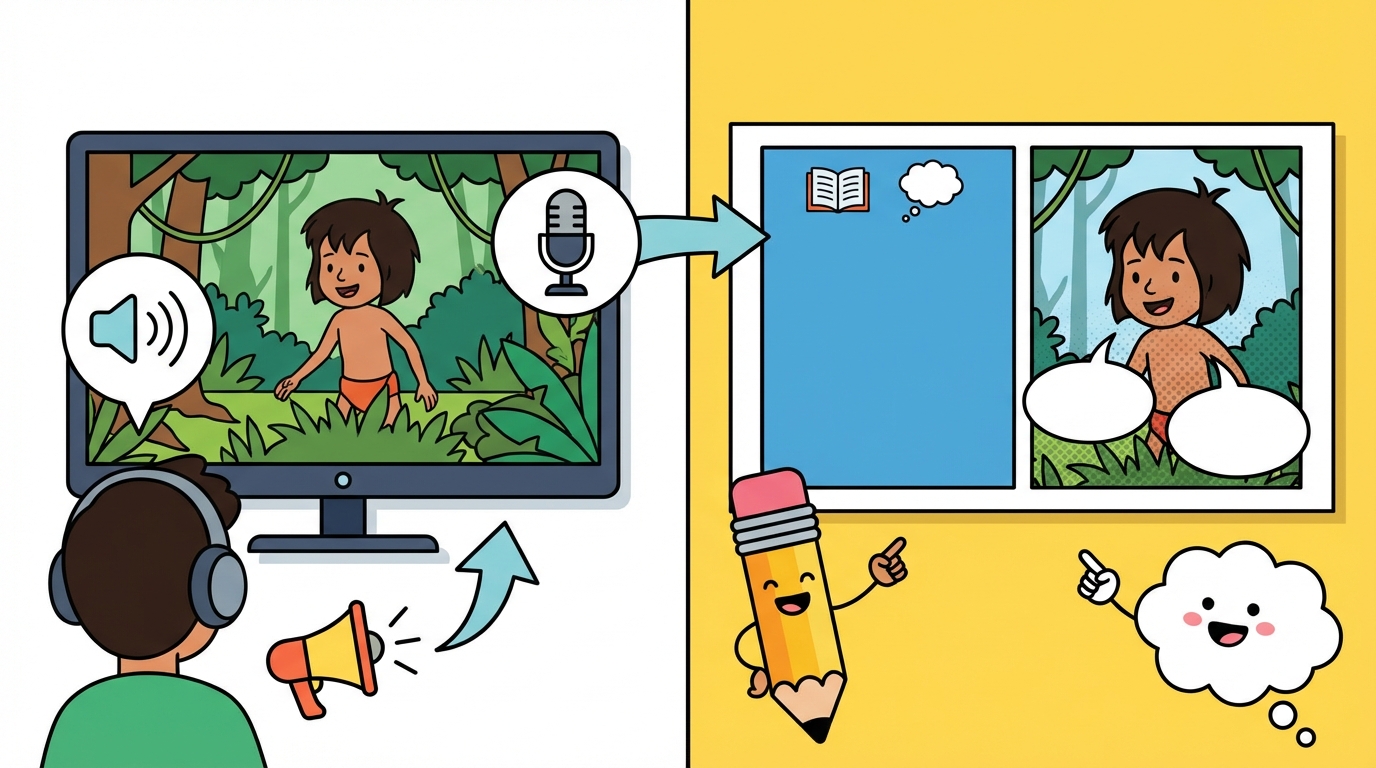
Have you ever watched a movie and heard a voice talking, but you couldn't see the person speaking? 🎬 That is called a voiceover. In comics, we use Captions to do the exact same thing!
A caption is a text box, usually a rectangle, found at the top or bottom of a comic panel. It is the Narrator's Voice. It speaks directly to the reader to explain things that the characters cannot say out loud.
What are Captions used for?
| Function | Example Text |
|---|---|
| ⏰ To show Time | 'Meanwhile...', 'The next day...', 'Three hours later...' |
| 📍 To show Place | 'Deep in the Amazon jungle...', 'Back at the secret base...' |
| 💭 To set the Mood | 'It was a dark and stormy night...', 'Silence filled the room...' |
Key Facts
5 Onomatopoeia: Seeing Sounds
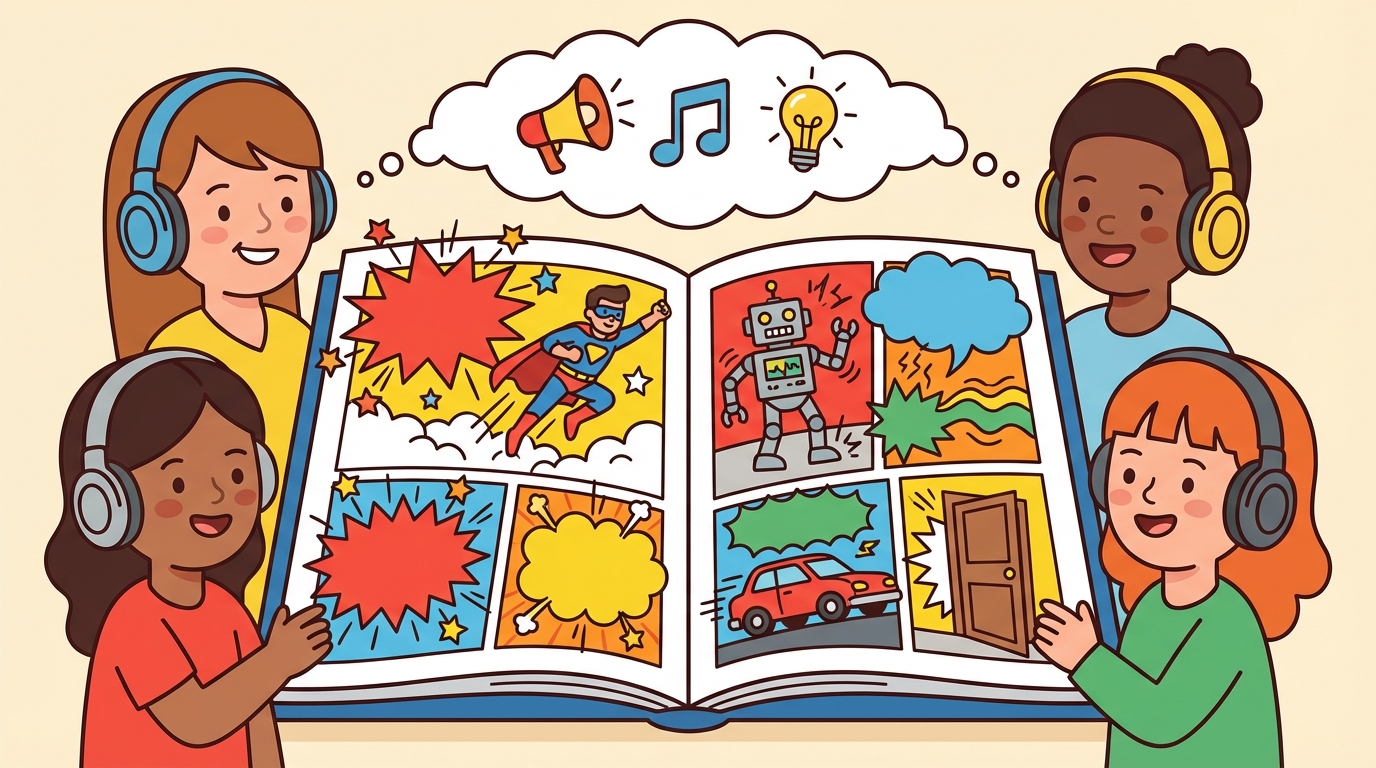
Have you ever heard a comic book? 🎧 Even though comics are silent images on paper, they are full of noise thanks to a special tool called onomatopoeia!
In comics, the artist doesn't just write the word; they draw the sound!
- Loud Sounds: Written in BIG, BOLD, JAGGED letters (like an explosion).
- Soft Sounds: Written in tiny, curvy, or wavy letters (like a whisper).
Did you know sounds are spelled differently in different languages? A dog in an English comic says 'Woof', but in a Spanish comic, it says 'Guau'!
Try this: Look at the table below to see common comic book sound effects.
| Action | Sound Word (English) | Visual Style |
|---|---|---|
| Punch / Hit | POW! WHACK! BAM! | Spiky speech bubble, bright colors |
| Sleeping | Zzzzz... | Tiny bubbles floating up |
| Eating | Crunch, Munch, Slurp | Letters look like crumbs or liquid |
| Something Fast | Whoosh! Zoom! | Letters leaning forward (italics) with motion lines |
Key Facts
6 Visual Metaphors and Kinetic Lines
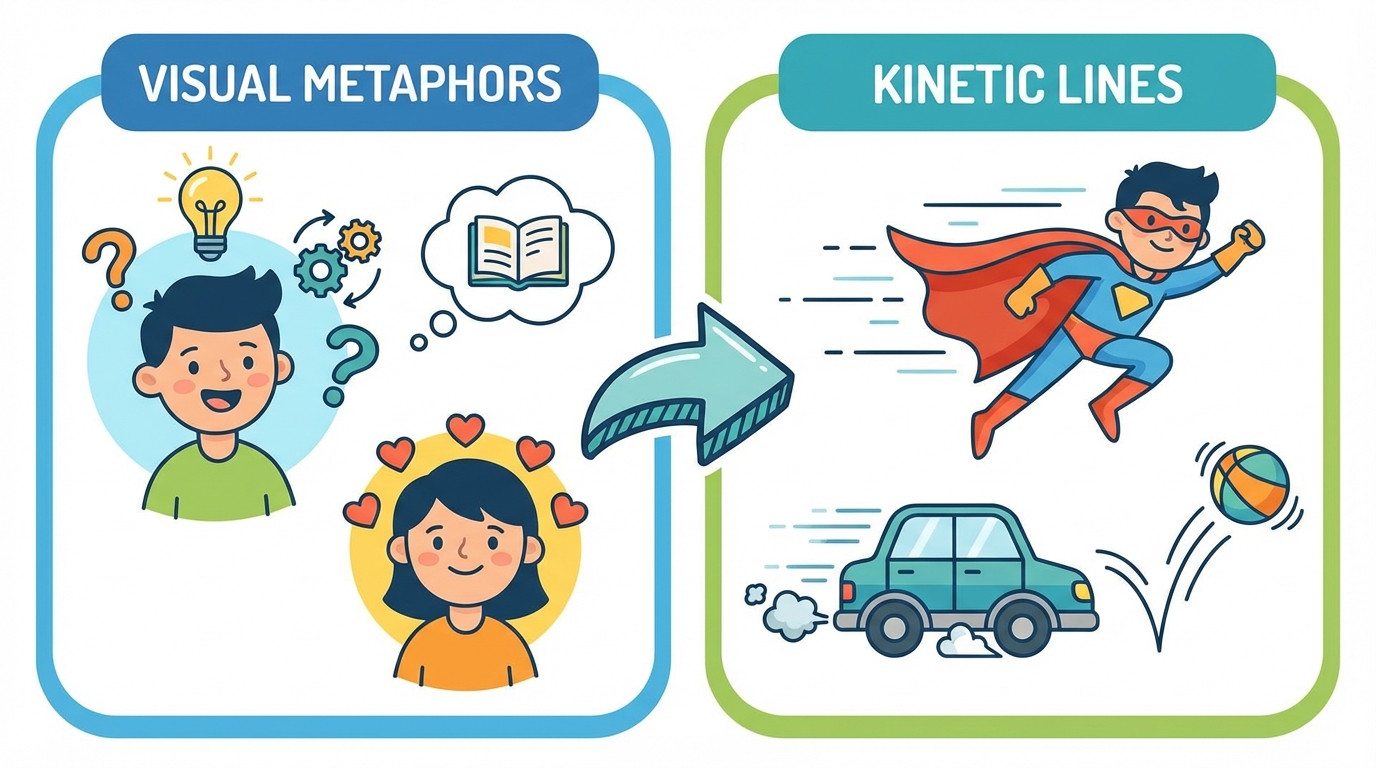
Since comics are still images, they can't actually move or make sound. So, how do we show speed or ideas? We use special artistic tricks! 🎨✨
💭 Visual Metaphors
A visual metaphor is a symbol that represents an idea, emotion, or feeling that is normally invisible. It is a shortcut for the brain!
| Symbol | Meaning |
|---|---|
| 💡 Lightbulb | Having a great idea |
| 🪵 Log & Saw | Snoring loudly (sleeping) |
| 💫 Stars | Pain or dizziness |
| 💀 Skull | Insults or swearing |
💨 Kinetic Lines
Also known as motion lines. These are lines drawn to indicate the path of a moving object or character.
- Straight lines: Show high speed (like a superhero flying).
- Curved lines: Show the path of a throw or a jump.
- Wavy lines: Show shaking, shivering, or a wobbly landing.
Key Facts
7 Visual Angles and Shots
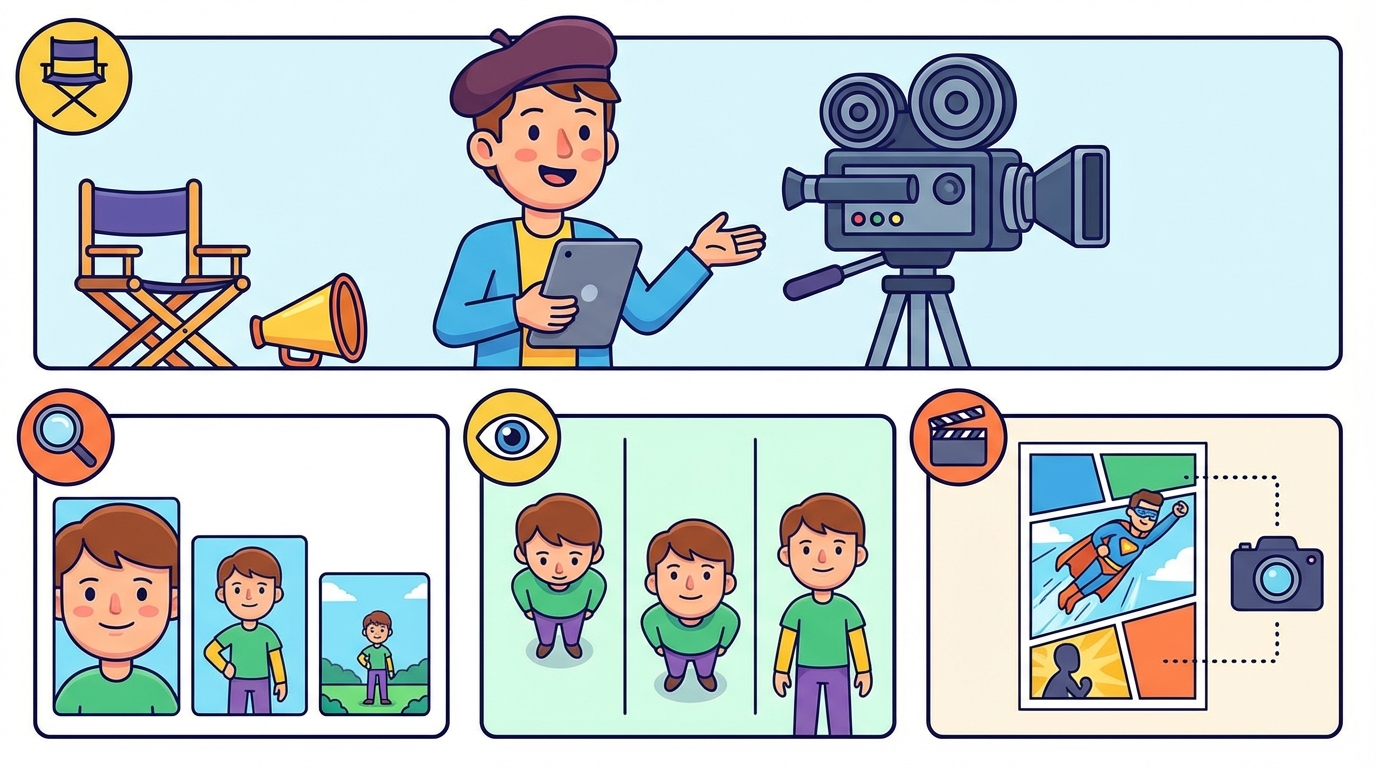
Think of a comic artist as a movie director 🎬. They use different camera distances (shots) and positions (angles) to tell the story without words!
🎥 Camera Shots (Framing)
How much of the character do we see? This changes the focus!
Shows the character from far away. Used to show the setting or where the story is happening.
Shows the character from the waist up. Perfect for dialogue and showing body language.
Shows just the face or an object. Used for strong emotions or important details.
📐 Camera Angles (Perspective)
Where is the camera placed? This changes how we feel about the character.
| Angle Type | What it looks like | What it means |
|---|---|---|
| High Angle (Bird's Eye) 🦅 | Looking down at the subject. | Makes the character look small, weak, or scared. |
| Low Angle (Worm's Eye) 🐛 | Looking up at the subject. | Makes the character look big, powerful, or scary. |
| Eye Level 😐 | Straight on. | Neutral. This is how we normally see people. |
Key Facts
8 Character Expression and Body Language
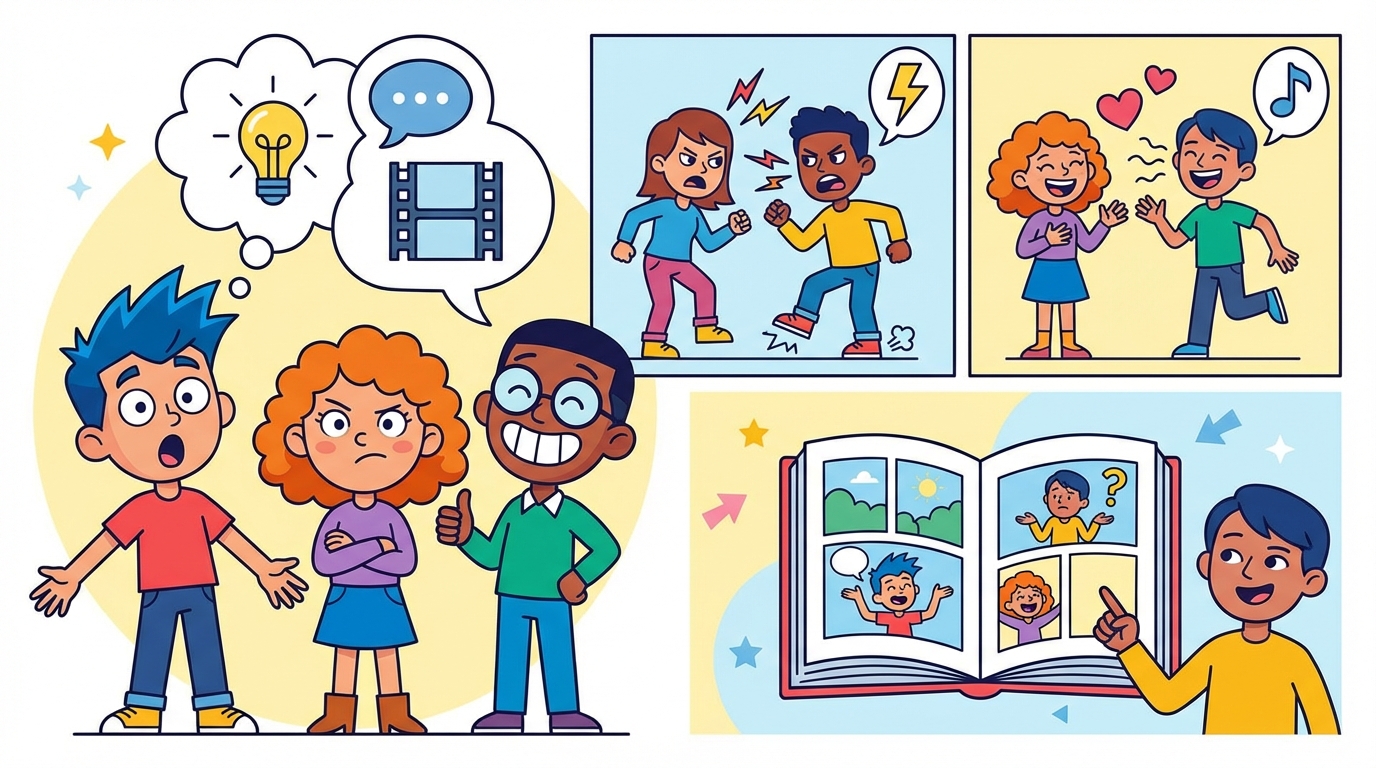
In a comic strip, characters can't talk out loud—they have to act! 🎭 Since comics are like silent movies on paper, the way a character looks is just as important as what they say in the speech bubbles.
The face is the remote control for emotion. Small changes make a big difference!
- Eyebrows: Point them down for anger (> <) or arch them high for surprise.
- Mouth: A wavy line can show confusion, while a wide open mouth shows shouting or shock.
- Eyes: Wide eyes mean fear; half-closed eyes mean boredom.
Don't just draw a stick figure standing straight! Use the body to tell the story.
- Shoulders: Slumped shoulders show sadness or defeat.
- Hands: Clenched fists show anger; hands on hips show confidence.
- Legs: Knees knocking together show terror!
Expression Cheat Sheet
| Emotion | Facial Clue 😲 | Body Action 🏃 |
|---|---|---|
| Happy | Big smile, cheeks up | Arms open, jumping |
| Angry | Eyebrows down, teeth showing | Fists clenched, leaning forward |
| Scared | Tiny pupils, sweat drops | Trembling, running away |
Key Facts
9 Writing a Script for a Comic
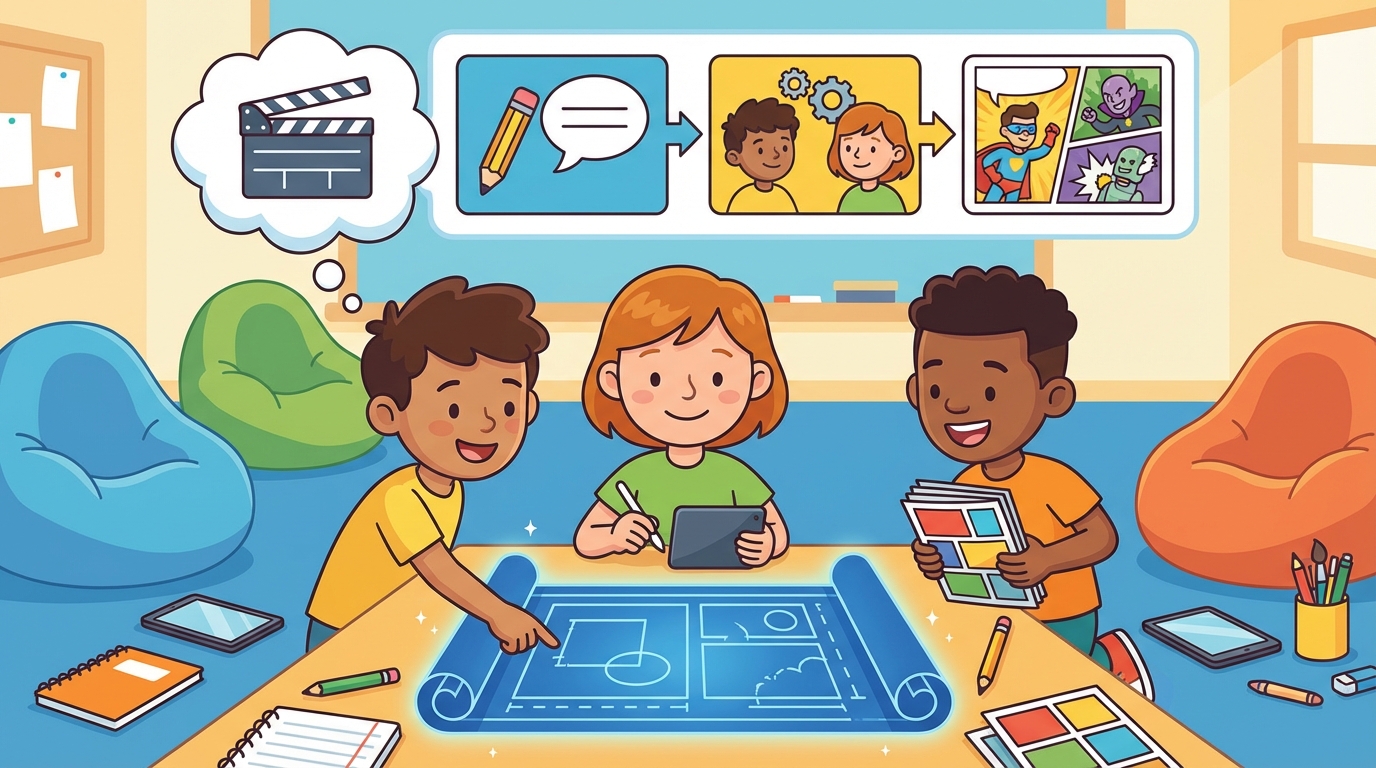
Before you grab your pencils to draw, you need a plan! A script is the written instructions for a comic. It tells the artist exactly what to draw and what the characters say.
- Panel Number: Identify which box (viñeta) you are describing (e.g., Panel 1, Panel 2).
- Scene Description: Describe the setting, the characters' actions, and their facial expressions. This is not spoken aloud.
- Dialogue: Write exactly what goes inside the speech bubbles or captions.
💡 Golden Rule:
One Action = One Panel
Don't try to make a character wake up, brush their teeth, and ride the bus all in one panel. Break it down!
Let's look at an example script! 🚀
PANEL 1
(Scene: A messy bedroom. MAX, a 12-year-old boy, is frantically looking under his bed. He looks panicked.)
MAX: I know I left my homework right here!
PANEL 2
(Scene: Close up on Max's dog, BUSTER. Buster is sitting in the corner with a guilty face, chewing on a piece of paper.)
MAX: (Off-panel) Buster... what is that?
BUSTER: *Chomp chomp*
Key Facts
10 Key Vocabulary
Master these important terms for your exam:
| Term | Definition |
|---|---|
|
Comic Strip
La historieta / El cómic |
A sequence of drawings in boxes that tells an amusing story.
Una secuencia de dibujos en recuadros que cuenta una historia divertida. |
|
Panel
La viñeta |
A single box or frame containing a specific scene in the story.
Un recuadro o marco individual que contiene una escena específica de la historia. |
|
Speech Bubble
El bocadillo / El globo |
A shape containing the words a character is speaking.
Una forma que contiene las palabras que un personaje está diciendo. |
|
Thought Bubble
El globo de pensamiento |
A cloud-shaped bubble that shows what a character is thinking but not saying out loud.
Un globo con forma de nube que muestra lo que un personaje piensa pero no dice en voz alta. |
|
Caption
La cartela |
A rectangular box usually at the top or bottom of a panel that provides narration or context.
Un recuadro rectangular, usualmente arriba o abajo de una viñeta, que provee narración o contexto. |
|
Onomatopoeia
La onomatopeya |
Words that imitate sounds, such as 'Bang', 'Crash', or 'Meow'.
Palabras que imitan sonidos, como 'Pum', 'Zas' o 'Miau'. |
|
Gutter
La calle |
The empty white space between the panels.
El espacio blanco vacío entre las viñetas. |
|
Motion Lines
Las líneas cinéticas |
Lines drawn to show that a character or object is moving or shaking.
Líneas dibujadas para mostrar que un personaje u objeto se está moviendo o temblando. |
|
Visual Metaphor
La metáfora visual |
An image used to represent an idea or emotion, like a lightbulb for an idea.
Una imagen usada para representar una idea o emoción, como una bombilla para una idea. |
|
Character
El personaje |
A person, animal, or being that acts within the story.
Una persona, animal o ser que actúa dentro de la historia. |
|
Setting
El escenario / El ambiente |
The place and time where the story happens.
El lugar y el tiempo donde ocurre la historia. |
|
Dialogue
El diálogo |
A conversation between two or more characters.
Una conversación entre dos o más personajes. |
|
Sound Effect
El efecto de sonido |
Text drawn in a specific style to represent a loud noise within the scene.
Texto dibujado con un estilo específico para representar un ruido fuerte dentro de la escena. |
|
Cartoonist
El/La historietista |
The artist who draws and writes the comic strip.
El o la artista que dibuja y escribe la historieta. |
|
Close-up
El primer plano |
A view showing a character's face or an object in great detail.
Una vista que muestra la cara de un personaje o un objeto con mucho detalle. |
Time to Practice!
There are 7 questions waiting for you. Questions are shuffled each attempt.
Take the Quiz